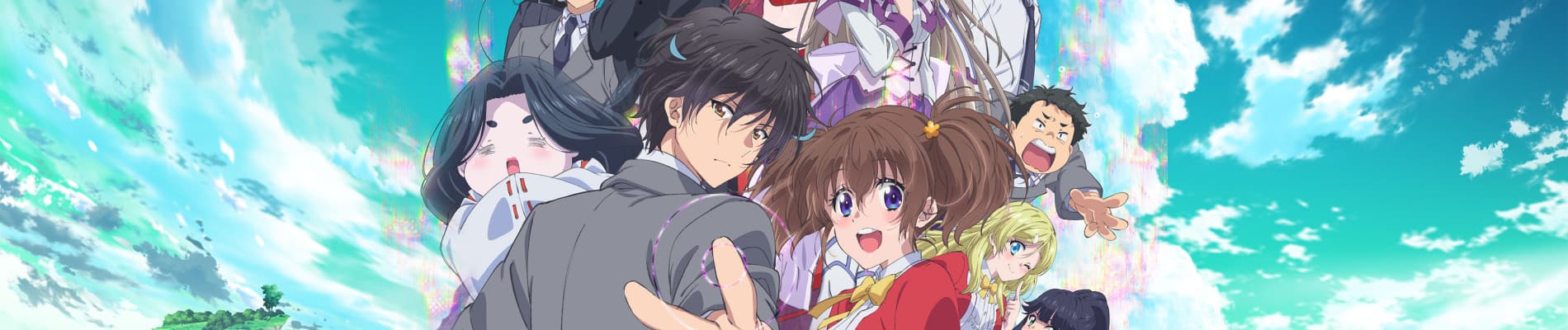
Sokushi Cheat takes a more extreme approach to the "overpowered protagonist" concept; the protagonist Yogiri Takatou not only never loses, but he also rarely showcases internal conflicts or opinionated goals to work towards. Author Tsuyoshi Fujitaka mentioned in an interview that this is exactly what he wanted to play with — a protagonist who never struggles until the very end. Fujitaka's concept naturally alienates many, for by design there is little to get attached to in the story's journey, and there's essentially no tension. However, this idea has potential to carry out a more lax attitude regardless of the intensity of scenarios. The nature of nothing in existence being able to threaten Yogiri enables him to engage with the fantasy world in a detached and reactive fashion. The most cataclystic of world events become moments that simply happen; Yogiri is there but effectively doesn't interact with it save for when he or his group would be threatened. The absurdities of Yogiri's capacities offer a license to examine a world filled with chaos and metaphysical absurdity without placing emphasis on the scope and extremity of such things. It establishes an avenue by which any fantastical concept can be framed as unimportant. In this way, I find the work conceptually intriguing.
Like many other Narou works, a lot of Sokushi Cheat's interactions are centered around self-awareness of its genre. Characters will make fun of the oddies of the setting and the absurd trajectories that arise from Yogiri's powers. There's an occasional amusing joke every once in a while, but rarely does the work standout in its self-awareness. One edge Sokushi Cheat has in its making jokes about its own concepts is that because there's no limit to the scope of power the other characters can have (by virtue of no level of power mattering against Yogiri), the work is able to take certain concepts to a more peculiar conceptualization and make fun of them. An example is a character whose base power is "cooking", but this power can be stretched to have unreasonably versatile applications from the holder's framing of everything in the lens of cooking. Elements like this are compounded left and right into the series, leading to a chaotic mess that couldn't really fly in a setting where the interaction of characters would have to be more stable, but Sokushi Cheat's world is able to as unstable as it wants by virtue of the protagonist's foundation. Any unstable element will eventually be nullified by Yogiri's intervention, opening the door to interactions of components far more absurd than in more conventional works.
Many Fujitaka works (e.g. Sokushi Cheat, My Big Sister Lives in a Fantasy World, and Harumi’s Legacy as the Strongest Mimic) have a particular absurd identity to their character interactions, as it's quite common for them to engage in conceptual discussions that feel too peculiar for regular characters to be conversing about. The conversations can sometimes feel too absurd to be organic which can be a turn-off, but at the same time, there's a particular charm to these overly conceptual conversations by virtue of how aberrant they are compared to conventional discourse. The anime adaptation for Sokushi Cheat unfortunately loses much of this, as the adaptation goes at a brisk pace and rushes towards the larger plot events. There are still remnants of these moments, such as the scene in episode 1 where the main heroine Tomochika Dannoura probes Yogiri on what his stance would be if Tomochika were to hypothetically betray him, but these are still far more tame compared to the more absurd conversations that were omitted. Consequently, the anime's conversations don't stand out as much as they could have, which is fairly unfortunate since with a lack of tension, character interactions and jokes are some of the main ways the show would be able to draw interest.
Some of Sokushi Cheat's more interesting moments involve characters trying to gain insight on the nature of Yogiri's powers. The clash with vampire sage Lain offered a fair bit of info on how different conditions interact with Yogiri, many of them failing and some at least offering an indirect way to survive. Such moments provide another avenue of interest, because while viewers may be aware of how futile dealing with Yogiri can be, characters in-universe will cling to possibilities. This enables an amusing information game that, while it's destined to fail, the way characters approach the herculean task of overcoming Yogiri's powers can be interesting to see. Unfortunately, the last third of the anime chose to rush its way to the more eventful moments, which led to the omission of one of the most compelling instances of such moments. It's with decisions like this that I feel the adaptation fails to fully captatilize on how the work retains interest in a tension-like environment. The rushing to eventful moments has less weight when these eventful moments have such anti-climatic moments to begin with, by virtue of Yogiri's invincibility.
Tomochika has some amusing straightman moments, but a lot of her banter doesn't add anything new. She does have one standout moment when she describes how she conceptualizes Yogiri's powers in relation to her morals, and Yogiri's reaction to this is one of the most standout aspects of her dynamic. Save for that however, her more notable conversations and self-reflections that existed in the source material did not make it into the adaptation. As such, she doesn't have a whole lot going for her apart from her standard straightman jokes.
While I do bring up a few ways in which the adaptation lacks some of the source material's best merits, that isn't to say that the core source material fully capitalizes on its concept. Although I admire Fujitaka's ultimate vision and some arcs have amusingly satisfying and chaotic payoffs, some of the shortcomings of the anime stem simply from certain arcs themselves having a trajectory or conclusion that doesn't offer much. The series has shown its capability of creating amusing constructions with the concept, such as conflicts that have been resolved before they have even begun yet the unknowing characters still take events seriously, or events piling onto each other in a way that feels incomprehensible by virtue of the main characters being outsiders to the unfolding scenario. However, for each of these more interesting trajectories, there's conclusions where characters simply come across Yogiri and die. Many occurances lack the thoughtfulness to be satisfying.
As someone who is willing to engage with tensionless fantasy works, Sokushi Cheat is a work whose concept I respect, and I commend the author's commitment to the lack of a protagonist struggle throughout. Nonetheless there are plenty of shortcomings both with the core work and the work's adaptation. I do hope that more authors experiment with the degree of lack of struggle that Sokushi Cheat does, as if capitalized with more creative trajectories, this sort of idea could be fascinating in challenging the standard storytelling constructions writers use to appeal to an audience.
12.5 out of 13 users liked this review
