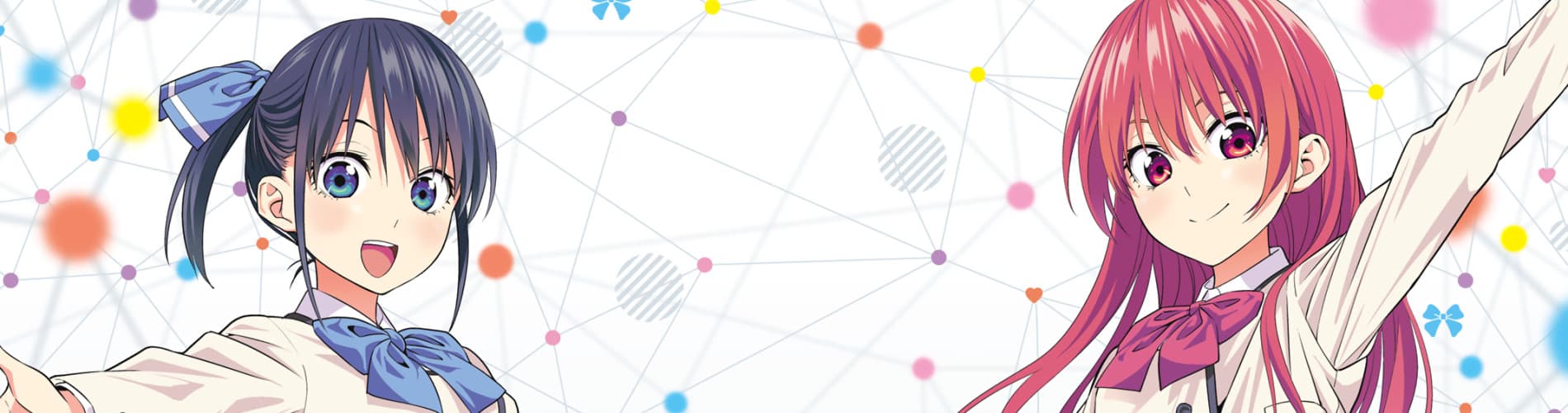
Make no mistake—Kanojo mo Kanojo is a series that’ll deter one’s amount of brain cells the more he or she consumes content of it (be it the series itself, a shitpost, or even a review). I suppose that it’s simply inevitable that any critical thought on the series would state a fair amount of flaws. Really, it’s a dumpster fire. However, it is also a series that is not meant to be consumed seriously overall. Thus, even if not constructive, I shall spout “fire” about Kanojo mo Kanojo, as it is a manga that I adore to the core.
Kanojo mo Kanojo is quite the eccentric series thematically; its characters are schizophrenic—especially the main girls—and the many ridiculously immense stupid happenings within the plot blow quite the whiplash. This only accumulates as the manga progresses; most of the time such is executed comically, but sometimes it’s also done in a slightly much more serious tone in (obviously) more significant scenes that could alter the story’s trajectory. I don’t exactly consider this as a bad aspect of Kanojo mo Kanojo, as I wouldn’t even assess it seriously in its entirety, since I think it's much more proficient in it’s comedy than it’s drama, though such is a trait I often expect whenever consuming a comedy or harem anime or manga. Anyhow, in turn, you’ll either love or hate (most likely individually) the characters.
Each one of the characters in this series acts in varying degrees of impulsivity, the most tantamount to the summits of such being the main character, Naoya, whose defining trait is that he’s insanely straightforward and, as stated by his first girlfriend SakiSaki, someone who “somehow always gets what he wants.” He’s also the character who yells the most, which I suppose could cause a bundle of readers to tune out or even loathe his character. But, surprisingly (not!), every other character in this series is just as brain dead as Sir Straightforward, and they all worsen in intelligence as the series progresses. As I wrote a paragraph ago, the most schizophrenic elements are found in the main girls: SakiSaki’s temper and ambiguousness, Nagisa’s tenderness and consideration, Mirika’s fiery determination, and Shino’s (Kino’s) shrewdness all amalgamate to tropey brain damage—only that this time it exceeds in such. Yet, Kanojo mo Kanojo endlessly entertains me with its absurdity founded in its inability to hardly take itself seriously. The characters are so immensely hysterical in most of what they do that it’s hard to ever catch any substance of rationality. It’s a sense of the cast’s chemistry that utterly engages me, and it continuously drives its momentum to sheer entertainment, resulting in nothing but my succumb to it.
The humor in Kanojo mo Kanojo never disappoints in consistency. It mainly constitutes overboard surreal, slapstick comedy (who would’ve guessed that it had such a unique comedic structure, huh) that heavily exaggerates itself. Comedy (in this case being surreal) is a highly subjective genre, and slapstick is quite hit-or-miss. A great handful of the comedy in Kanojo mo Kanojo consists of the characters’ degeneracy as they slowly lose any faint sound thought throughout their spiral of adapting or opposing to the polygamous relationship instigated by Sir Straightforward. A character’s intrinsic nature engulfs their sanity, and then they proceed to follow just that, causing the many antics the reader will experience and possibly be amused or dismayed by. Frankly, I’m of the former. It’s pure delirium, regardless of however formulaic, that continuously bewilders me each panel. Even if a scene doesn’t exactly make me laugh, I’d be lying if I ever said I was never stimulated by it. It’s genuinely nonsensical and electrifying in that sense, and I’d gladly take it.
To amplify such lunacy, Hiroyuki (the mangaka) incorporates a fair amount of simplistic dynamic effects (e.g., “speed lines'' most noticeable whenever SakiSaki punches Naoya) to evoke the sheer momentum within the most comical scenes in the story, while soft additions (e.g., "love bubbles" in romantic scenes) are employed in delicate scenes so as to illustrate a character’s warmth. All of this is standard practice in manga technicalities, but Hiroyuki utilizes such at just the right number of doses when most relevant or appropriate. I also think that Hiroyuki showcases his best character designs in Kanojo mo Kanojo, as each one of them sufficiently expresses the defining qualities of the character. Sometimes the background of Kanojo mo Kanojo, especially in the two-page spreads, arouse jarring juxtapositions between it and the scene’s subjects, though such isn’t executed so horrendously that it would make me dislike it. I actually like it and find it endearing. The art of Kanojo mo Kanojo isn’t anything fresh or the like, but it is outstanding in what it attempts to achieve, and such is perfectly suitable for its narrative.
Moreover, lying under the multi-layered comedic structure is the series’ baffling tackling of polygamy. While Naoya simply wishes to sustain a satisfying polygamous relationship with his girlfriends, the rest of his harem feel conflicted in various ways. Such an unorthodox concept in romance fiction isn’t addressed the best here, noticeable as the characters’ approach to such is hardly constant nor concrete. However, something I think it tackles adequately is the character dynamics, often questioning how each one of them feels about their relationships with others. The author understands that this varies between each character and often uses it within the plot. Romance is a topic that simply isn’t exclusive to a single variety. It’s diverse, and, despite it being comically displayed here, can concoct a delightful narrative. The absurdities within the spectrum of infatuation and love conceived aflutter in each one of their arbitrary minds, so fragile yet firm, so instantaneous yet gradual, so ambivalent yet acute.
Nonetheless, Kanojo mo Kanojo seems oblivious in one or two aspects, but I, at the very least, enjoyed reading it. One could perhaps say that I’m simply overshadowing a value over another, but Kanojo mo Kanojo is a story that I believe hardly offers anything notably valuable thematically. Rather, its greatest strength is its direction for amusement. If even something substandard can unironically pleasure, whether guiltily or not, its consumer, it at least deserves commendation for such. Thus, once again, I indulge myself in escapism, and I find it charming. Schizo Kino Kiryuu/10.
20 out of 24 users liked this review