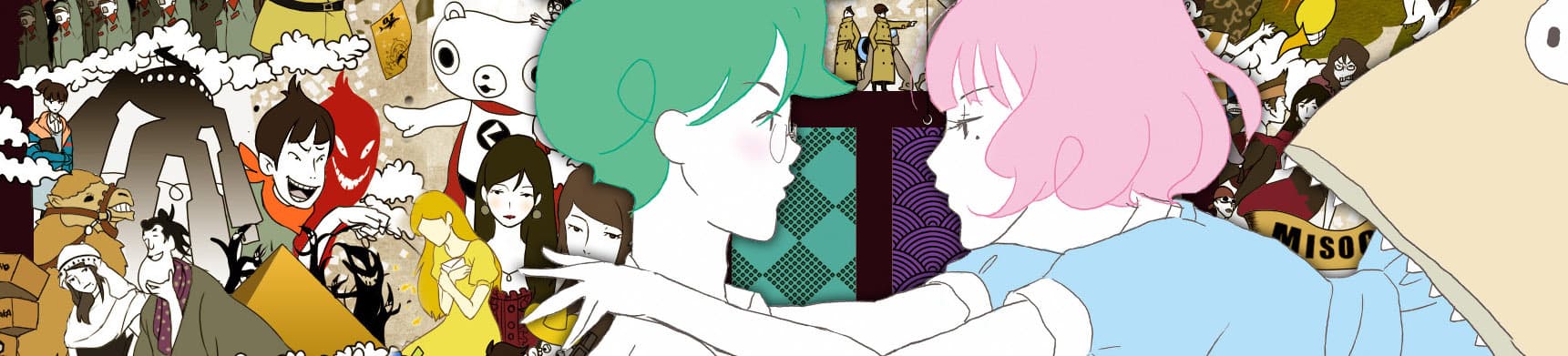
Tatami Galaxy: surreal, hilarious, visceral, eclectic, profound. It is the embodiment of magical realism; if Murakami and other contemporary classics of Japanese literature in the genre had their essences extracted and turned into an anime. In fact, this is no exaggeration since Tatami Galaxy was adapted from its original form as a campus novel. With snappy dialogue that brings the characters to life, witty narration that embodies the voice and tone of Morimi Tomohiko's writing, and charming visuals echoing traditional woodblock prints, Tatami Galaxy exudes style. One that succeeds in capturing the essence of uncertain youth and the student experience that is almost a preoccupation in Japanese life.
Although the theme of how to achieve an ideal student life is ubiquitous in anime, there is good reason for it. Being a student is one of the few almost universal experiences in Japanese life, capturing the imagination or emotions of many. Remembered by many fondly as a more carefree time, one with untapped and nearly limitless potential, it is also a source of a great deal of uncertainty for those moving through it. This has led to a great deal of expectations being built around the school experience, through no small part by the abundance of stories centred around school and campus life. Many of them paint unrealistic expectations, some as a means of vicarious wish fulfilment, others the unwitting products of its creators looking back with too much nostalgia. Tatami Galaxy, in many ways, questions and lampoons all of it with its absurd and whimsical take on the many possible paths in university. While it has sharp rhetoric, at times revealing the potentially hollow and ridiculous nature of many student pursuits through its parody, the story never strays into cynicism. Instead, it deftly peels back many of the layers built up around the "ideal" university experience and ask how much control a person really has and if the outcome really matters more than the journey or even sentiment itself.
Tatami Galaxy achieves a whimsical and surreal blend of an acerbic protagonist in an absurd world by keeping its roots as a novel. It understands that the visuals and sound mainly serve to heighten the narrative instead of being the core focus despite its transition from the page to the screen. The witty dialogue and biting monologues are still left to shine, kept in balance for a visual medium with the exaggerated and sometimes abstract art. Unlike the expectation of most anime, showing an objective third-person perspective for the vast majority of the time, Tatami Galaxy keeps to its framing as a novel by having everything on screen be the subjective perception of our viewpoint character. For instance, Ozu is described as having the appearance of a tengu, and only shifts to his "real" appearance when there is a change in our protagonist's perception of him. It highlights that even the visual elements of the show as an extension of the protagonist's descriptive internal narration, creating the atmosphere of this being a novel turned into animation instead of merely its story or plot being transposed into a visual form. The close framing and psychic distance of a novel are maintained in an outstanding feat of adaption that few other anime ever reach, most losing that unique character or tone of a piece in the shift to a different medium. Much of the writing is also kept to its novel roots, forgoing the usual anime style of colloquial but tonally exaggerated dialogue, something uncommon in novels since diction alone has to carry most of the voice. On the other hand, this allows novels to get away with more complex language and construction, a hallmark of which in Japanese literature is the use of the formal first-person singular: Watashi. It is a different kind of exaggeration that steers away from the "naturalistic" style to one with more linguistic flourish. While not necessarily superior, it provides an essential tonal frame for Tatami Galaxy and is the source of a lot of its wit and humour and preserves that novel like quality despite it now being animated multi-media. This maintains the central spirit and appeal of the story as being a viewer or reader experiencing events through the lens of the protagonist, hearing their scathing inner thoughts and honest reactions, ultimately allowing us to come to understand or even empathise with their unique perception of the world. It is something novels as a medium excel at and has been preserved in Tatami Galaxy to give it an exceedingly strong tone and framing that alone can captivate viewers.
The premise and narrative of Tatami Galaxy is quintessentially Japanese magical realism. With the ambiguous appearance of a time loop as suggested by the visual of Kyoto University's clock that ends every episode, the narrative explores the different possibilities of university life. From this premise, the show draws much of its humour and themes with our protagonist quest for a socially fruitful university life that often end in absurd situation. The different scenarios the protagonist finds himself in gradually introduces the viewer to more of the cast and gets them ensnared along with him in increasingly zany escapades. This is a fantastic employment of a time loop style narrative, allowing recognition and anticipation to build as the viewer recognises more elements and characters that remain constant in each iteration. It makes later scenarios even more amusing since the viewer remembers a different perspective of events or has information on characters the protagonist now lacks, allowing them to anticipate various antics or be pleasantly surprised when their expectations are intelligently subverted. While the different timelines follow the same general plot structure, Tatami Galaxy never gets repetitive. Each of them has elements to distinguish themselves and make them uniquely entertaining. More importantly, they know when to abridge repeated sequences like his conversations with the fortune teller to avoid boring the viewer, leaving enough to maintain the established pattern. The recurring cast and their predictable behaviour gradually creates subtle sense of interconnectedness that eventually culminates into a larger theme that goes beyond Tatami Galaxy being simply a collection of quirky short stories that share a premise.
With each new timeline, the viewer begins to piece together more fixtures of the protagonist life that remains static regardless of his own actions. They build this sense of inevitability and immovability in some parts of our protagonist's life. Most obviously, he is stuck with Ozu and often runs into Akashi in various ways. While each scenario does highlight how his life could differ quite drastically, they are never radically changed. This mixes a competing idea that a person has only so much within their direct control and should attempt to make the best of it. Although rewatching the earlier timelines would shed some light on certain events, and could make for an entertaining laugh on a second watch through, the order they are presented in is very much intentional. The stories go from inane, to absurd, to some rather sinister happenings beneath the surreal and quirky tone and visuals that show a a gradual descent into worlds that grow more and more divorced from reality. It is interesting symbolism baked into the very structure of the narrative with a myriad of interpretations and depth; most apparently for how this constant search for the ideal path in life can eventually harm someone, or perhaps how fruitless it is since there is always some worse world out there. Even if the protagonist can avoid the particular disasters like the Softball Circle of the Lucky Cat Restaurant, there is no avoiding what is, for lack of a better word, fate. In this case, fate or destiny is not one specific scenario that must play out but a certain set of constants that give the protagonist unavoidable problems. Or if viewed from a different lens, opportunities and entertainment. Perhaps even the most inane scenarios the show goes into are not pleasant experiences at the moment, but they do make interesting memories that can ironically turn out to be that ideal school life only after the fact.
Tatami Galaxy leans towards the conclusion that you make do with what you have and try your best despite knowing that there never will be an ideal life. The hilarious misadventures of each timeline perfectly culminate in the surreal climax of the series. Even with muted, monochromatic colours, the visuals of the finale are haunting. The art propels an already mind-boggling and unnerving premise to genuine existential dread. Although strong throughout the story, the art style reaches its peak, conveying much more than words could achieve in this setting. There is only monologuing and variations in the same confined location, yet these are the story's most gripping moments. It dispels even a shadow of a doubt about whether they should have adapted the novel into an anime. It makes full use of the visual medium, adding to the narrative in ways words on a page cannot achieve while retaining the spirit and charm of the book. Even though the conclusion reached is simple and without substantial change in material circumstance, the internal revelations of the protagonist are incredibly potent.
Although there is a plot, the nature of the story with its different variations on the same scenario does not lend itself to being plot-driven. True to its campus novel roots, it is not plot but experience-driven. In that, it is not even necessarily focusing on a change in its characters but on what we see them go through and learn about them. Some might not get over the fact that there is no clear answer to which timeline, or more aptly, universe our conclusion takes place in. Or perhaps it was all a delusion in the mind of our protagonist as he sits in his room before making the fateful decision in the final episode. Is it really a reflection focusing on the possibilities that could have been? Or could it be more of an indirect love story with how Akashi features so heavily in it? The narrative being the protagonist coming to terms with her being the one person in his life cannot be bare to be without. This literary ambiguity is not for everyone. Some might be frustrated with the lack of absolute clarity, but this is to be expected from an adaptation of a novel and a core part of its surreal charm. It has apparent and evident core themes, but there is enough intentional ambiguity or room for interpretation to make an interesting story to engage with and experience.
Overall, Tatami Galaxy is one of those few shows that genuinely deserve the title of masterpiece in its level of polish in how it was translated to a visual medium. In a way, this feels a bit like cheating since it was adapted from a literary novel, an advantage few other anime have. It gives Madhouse a robust story that tackled deeper themes in a brilliant way that needed little shoring up. While the artwork, voice acting, and adaptation were extraordinary, they were already starting from a place of strength. Although media can have vastly different objectives, it is admittedly easier to score something aiming to be profound higher than something done chiefly for entertainment. Even actively restraining that bias, Tatami Galaxy still more than earns its score with its complexity and literary flourish. In particular, this show will resonate with anyone who has gone through or is currently in university despite the exaggerated world. This is especially true personally, with Kyoto University being a lot like my own alma mater that I love dearly. It is easy to see that despite the acerbic and pointed dialogue, Morimi does have a great fondness and even nostalgia for Kyodai that shines through and gives his narrative that last bit of emotional punch it needs to really land its conclusion.
28 out of 29 users liked this review