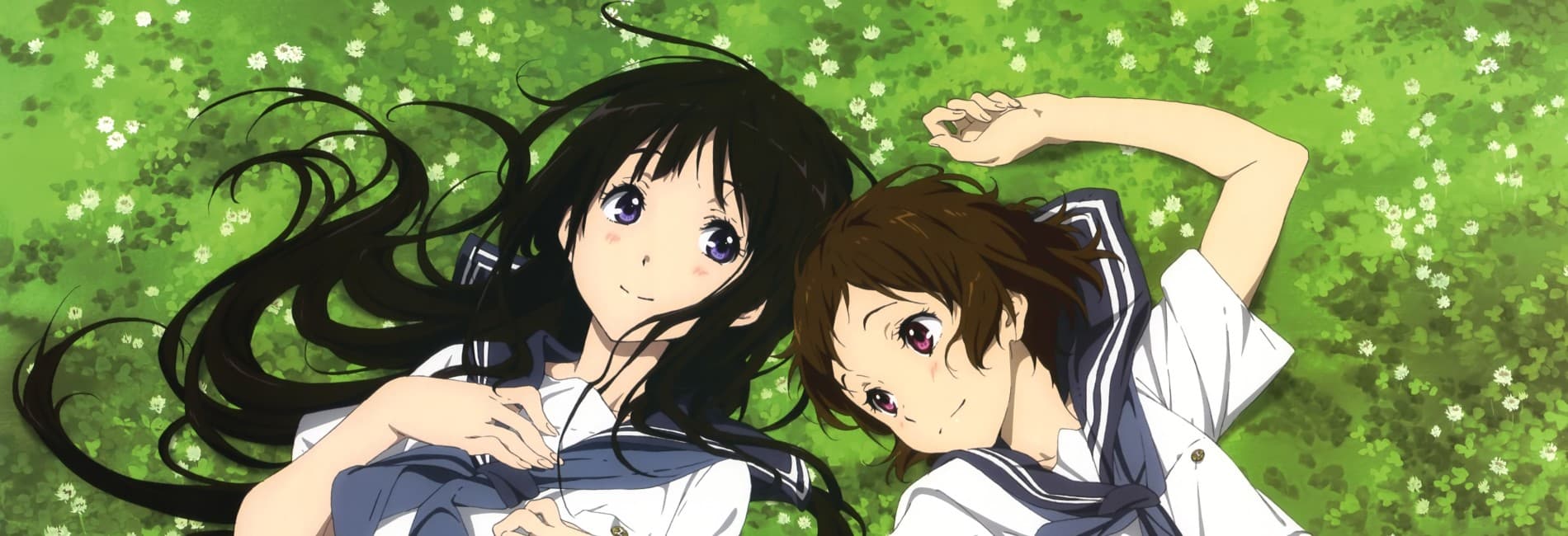
Hyouka
a review by Scheveningen
a review by Scheveningen
Hyouka is one of those rare shows that makes excellent use of its dual genres, blending them together seamlessly creating both an excellent mystery and a character slice-of-life show. Benefitting from a longer run than more recent anime, it gives the show the opportunity to have various sub-stories that not only demonstrate its excellence with each genre but also the potential of combining a mystery together with an additional layer of more mundane social elements. The visuals have that fantastic KyoAni charm and polish that brings the characters to life and, more importantly, conveys their inner thoughts and perspective with an immense amount of artistic flair. Despite slice-of-life and mysteries being notorious for having characters remain static or pigeonholed to preserve the storytelling dynamic, Hyouka weaves in a subtle but noticeable amount of character growth. This is aided in no small part by the expressive but only mildly exaggerated voice acting of the cast that brings the characters to life in a way that is both incredibly endearing and convincing. Accordingly, this more grounded tone limits the stakes and grandeur that the mysteries can have. This would trip up lesser shows since they often rely on heady stakes to retain the viewer's interest instead of properly and intricately constructed mysteries the viewer can actually engage with and attempt to solve if they so desire. Hyouka proves that mysteries do not need to have some grandiose or fantastical premise to be interesting, and instead, even the most mundane of quandaries can be made compelling when they are made to have a personal meaning to the characters. Even then, it is abundantly clear that the mysteries are vehicles for developing the characters rather than being intellectual puzzles only for the sake of it. These two elements do compete for prominence, waxing and waning in different parts of the series, but they always come together to create a compelling character narrative that gives the series its emotional core and throughline.
The structure of the individual stories and the series as a whole demonstrates the amount of thought that went into both the novels and the adaptation. The series does have a slower start with Oreki needing to be convinced to become involved in the mystery instead of it being taken as a given, but more than anything it emphasizes that Hyouka's focus on characters instead of this just being an excuse to craft a few mysteries in a high school setting. KyoAni's stunning animation is immediately put to great effect, solidifying the show as being driven by Oreki's perspective and giving us an insight into his imagination. The vibrant visuals of his imagination and mental projections are strikingly contrasted with the more muted colour pallet of the school. Hyouka signals here that the show's dynamic elements are in the character's minds instead of the material outcome the mysteries might have. There is some truth to the criticism that some mysteries are quite inane, but that is distinctly missing the point. Hyouka starts with The Niece of Time, which balances the various genres and priorities it is attempting to juggle. The mystery itself surrounds Chitanda's uncle, giving her a personal connection and interest in solving it that allows the audience to learn more about her character. At the same time, it creates emotional stakes that necessitate Oreki at least attempting to solve it instead of just having him and the audience brush it off as a curiosity they can be satisfied with not knowing the answer to. As an introduction to what the series is capable of, it also shows the viewer the technical skill Hyouka has at constructing its mysteries by giving the audience sufficient information to work with while maintaining intrigue. All this comes together as an excellent opening that shows the potential the series has for its mysteries and characters once it finds more firmer footing.
Where Hyouka hits its stride is in its longer-running mysteries, The Credit Roll of the Fool and The Kudryavka Sequence. In these sub-stories, the show digs down into elements more specific to mystery and slice-of-life respectively, creating compelling blends of the two genres at different ratios, so to speak. KyoAni's excellent directing and artistic ability truly shines in The Credit Roll of the Fool where they successfully execute the framing of having a show within a show without ever taking the viewer out of the experience. It mimics the extremely amateurish home movie style of the class project that is the subject of the mystery to such a degree that it completely draws the viewer into the mystery from Oreki's perspective. This story focuses very much on the mystery aspect of Hyouka, where the constant drip-feed of information sets both the characters and viewer's minds running with the possibilities. There is no use of cheap red hearings with the writing intelligently going about potential resolutions yet also fairly presenting contradicting information to the viewer in such a way that they can note it before the characters themselves reach that conclusion. What makes The Credit Roll of the Fool stand out is its layers of mystery stemming from both its metanarrative premise and genre fluidity. Hyouka is subtly able to shift between the various layers by leveraging its slice-of-life framing and tone in the most innocuous of ways. The ambiguity between what is related to the puzzle and what is more character drama helped maintain this intrigue, especially for a more astute viewer who remembers to consider not only the solutions to the mystery presented but also the motive for presenting it to Oreki and the Classics Club in the first place. The conclusion reached is incredibly satisfying with its shift in perspective and even genre to reach a resolution that leaves viewers impressed at how convincing it was for even the characters to miss such an obvious answer that was staring them in the face. Hyouka here is at its strongest, demonstrating how slice-of-life framing can create layers to the mystery and how the process of solving it can reveal compelling things about our characters.
The Kudryavka Sequence is very much the reverse of this, where the mystery takes a back seat, and slice-of-life comes to the fore. While there are pepperings of a brewing mystery even in this story's first episode, the focus is never quite on that. This is made clear by the lack of information given to the viewer relative to previous stories, and that narratively the mystery more or less runs parallel to the character's experience during their cultural festival. The positioning of the slice-of-life heavy elements later on in the season demonstrates excellent construction. Having established their characters, they are now able to stand by themselves as the centre of attention while the mystery is used more to set the atmosphere. It proves to the viewer that Hyouka has more ambition than simply being an intellectual exercise and that it has the ability to do compelling character work. Sadly, The mystery is notably weaker in this specific story since much of it is resolved with information held by the characters but not the viewer. It never reaches the point of being convoluted or unsatisfying, but it certainly employs more narrative sleight of hand with how much of its resolution must be anticipated or guessed by the viewer using genre-savviness. While not ideal, it is still compelling as more of pure intrigue that occurs as the backdrop to the experiences of the cast. Even then, this sacrifice is understandable since a full-blown mystery would have distracted and derailed the more interpersonal narrative. There still remains a strong thematic link to the mystery's outcome in how it reflects on the Classics Club's dynamics and possible future that supports a compelling series of episodes that develop the characters more directly.
Hyouka is capped off with some of its one-off stories that delve into its character relations with mystery taking a backseat almost entirely. The final episodes demonstrate how effectively the mystery has been used to develop our characters; even if they are no longer a major part of the narrative. The Classics Club members' changes become apparent, and we see the relationships and flaws that were bubbling under the surface come to the fore. Other subtle elements supporting this also eventually become clear with the growing vibrancy of the colour pallet, reflecting Oreki's world and perspective on life, finally becoming fully saturated in a way that feels exciting and alive. It is a testament to their character development that the conclusion does not feel dramatic and direct enough with how much is left unspoken. Yet that fact also demonstrates how consistent the show remains with its tone and vision as a more grounded series. Perhaps it is enough to ponder where things are headed instead of having to be told it so directly, reflecting the beauty in narrative subtlety that Hyouka strives for.
Hyouka is a masterpiece of using various elements within a show to complement each other. While it does this by dialling back one aspect and pushing forward another, they still come together in a cohesive whole; both within the individual stories and the season as a whole. This excellence in construction is a testament to the original novels and KyoAni's ability to adapt them as a single season of anime. It is almost necessary to watch this show as an active viewer, considering the details and information presented to get the most out of it. Yet it is well worth the effort, both on the mystery and character fronts. It is easily a 10 out of 10 with how well it combines both its genres to be more than the sum of its parts while also ensuring that they tie back to support compelling character work instead of existing merely for the sake of it.
30 out of 31 users liked this review
