
This review contains some spoilers (mainly about the direction of the story and characters), but should be safe to read for those not looking to go in completely blind.

There's a lot of manga nowadays fixated on the idea of the lonely loner: characters that wear a standoffish loner persona as a guise to hide their inner loneliness and desire for companionship. And don't get me wrong, this is a great concept, and I love some of the series that tackle it (e.g., Oregairu). But I wanted to find a series that depicted a true loner: somebody who legitimately enjoys being alone, relishing and even preferring their own company over the company of others. Not unhealthily or negatively, but someone who has confidence and their own hobbies and simply finds joy being by themself.
That’s what drew me to Yugami-kun. I saw a few obscure recommendations for it, and randomly decided to pick it up to pass the time. My expectations were not super high—I expected a fun (and maybe a little dull) school comedy. And that’s what it was to me for a while. But as I kept reading, my opinion of this series kept rising and rising and before I knew it, I was super invested in these characters and their relationships.
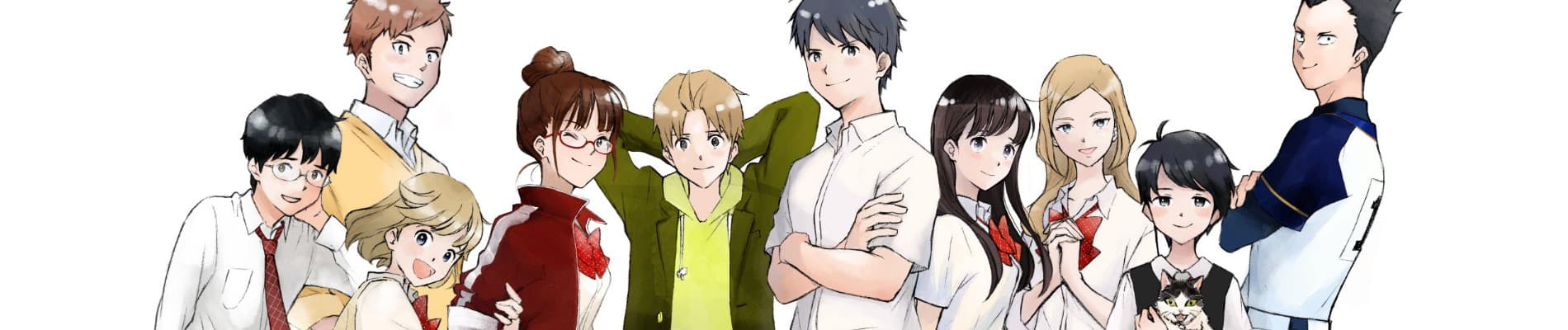
To put it simply, this is an exemplary school comedy. It’s not overly funny, nor is there any crazy romance or incredible drama or beautiful art; it’s just regular old slice-of-life at its best, showcasing its lovable cast of characters living their lives, deepening their bonds, and—slowly but surely—growing as people.
Yugami and Chihiro's Relationship
The main draw of this manga are the two leads and their relationship with one another. Watanuki Chihiro is a newly arrived transfer student who, thanks to constantly moving, gave up on making friends. But now, she’s done transferring and wants to establish herself and befriend her classmates. Unfortunately, she arrived in the middle of their second year of high school, so she finds it hard to insert herself into an already established friend group. Combine that with her blatant lack of assertiveness, and she unwillingly becomes a recluse relegated to a lonely school life. And it doesn’t help that her deskmate, Yugami Yuuji, is an eccentric and dogmatic loner isolated from his class.
Thanks to a load of idle chatter, shared experiences, and chance coincidences, Yugami and Chihiro’s relationship gradually blossoms into something beautiful. They are polar opposites—one desires companionship, and one actively avoids it—yet they are uniquely drawn to each other. They’re not quite friends and definitely not lovers, but they both eventually become irreplaceable constants in each other’s lives. It’s an ambiguous relationship that cannot and should not be defined in words, one that doesn’t need romance to be profound or powerful. It’s a relationship that subtly grows and changes over the series, so nuanced and indeterminate that neither character could fully define it. And let me just say, this type of relationship is extremely rare to come by and very emotionally fulfilling; it’s honestly one of my favorite platonic relationships in all animanga.
As their relationship evolves, so too do the characters. And that’s thanks to their respective positive influences on each other: Chihiro inherits part of Yugami’s assertiveness and confidence, while Yugami learns about consideration and how to better deal with those around him. Yet despite this fact, they fundamentally remain who they are, coming to mutually respect and understand each other and their vastly different lifestyles.
Watanuki Chihiro
Chihiro originally struggled to make friends, acting as a people-pleaser out of fear of being hated, rejected, or ostracized. She’s the type of person to let others step all over her if it means she can feel included, like she’s part of the group. But as the series progresses—and in no small part thanks to Yugami's crudely accurate advice—she learns to value and stand up for herself, finding a place to belong, friends of her own, and even a kouhai to guide. Her evolution from a timid girl desperate for friends to a confident senpai with a place to call her own—someone who tries to help those in similarly lonely situations to her old self—is legitimately incredible. You can even see this development in the lovely chapter covers, where Chihiro exudes such confidence and self-assurance in the later covers.

It's also in large part thanks to Yugami that Chihiro is in her current situation. Not just because of his blunt advice: his sheer indifference to those around him—specifically his ignorance of societal norms and nonchalance to the opinions of others—inspires Chihiro, who is constantly weighed down by these hindrances. And she beautifully expresses this sentiment in her fantastic letter in chapter 69, which is likely my favorite scene and the moment that completely sold me on this series. Furthermore, it's through interacting with Yugami and hanging out with the baseball club that she even met her current friends: her best friend is a girl from another class she met through Yugami, and it's the baseball team's manager (who she also met through Yugami, the ace of the team) that essentially adopts Chihiro into her friend group.
Yugami Yuuji
Yugami, unlike Chihiro, doesn’t noticeably change nearly as much. He appears to be the same at the beginning and end of the story; however, that's far from the truth. Yugami, both at the beginning and end of the series, has always put himself above others: he proudly proclaims his disinterest in friendship, citing it as a waste of mental resources. All he cares about is his own personal enjoyment, blindly ignoring what others think of him or how they treat him. But he’s not selfish. Sure, he may be extremely self-centered, but he actually does occasionally think about and try to help those around him. When he receives a love letter, he stresses over it for days trying to figure out the best way to resolve the situation for both parties. And though the conclusions he comes to are pretty abysmal, his heart is (and has always been) in the right place.

He may seem harsh and inconsiderate from the outside, but once you get to know him (as Chihiro does) you learn that his actions come from a place of goodwill. He sounds mean and critical, but he’s only expressing his honest opinion in an attempt to help out. His perspective—as one not tied down by friends or negative atmospheres or social constraints—can honestly be quite helpful: things appear obvious to him that might not stand out to those who follow normal social conventions or are in the thick of it. He’s an extremely logical person and an outsider, one who (often harshly) expresses his unique opinions to try and assist those around him. And once you realize that, it’s clear to see he’s not a bad guy.
As the series progresses, Yugami comes to learn about (some of) the nuances in human expression. At the start of the series, he had a distinct lack of understanding when it came to social cues or the intentions of others; he finds it difficult to pick up on subtle hints or comprehend the actions of those around him, since he has never had (or wanted) friends. But over the course of his high school life, Yugami comes to understand many of the implicit meanings behind short phrases or smiles, and it’s actually so lovely to see. The core of his character remains unchanged: he’s still the same self-centered person as he was at the beginning of the series, really only thinking of and living for himself. Yet it’s clear to see how much he’s grown when compared to the Yugami of the past.
Yugami’s development is primarily thanks to Chihiro’s influence. She’s the one who made him realize that his outlook and ideas aren’t the only correct ones (and can even be wrong!), which marked the turning point for his consideration of others’ words, actions, and principles. He’s the type of person who’s confident he understands himself, and if there’s something he doesn’t know about himself, he won’t hesitate to think about it for hours to arrive at an answer. And over the course of the series, he is forced to do this many times, coming to realize many more small things about himself and others that serve to gradually advance his character.

___
It’s not just the two leads that are well-written or entertaining. Their characters and relationship are by far the draw of the manga, but the side characters are also entertaining, well-written, and have their own small developments. But the series never excessively concentrates on them, well-aware that the two leads are the most interesting and entertaining. In this regard, the author is really good at balancing focus on the main and side characters, switching between the two to keep readers entertained and ensure the series stays fresh.
Yugami-kun isn’t exceptionally funny, but the character dynamics are very entertaining, and the series deftly plays with readers’ expectations by subverting established tropes and avoiding common cliches. Yugami-kun may not often have me laughing out loud, but its lighthearted character dynamics are always entertaining to read, and Yugami’s hilariously bizarre behavior occasionally elicits some laughs from me. Furthermore, the author avoids pretty much all the classic cliches associated with high-school manga and even plays with common tropes. Sometimes, it may look like a crazy love confession is about to happen, or that Yugami is about to say something extremely profound or emotional, but it’s abruptly revealed to just be another one of Yugami’s eccentricities (and/or a hilarious misunderstanding on Chihiro’s part).

These next two paragraphs contain spoilers for the ending of the series.
Spoiler, click to viewclick to hide
I really respect that Jun Sakura didn't feel pressured to stuff Yugami and Chihiro's relationship into a label. She didn't conform to desires to provide certainty or clarity into their relationship, even by the end of the series. Despite actively seeking her out to watch rakugo together (as shown in the final omake), Yugami still doesn't consciously consider Chihiro a friend. And that's okay: Chihiro has accepted that that is who Yugami is and who he will always be, and she is more than grateful for his assistance over the years and just being able to spend time with him. Though it's pretty clear to see that Yugami is at least treating her like a friend, actively going out of his way to watch rakugo together (and even paying for her tickets!).Spoiler, click to viewclick to hide
As evidenced by Yugami's further invitations (despite already accomplishing his goal), they will continue to spend time together in the future. And since their relationship is constantly evolving, who knows what will happen to it. Maybe it will be romantic, or maybe Yugami will finally reevaluate his opinion on not needing friends after realizing how he treats Chihiro. Either way, it's clear they both want to spend time with each other, and the ending is a wonderful conclusion to the series: Yugami and Chihiro's story is far from over, but they've both come so far and will surely keep growing as they continue to see (and positively influence) each other. What more could I ever ask for?___
Yugami-kun completely shattered my expectations. The somewhat bland art and the series’ lack of attention wrongly convinced me that this would just be yet another high school romcom, but this series is so much more than that. I could probably count on one or two hands the number of profoundly moving moments in this manga, yet each time one comes around it utterly amazes me. I’m not usually personally impacted by the media I consume, but this manga was dangerously close to reaching that level: I found Chihiro’s journey to be extremely inspiring, and the way their relationship develops—as well as some of the heartfelt things Yugami and Chihiro say (such as the letter, Yugami’s speech, etc)—were extremely touching and completely blew me away. I'm still feeling empty just thinking about this fantastic series, and I can tell my opinion of it will only grow as time goes on and it fully skins in. Because of that, I can’t suggest this manga enough if you’re looking for a lighthearted read with a lovable cast and subtle character development.
