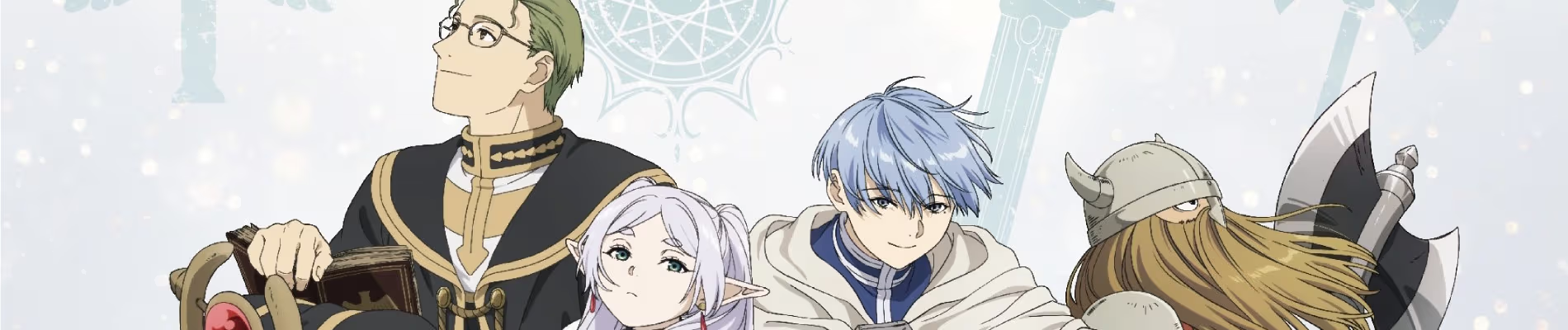
(note: Frieren is referring to the character, and Frieren is referring to the series)
Frieren: Beyond Journey's End has a premise likely to catch most people's attention right away, and it is an interesting one for what initially seems like a fairly basic fantasy setting. The idea of seeing the aftermath of the party that saved the world is a compelling one, and for the most part it immediately delivers on this idea well. Himmel's death may seem like something premature, but the way it's done emphasizes an important point about how Frieren has barely paid attention to the passage of time. Those 50 years are as much of a blink for us as they are for her.
Himmel's death is something that looms over the entire series, and it makes sense that most of his characterization comes through flashbacks because that's also how Frieren begins to understand him as well. This works surprisingly well for the whole series, and it's hard to say this setup gets old for me. But when it truly hits its stride, Frieren becomes about much more than this. It takes full advantage of that premise to reflect on the fleeting nature of our time spent living, the legacies we impart on the world around us, and the value of adventures and the companions we take with us.
It may sound strange to say for a series with such rich topics to cover, but Frieren feels like it thrives in subtlety, letting these moments breathe on their own as the group continues on their journey. The primary director, Keiichirō Saitō, is most known to me from the excellent eight episode of Sonny Boy, which had some similar goals to Frieren. Both create an atmosphere centered around the beauty of the road ahead while never feeling too whimsical to the point of being divorced from their settings. Its what keeps Frieren's flashbacks from ever feeling too jarring or random. It's never so sappy to feel like these memories only come at plot convenient times to teach her a lesson, yet even just the more silly or fun times that the Hero's party had feel like they carry weight for Frieren herself. When she sees villagers cherish a statue of Himmel, she's able to laugh while remembering how absurd he was acting when the statue was made. Yet simultaneously, these moments wordlessly get across how much being on that journey meant to her. We get the sense that the journey did ultimately shape her outlook, yet it was also just fun for the sake of it too.
My point is that Frieren manages to be reflective and sentimental without ever devaluing the adventure aspects, and this is true for the "present day" characters as well. Fern obviously has a great dynamic with Frieren right away, frequently pushing her to value their time together more and more in a way that feels true to both characters. Sein, who evokes Frieren's "aversion to one's kind", feels like a succinct but effective way to show how starting that adventure just takes one little push. There are some point where the journey drags a bit (did we really need two episodes about birthday gifts with the same message) or where it lacks subtle where I wish it had some (Frieren does a lot of restating of things I inferred just fine on my own) but it's hard to say these are anything other than minor annoyances with what is overall a winning formula.
Of course I haven't forgotten about Stark either, but I want to use him to illustrate my favorite episodes of Frieren, 12 and 15. These two episodes feel like the points where Frieren truly strikes gold and rises to something greater. So many different ideas convene here to great effect: Stark's cowardice and survivors guilt over his village, the idea of heroism and the mark that a hero can make in the world, and found family and master-apprentice bonds. Stark cowardice goes from more of a gag to something that really does emphasize how kind-hearted he is, how he stands apart from his family in that he sees more to being a warrior than just fighting on a battlefield. He inherits both Eisen and Himmel's idea that being a warrior is about protecting people more than anything. Episode 15 does an especially effective job of showing the life that Stark may have missed out on through Orden, yet he ultimately accepts that his experiences have made him the way he is and that it's too late to become someone else. Episode 12 puts a great twist on our traditional idea of a "chosen hero". Himmel wasn't "chosen", yet we know that he doesn't need to be to become a hero. We've been shown that he created his legacy through his kindness and willingness to help people even when it meant going out of his way. It feels particularly powerful seeing Stark unconsciously striving to carry on this legacy. It's no wonder that all of these aspects reemerge in the final episode, seeing Fern affirm Frieren as her master and seeing how it's the small acts of kindness that truly makes one a hero.
All pretty glowing praise so far I know, but this is only talking about what is probably less than half of the content of the show. The true misfortune of Frieren is that it more often than not fails to truly be great, and this shows the most when it tries to add some more depth.
What was by far the worst example of this for me was essentially the entire concept of the Demons and the arc surrounding them. Anyone who has read even a few traditional fantasy works knows that racism is a large part of many of them, and the portrayal of the Demons feels like a particularly odious carrying on of that legacy. Here they are made to be sentient, thinking creatures but are in essence worse than animals. They kill without feeling, are inherently evil and duplicitous without the possibility of change.
I'm not entirely against the idea of having just plain evil villains in fantasy works or any works for that matter, however this just becomes downright disappointing quickly for a series that felt pretty compassionate and empathetic. The framing here is what makes everything a lot worse. Immediately after entering the town, Frieren calls the demons liars and says that their peace efforts can't be trusted, which the characters give some pushback to. It feels like a good opportunity to show how Frieren's opinions are outdated, but it just immediately proves her right a few scenes later; the demons are just evil and there to murder everyone. There is also an extended flashback sequence where the show goes out of its way to show Himmel and the village chief being merciful to a demon girl, only for it to just affirm that it doesn't matter what they do because she will just be a vicious murderer who lies to be spared. It's a major shame to me that the show feels so excited to constantly affirm that the objectively correct path is to genocide this sentient race and denigrates them to be less than animals at every opportunity.
Maybe you think I'm silly for applying morals to this show, and maybe you're right, but I also think the bigger issue here is that this is just lazy and thoughtless writing. I don't think it was specifically giving a pro-racism stance, but I think it's a byproduct of not being willing to create a conflict with real stakes and just relying on dated fantasy tropes instead. Frieren's fight against Aura has a lot of build up, it's the first time we get to finally see her legendary power unleashed. But what sort of interesting stakes does this conflict even have? What meaning is there to gain from this other than enjoying it as pure schlock? The extended Flamme conversations imply that this is a dirty style of fighting that Frieren is using, yet the show gives us no reason to think why doing this would be a bad thing. My point is that the show feels scared to establish a conflict with any meaningful consequences for the character. Demon's are just a stand-in for humans, except you don't have to feel bad about fighting them at all. Sure it's fun stuff, Madhouse can crank out amazing sakuga for days and the soundtrack is killer, but it feels completely meaningless.
By the time the show finally mentions conflict between humans in the Mage Exam arc, it feels much too late and still suffers from poor execution. The show wants to both retain the introspective character interactions while also having more morally questionable characters here, yet the former comes off as half baked and the latter is just outright shallow. Wirbel is meant to be a mercenary who has openly killed child soldiers in the past yet this aspect of his character is waved away fairly quickly as just him "changing for the job" and he's meant to be seen as a nice guy by the end. Richter is even more strange, attempting to murder Lawine and Kanne only to go back to a chill shop owner after the first round lol. Denken is probably the more consistent one, yet it still feels weird that the cunning and deceptive politician would change his manipulative ways so quickly. It also felt disappointing that his conclusion seemed to be "well train enough and maybe one day you can be like me" when it felt like he was starting to enjoy being a mage in spite of his power and influence. Ubel is probably the best in terms of how it honors her character while showing the potential for her to grow as a person later on.
The mage exams are hard to hate on their own, but it is again disappointing that they leave the formula of the earlier episodes behind only to not have much interesting to replace them with. The show feels close to making a comment on how humans repurposed Serie's gift of magic into exclusively using it for combat, yet it ultimately feels a bit disappointing how Fern succeeds due to her innate powers rather than her personal growth. I think the sad part about all of this is that it makes me think a bit less of the series as a whole. Even at it's best moments, it's still an army of Demons that Orden and Wirt were fighting in episode 15, which epitomizes how unnuanced the world feels as a whole.
I'm not about to take back my enjoyment of the great parts of this show. It shows how in spite of the rote fantasy setting, this show can still have a lot of heart behind it. However those great parts make the rest only feel more disappointing. It gets so close to being a masterpiece at so many points, yet is haunted by the failure to have interesting wide-scale conflict. I wouldn't be in my right mind to give this show a negative rating for that fact, but I'll leave you with this fact: the manga's author initially wanted this to be a gag manga about killing demons.
233.5 out of 334 users liked this review