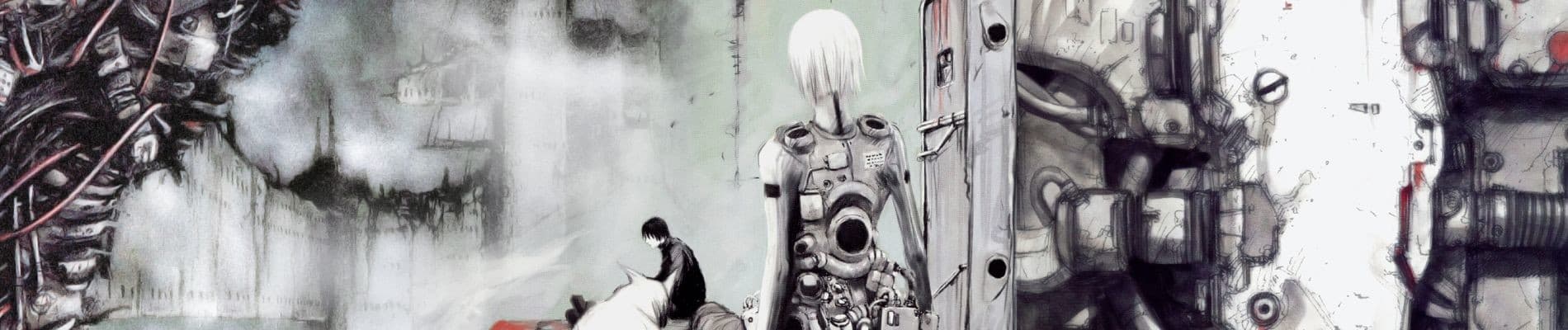
Nihei's titular work, his magnum opus, is an interesting take on medieval epics. Blame is hardly interested in telling a compelling story, it's as if the entire plot is a plot device in itself, an outlet to let Nihei experiment with otherworldly designs and captivating, majestic illustrations.
Spoilers from now on.
It doesn't have a start or an ending, our hero has been tasked to retrieve the natural gene that unlocks control of the administration's commands (basically the entity responsible for the actual building of the world), which has gone rogue because of reasons. Through a predictable set of intricacies and developments (the hero's companions, the traitor, the literal deus ex machinas coming at the rescue, etc.) he gets the McGuffn and (perhaps?) saves the world through it.
There, I spoiled the plot. There's really not much else to say. In a way, while banal, the story is not actually required, because Blame can work as a narrative expedient to flesh out the characters. This is what skillful writers do.
Alas, Nihei is a terrible one, which is compounded by the lackluster if not downright horrible human sketches he depicts.
To understand what I mean, consider this: Blame reads more like a 10-volume artbook full of cool monster designs and monumental double spreads. The post-punk apocalyptic world is also wondrous and alluring. The problem is... it's all wasted.
Nihei does not care about the narrative, and he doesn't even consider his human characters. They have no motivations from start to finish, they show no emotion, no internal dilemmas, and most of them come and go, getting slaughtered in no more than a few pages since their introduction. It gets to the point where the repetition becomes bothersome if not downright hilarious.
It's especially accentuated during the first few volumes. You get to see a bunch of technological fishermen, they save our protagonists, and once they reach their village, you already know where this is going. They all get slaughtered in mere seconds by a generated enemy. It's honestly pretty funny, although it spells the death sentence of thematic coherence, you get tonal whiplashes that are unquestionably not meant to be there.
As I said, Nihei doesn't care about story and characters, which leaves... the drawings. These are the best selling points, but at 10 volumes and with not many outstanding ideas, it becomes repetitive pretty fast.
Moreover, since he doesn't know how to write human characters, a bunch of scenes are badly sketched, too. He goes from extremely detailed pages to downright scuffed drafts, as if he wasn't feeling it that day.
To put it in another way, Nihei failed the "show, don't tell" test by steering too much in the opposite direction. His story heavily relies on showing stuff, but he can't do so (and that's understandable, it's a daunting task), and even worse when he cannot draw different human faces or even symbolic expressions. Characters hardly react to what happens around them, they move through sectors of the megastructure without batting an eye, even when most of their friends got mowed down 5 minutes earlier by nightmarish horrors.
To be fair to Nihei, some stuff does indeed make sense (instead of whatever happened in Biomega). We can kind of correctly imply who Kyrii (the protagonist) is, although we don't ever find out his motives. The overarching plot is confusing, to say the least, but the factions here have somewhat clear (with a few exceptions, like what happens to the safeguards in the endgame) motives. But this all goes to waste because Nihei gives no time to the reader to reflect on what is even happening.
Particularly in the earlier volumes, it's just a constant stream of gruesome battles with no reason whatsoever. Kyrii and her friend Cibo do not react or show emotions to them, the enemies have incomprehensible motives until much later, and even then these are pretty basic if not outright offensive (silicon life kills humans because they need to reproduce, never explained why that is).
The story proceeds from one place to the next, and whilst the fights look repetitive, they're cool to read... until you understand that Kyrii (and even Cibo) have immortal plot armor and broken weapons.
Most of the time Kyrii needs to take a shot against the enemies and his pistol is so overpowered that it straight up destroys entire square kilometers of structures. Sometimes enemies can dodge his shots, but then they don't. There's no pathos to the narration because it's all black or white, and even if the enemy ends up winning, he resurrects himself because the plot needs him to. He's basically unkillable and overpowered.
The narrative middle steps are hideous and confusing, too. Most of the time it has to do with characters jumping into existence and helping our heroes, even if they shouldn't. Nihei also had the brilliant idea of adding space-time warping shenanigans for no reason. They add nothing to the story and make the plot even more convoluted.
Going back to the drawings, Nihei has piss-poor paneling in most of the early volumes. He skips some steps during fights, and since all humans look pretty much the same and he likes roughly drawn monstrosities, that's a recipe for puzzlement.
It gets better later on but it's never consistently great.
Once Kyrii reaches the endgame (he does this in an incredibly confusing and undeserving way, the same goes for Cibo), the world changes for the better, as it's a bit more streamlined and comprehensible, but that's still too little too late.
Again, I know some people will find a way to make (almost) everything connect, but what even is the point? The entire plot is not even the second selling point, it's banal and insipid, the characters are worse than one-dimensional, often lacking any dimension at all, and the quality of the illustrations ranges from breathtaking to terrible. High highs, low lows.
I'll have to say that the conclusion, albeit vague and open to interpretation (as always), is quite pleasant. Not worth the slog, though.
If you enjoy reading what essentially amounts to an ADHD artbook with post-punk transhumanist designs, then this manga might be for you. For everyone else, Firepunch is the better option (although not perfect).
I guess the lesson for Nihei should have been: show don't tell is very hard, and if you do it, you need to draw good characters at the very least. Quality illustrations only go so far as to make Blame a worthwhile reading experience, and unfortunately, even then, there are much better options. He did not get it, and in fact, even doubled down with Biomega.
As it always goes for mangakas, having a few good concepts is not enough to write a persuasive and engrossing story with intriguing characters. And if you don't have any of those two, technical skills can't carry Nihei to the finish line.
102.5 out of 177 users liked this review
