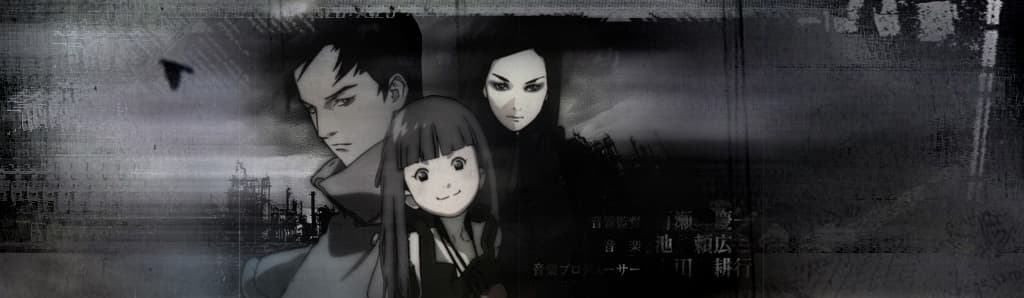
Ergo Proxy
a review by NullMoon
a review by NullMoon
(This review contains spoilers for the whole series. Proceed at your own discretion)
Ergo Proxy is a series that tends to be polarizing to some degree. I've seen it around for many years in the anime space as a bit of a cult series, and the reactions tend to be either that it was an amazing and unique experience with interesting themes, or a pretentious esoteric slog. There didn't seem to be too much middle ground between those two opinions. Having finally watched the show, I don't think either is really correct although I'd probably find the more negative assessment more accurate for a few reasons.
To begin with, the show is bound to disappoint some people because its promotional material, the other kinds of shows that are recommended with it, and even the first few episodes of the series, give the impression that it's going to be a very different type of show than what it actually is. It seems like it's going to be a cyperbunk thriller action show ala Ghost in the Shell, or a mind screw series like Serial Experiments Lain. But it isn't very much like either of those series.
The initial setting of the series, Romdeau, does have a few Cyberpunk-like traits, but not all of them (there's no mention of any corporations running things, it's all a centralized authoritarian government), and more importantly the series is not interested in dealing with any real cyberpunk themes or narratives.
This isn't really bad in itself. However the way Ergo Proxy executes on and communicates its themes and concepts is something I did find myself taking a lot of issue with.
The series can be distinctly divided into two halves: the first half takes place mostly in Romdeau and some surrounding areas and follows a pretty serialized narrative establishing the setting and most of the series concepts. The second half is when main three characters (Vincent, Re-l, and Pino) have all finally gotten together and decided to go on a journey to find out about Vincent's past and what the Proxies really are. This second half overall is more episodic as the episodes tend to be split between either character building episodes or the gang running into a Proxy of the week, with a few episodes that take place back in Romdeau moving the main story forward, until it finally gets serialized again for the last 3 episodes.
The first half of Ergo Proxy has a pretty big issue: it doesn't give any sort of meaningful hook for the audience to latch onto, whether it's in terms of characters, themes, or anything else. This is because it either gives too little information, or the information it does give is poorly conveyed or obscured, along with some baffling writing choices.
To begin with, Romdeau as a setting feels really undercooked. Technically, we know all the key information about how it works for the story to function, i.e it's an authoritarian city with a big class divide between "model citizens" and immigrants to the point of segregated living quarters for both. But it still somehow feels really insufficient. We never get that great a sense of what living there is like or how it's organized. We don't really have any viewpoint to ground us into the setting. The closest we get to this is the opening episodes with Vincent seeing him do his job as an immigrant. But that doesn't last very long and even then we have little idea of how that whole system of jobs is organized. The first episode alone really does a poor job of establishing things really, it doesn't even explain exactly what an autoreiv is.
In terms of characters, there really is very little to sink your teeth into: Re-L is the only standout character in the beginning, as at least she has something of a strong personality and tries to make decisions and move the plot forward. But she isn't magnetic enough to carry the story forward in light of all other issues. The other lead, Vincent, is not a particularly compelling character for the first half of the story. He is extremely reactive, wishy-washy and doesn't have much of a personality to speak of. This is something of an intentional decision as part of Vincent's development is him slowly becoming more assertive, however I don't think there was a very good balance struck here as it just means he ends up being a lackluster main character who just gets bounced around plot points without any real pull to him for a good while.
The other characters are mostly not worth talking about as the show fails to give much of a reason to be invested in them, and what strikes me as baffling is there's two big examples where the show could have done something, especially in light of later information.
The first is Re-L's grandfather, Donov Mayer. He is basically the head honcho of the city and Re-L states towards the end that all she ever really wanted was to be loved and recognized by him. But he isn't really a character at all. He never speaks, despite the characters going to see him multiple times. Instead the bizarre council of greek statues speak for him. His relationship with Re-L is never really explored in a meaningful way throughout the show, and it's only in the very end that we learn anything of substance about him as a person, after he's already died. It feels like a very strange omission to have such a theoretically important character handled this way.
But what's even more bizarre is what happens with Raul. I honestly did not care about him for the first half of the story as he didn't have much of a defined personality at all outside of being vaguely smug. But in the second half of the story we find out that Vincent was indirectly responsible for the death of his wife and son, as well as taking his robot daughter Pino with him. This ends up humanizing him a fair bit and makes him much more interesting as this actually does ground his character and his mental breakdown that he later undergoes, but the execution of getting to that point feels totally off. I can sort of see what they were doing wanting his relationship with Pino to be a meaningful reveal, but I think this whole arc would have had much more impact if we had seen Raul actually be a loving father and husband to his family before it happened, not to mention it would give the audience much more of a reason to actually care about him as a character.
There isn't really any meaningful exploration of themes in the first half either. We get a lot of gesturing towards themes, with the aesthetic and the philosophical and mythical references the show has, but there really isn't any attempt to engage with the existential or philosophical ideas being gestured at. The show spends most of its time trying to set up a mystery with the Proxies, but it doesn't give a whole lot of reason to care about that mystery and as a result the show doesn't have much momentum pulling the story forward, and it becomes even worse in retrospect as you realize that certain plot points the show takes time to establish end up feeling pretty pointless.
Take the Cogito virus for example. It basically gives the autoreivs something resembling sentience and the opportunity to grow from their programming. The way the early episodes go makes it seem like it's gonna be a big deal and explore the typical themes of robot personhood and humanity, but that mostly doesn't happen. It basically only kinda matters in a few instances, one of which in the finale feels rather abrupt. It makes you wonder what the point of establishing it that way even was as I'm sure there were simpler explanations to be had as for why characters like Pino and Iggy end up the way they do.
So far I've mostly just been trashing the show. So why is my score at 60 instead of something lower?
That's because in the second half the show actually becomes much more enjoyable. Episode 11 is where this transition occurs with the first episode I'd consider actually good, as it's a story about Re-L's robot servant Iggy essentially losing his mind to the virus due to the grief of having the reason for his existence denied, and snapping as a result of all the built up resentment. It turned Iggy from essentially a nothing butt monkey character into one of the most compelling of the show, even though it's his last appearance.
The reason this episode is good is actually very simple: it not only follows up previously established characterization in a logical and compelling way (as Re-l's poor treatment of him was basically left unaddressed until then), but it also FINALLY is an attempt by the show to meaningfully engage with the kind of themes that it suggested it would from the start.
And this is something that the show largely sticks to from that moment on. There is a real attempt at trying to explore the relationships between the characters, their motivations, and exploring themes of consciousness, personhood and reasons for being.
There are two pretty good examples of this: the first is the episode where the crew gets stuck in some wind-less weather and have no way to propel their ship. the episode is entirely about Re-L struggling through the monotony of their slowly dwindling supplies and being frustrated with Vincent and Pino's carefree attitude towards the whole thing, until in the end she realizes they were right and that it was better to not worry about a situation you can't change as oppose to trying to find the levity and beauty of things where you can. This episode doesn't move the larger plot forward at all but it's a nice character focused episode that brings re-l closer to vincent and Pino.
The second is the bizarro episode of Smile Land. Pino is whisked away into a dark parody of Disneyland, where the Proxy Will B Good (a transparent analogue of Walt Disney) has decided he wants to create a saccharine utopia for his citizens to protect them from the horrifying end that is slowly creeping in. This could have been just a weirdo diversion but it was honestly pretty entertaining for its take that at the artificiality of Disney while tying it into the broader themes of the show.
What stands out the most here is two things: first is that Ergo Proxy is a bizarre example of a show that mostly got better when it became episodic as opposed to the other way around. But the second is that for all of Ergo Proxy's reputation of being an esoteric mind screw affair, all the best moments of the show are when it's not being that and instead focusing on straightforward explorations of character and theme. The finale of the show actually suffers a bit from going back a bit more to the esoteric direction of the early episodes (where characters go on about vague highbrow stuff that's difficult to parse), but by then you at least have some reason to care about the characters and the ending is actually surprisingly uplifting and affirming.
I want to be clear here and say that I'm not trying to make an anti-intellectual argument. I don't think there is an issue with things being weird and not having immediately obvious meaning, ala something like David Lynch movies. It's not wrong to want the audience to interpret things and not spell out everything laboriously. But I never felt like Ergo Proxy's vagueness made the show more interesting, and even with more experimental or opaque fair you still need to give people a reason to care about your story. And Ergo Proxy really struggled with doing that.
Ultimately, even with this much more enjoyable second half I'd hesitate to say the show got amazing, and with a first half that was so lacking in things to care about, it really does leave Ergo Proxy in a strange place, where there's certainly stuff to enjoy but you have to endure an absolute 10 episode slog to get to any of it. It makes it a very difficult show to recommend to most people.
19.5 out of 32 users liked this review
