PUNCH LINE
a review by planetJane
a review by planetJane
Really if PUNCH LINE has a major flaw it's actually that it tries to do too much in its short runtime (just the standard single-cour twelve episodes. No more, no less), and its many moving parts lead to a bit of clash. But we're getting ahead of ourselves here, what exactly is PUNCH LINE? The simple answer is that it's a MAPPA-made (Yuri on Ice!!, Kakegurui, Teekyuu) animation that seems to have kind of arisen from nowhere. Directed by Yutaka Uemura, a man whose credits in the industry are sparse (and since PUNCH LINE ended, have included only the adaptations of the utterly noxious Tanya The Evil franchise), and written by Kotaro Uchokishi, an unknown within the anime industry but responsible for a good deal of video game writing outside of it (most famously, he is the writer behind Nine Hours Nine Persons Nine Doors), there is precious little to be found online, at least in English, as far as what prompted PUNCH LINE being made, so its origin is something of a minor mystery. My own best guess is that it may have been put forward to ride the wave of renewed interest in Daicon-lineage anime prompted by the success of Kill la Kill (not unlike the contemporary Rolling Girls), but a guess it remains.
Regardless of the why, the what of PUNCH LINE can be cleanly separated into the story's two major acts. In the first, Yuta--our protagonist--is knocked out of his body, and into the past, after essentially going super saiyan and overpowering a terrorist during a bus hijacking. How did he power up like this? Well, he saw one of his fellow passenger's panties.

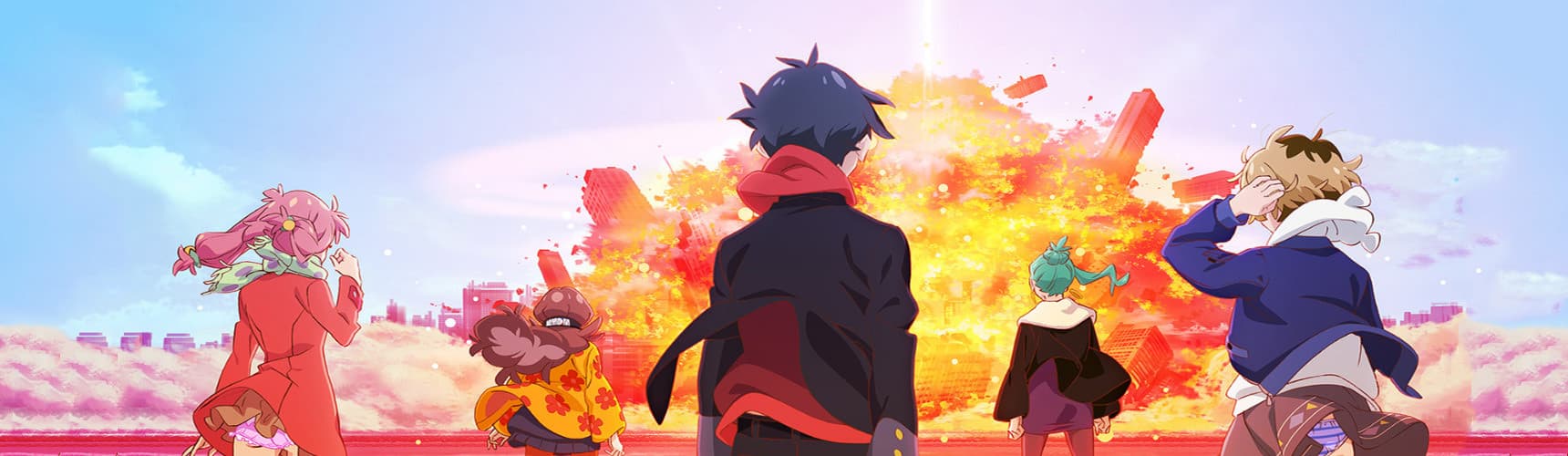
Again, you could be forgiven for thinking that this show is exactly as screwball as it seems on the surface, but this actually does go somewhere. The first six episodes of the series revolve around Yuta's ghost attempting to avert the end of the world, to be caused by an Illuminati-like organization called the Qmay Group, who wish to destroy the planet via asteroid strike, and start human society anew. Thus, the first half of the series is a blend of Yuta trying to solve the mystery of how this is going to happen in the first place and thus try to stop it (with the "help" of a snarky cat spirit Chiranosuke), and some character development for the remainder of the cast. Going over every in and out of the residents of Korai House--where Yuta lives, and now, haunts--would take a lot of time, but in brief, these characters are; Mikatan, an idol who moonlights as the magical girl Strange Juice, Meika, her manager both in idol and hero life (who turns out to be a robot in the first of many, many plot twists), Ito, a shut-in with a pet bear cub who was bullied out of her school after she was seen being driven home by a teacher, and Rabura; an unlucky-in-love fake medium with a gyaru look about her. Lastly there is Kenji, a mysterious super sentai-style masked superhero with powers similar to Mikatan's, but he is something of a special case.

Each of these characters gets enough fleshing out, often via flashbacks interlaced with narratives in the here and now, that when the shit hits the fan in the series' second act, you genuinely worry for all of their safety. Yuta, notably, observes these narratives but due to his nature as a spectre, is not really a part of them. This, as it turns out, is by design, as it's also in this second act that the plot starts to tie itself into knots, for both good and bad. The very, very broad stroke is that Kenji turns out to be Yuta from the future, and at the end of the sixth episode, Yuta actually fails to prevent the end of the world, and with the help of "Kenji", he goes back in time once again. Everything resets to the beginning of the series, and Yuta--now in possession of his body once again--makes a second pass at staving off the end of humanity, this time in an active and present way, and despite the pesterings of Chiranosuke, who tries to insist that he repeat his past actions almost exactly.
This doubling back on the narrative lets PUNCH LINE pull off an interesting trick. Things that seemingly made no sense the first time around are given additional context on the second, and it's here that the show starts foregrounding the mystery element (even as the comedy remains a constant throughout most of the episodes). We're introduced to the idea of uberfication (the super mode that several characters have), the virus that causes it, the motives of the Qmay Group, secret lab facilities and body-swapping. Yuta is even revealed to "biologically" be a girl (rather: his male soul has been swapped into a woman's body, it's complicated. As an aside, the show should be praised here for not making this into the subject of much jest or angst. The only person who really gives him any shit about it is Meika, who comes around eventually. It's no progressive masterpiece, but this is the sort of thing it's very easy to get wrong). This style of storytelling--revelation on top of revelation and twist on top of twist--is undeniably not to everyone's taste, but the rapid clip makes every episode count--PUNCH LINE has zero filler--and by the time the show is in its 11th hour (starting in the 11th episode natch), you're seriously rooting for the characters. Here, PUNCH LINE flips again, into a straight-ahead superhero show. The residents of Korai House become Justice Punch, and each plays a part in taking down a joint attack on the house by the US Army, The JSDF, and a battalion of supersoldiers called W's, all controlled by The Qmay Group. There's a real super robot feel especially to Ito's scenes, where she pilots a squat mecha created by Meika, her piloting ability hilariously being attributed to her skill at mecha sim video games.

The ending is maybe a touch predictable. There is a heroic sacrifice--Yuta, or at least an incarnation of him, dies. To save the main villain no less--but life goes on for the surviving members, and Rabura, now somewhat inexplicably a genuine medium, is able to commune with his spirit.
PUNCH LINE's story, both in a literal and meta sense, could've ended there. Spectacularly though, this bizarre, underrated lovechild of FLCL and Zero Escape has managed to spawn a tiny franchise of its own. There is a sequel manga--unknown in the west, but apparently a direct continuation of the story from the anime, and, by sheer coincidence and mere days before I sat down to watch the show, a visual novel. Available, officially, in English, on the PlayStation 4, courtesy of translation company P-Qube. PUNCH LINE is far from a perfect anime--the humor in particular is very much a hit or miss sort of thing and will depend largely on how much humor you can still wring from panty gags, but there is a clear and apparent amount of love poured into every frame of it, and even though its ambition to be everything to all viewers outstrips what it actually pulls off, that's not really a knock against it in this case. If more anime aimed this high, PUNCH LINE would maybe be merely average, but most do not. To be sure, it's not exactly thought-provoking. But as far as anime that aim to hit you in the gut in just about every way possible, and succeed at just that, and for the sheer effort, PUNCH LINE deserves a watch. That it manages to be as good as it is is just icing on the cake.
51 out of 52 users liked this review
