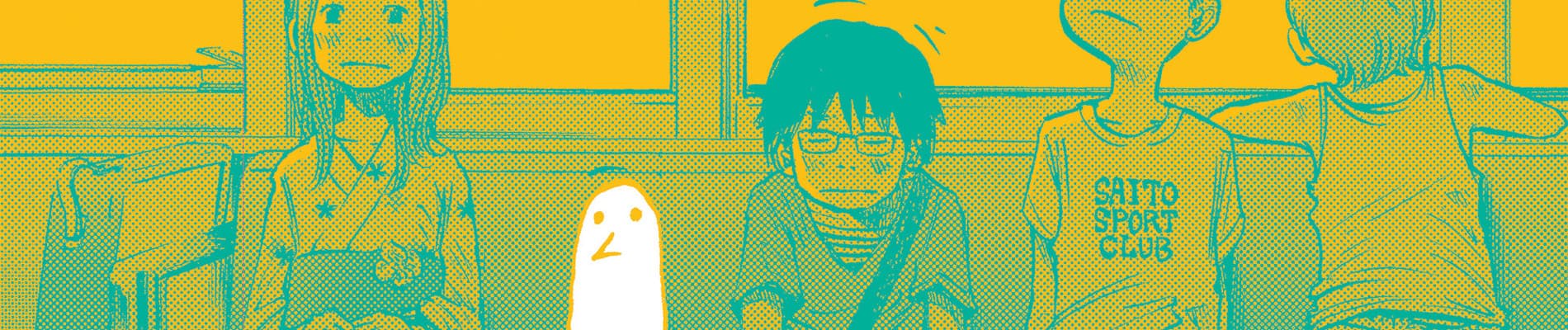
Life is full of hardships that may stray us from the well-worn path, but it’s how we deal with those problems that define who we are and what our prospects in life will be. Life is brims with open doors, but some require you to be the one to turn the handle instead. Do we accept the help from those around us or wallow in the pain alone? Goodnight Punpun is a slice-of-life drama series that gives an introspective perspective of an ordinary Japanese man Onodera Punpun, who had his fair share of troubles throughout his life. The story doesn’t always revolve around him, though, as people from his childhood, family, and friends in his adult life have their own stories to tell. It delves into the themes of depression, toxic relationships, trauma, and identity. Pretty much the whole story is divided into 4 (or 5 if Aiko’s arc is separate) stages of his life: Elementary, middle, high school, and adulthood, with each stage becoming more traumatic than the other. Characters have their own problems, moral flaws, and highs & lows. Everything from the first 3 stages of Punpun’s life escalated into the heaviest arc in the entire story.
(I’m probably gonna mostly talk about Aiko’s arc)
The story begins in typical coming-of-age fashion, with our titular character meeting the love of his life, Aiko. They go on adventures, share their dreams, and make promises to each other just like how typical love interests act. However, it’s the one promise that Punpun made for her to run away to Kagoshima that damages their relationship. Punpun had a second chance to run away with her during a bet with Yaguchi but decided that Yaguchi needed her more than him. Not only that, Punpun suffered a broken family where he struggled to maintain a healthy relationship with his mother, getting SA’d by Midori. All of these events snowball into the man that we see in the latter half of the manga.
I think what I love about the setup of this story is how we get a deeper and innocent first-hand impression of Aiko and Punpun’s relationship. It’s reminiscent of how we often view our childhoods through rose-tinted glasses and remember the positive highlights of the past. I think it was clever how the story builds up throughout their whole lives, where they both share dreams of seeing the same sky from their childhood and all the highs & lows they experience to make the Aiko arc much more impactful.
Punpun is practically a story about dealing with hardships in life. Punpun isn’t the only person who lived with trauma; other characters had it just as bad as him. One shouldn’t take away the series as a story that aims to be dark to express that everything in life is meaningless…I don’t think that was Asano’s intention. Sure, he loves to write the story in a way where when things seem to be going Punpun or Aiko’s way, Asano betrays our expectations for something better, but in the end, most of these events occur due to Punpun’s outlook on life.
His outlook on life has been molded through the trauma and hardships from his childhood, snowballing into the broken man we see in his adult life. Does that excuse the many sins he committed? No. Does it at least give us some context and understanding of what led up to his downfall? Yes. At its core, Punpun wasn’t necessarily a bad person, nor a good person, just a regular person who happened to have skeletons in his closet that needed a push for him to fall further.
Unlike Aiko or Seki, Punpun still had a support system that he could lean on. Sure, Sachi isn’t perfect either, but in the end, she was the person who pulled him from hell and back to earth. The apartment guys and his high school friend are still there to shoulder his troubles, he has his uncle, and his dad that he could still reach out to. The problem with him is that he doesn’t have the best coping mechanisms to deal with his problems, and his mindset is what causes him to regress, and avoid seeking help from others.
In Aiko’s case, she didn’t really have anywhere else to go. Her mother was a psychopath who tried to kill her, finishing off her mother meant she was a wanted criminal, and the only person she had any sort of love for was Punpun leading to her codependency towards him, where she was unfortunately abused by him. Nothing in life went her way, and she couldn’t turn herself in, since Punpun would’ve let himself take the blame, which would’ve left her all alone again. So her only solution was to end it all while she still had the small amount of happiness from when they were kids, and let Punpun be free from her. (Damn I feel so bad for her)
Aiko’s story also showcases just how unfair life is. During her childhood, the abuse from her mother pushed her to yearn for an escape from that household. Aspiring to become an actress and running away to Kagoshima with the sole person she loved, she was basically an angel who aspired to fly but never got her wings. For Aiko, the absence of love in her life and emotional support, to begin with is, what kindled her dream of rediscovering the sky they saw that night, a time when she was truly happy, giving her hope for the future. Unlike Aiko, who never had much to begin with, Punpun had a normal life but started losing everything as he got older, and he lacked any sort of dreams. This is exemplified when he tells Aiko that he wishes that there would be no more shooting stars to show that he doesn’t believe in the future anymore. This stark difference in their mindsets makes the ending feel more unfair. Throughout the story, Aiko longs for a fulfilling life, while Punpun is ready to end it all, but instead, Aiko leaves this world, while Punpun is brought back down to it.
There are a lot of other stories I’d love to talk about such as Uncle Yuuichi, Mama Punpun, Sachi, and Shimizu, but this would take forever. This is probably the hardest review I had to write, simply because I didn’t know what to feel after the final arc. I’m not even sure if this review serves justice to what Goodnight Punpun is trying to convey. It’s a heartbreaking, down-to-earth, and realistic story that doesn’t sugarcoat just how cruel life can be. So, no matter what, don’t be afraid to express your real emotions with the right person, and continue finding that person you can rely on. Because no matter how much you want to sleep and hide in the night, you're always going to wake up when a new day comes.
35.5 out of 37 users liked this review