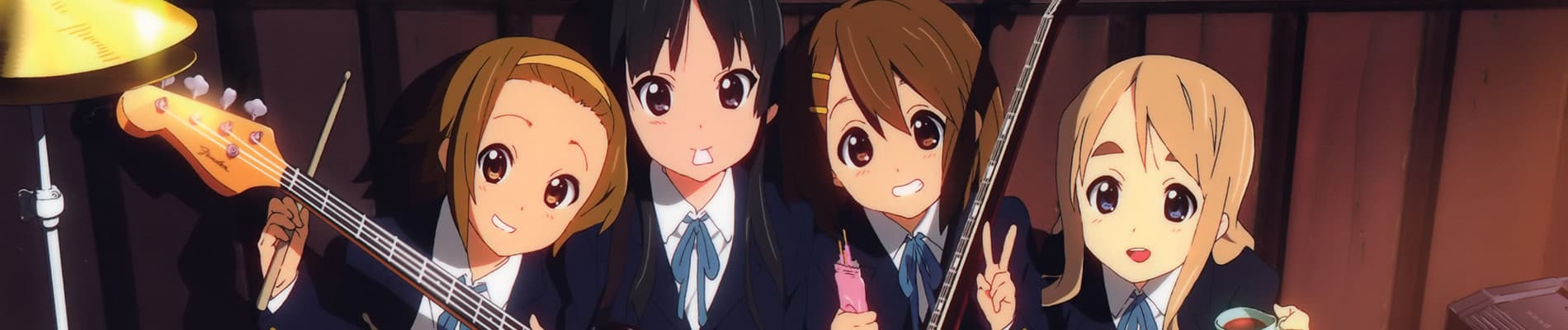
So K-on. At first glance, a typical slice-of-life anime where nothing happens, with likable but one-dimensional characters who prefer to fool around and eat sweets all day instead of improving their instrument playing skills. But, as I pointed out at the begnning, only at the first glance, because thanks to Kyoani high production value, combined with the very talented director Naoko Yamada, they create something that exceed all boundaries of the slice of life genre.
The biggest factor that makes K-on unique in its category, but also for many relegates it to the 'ordinary moe anime', is the aforementioned mundanity of the events and characters, which can make the anime seem at times monotonous or unattractive to watch but I think it was intentional to make the series even more grounded and down to earth. To this day it is amazing to me how Yamada manages to portray main characters as individuals with their own feelings, world view, problems and ways of solving them - you really feel that these characters have their own lives outside the club and are more than just a factor pushing the 'plot' forward when needed. This element, along with Naoko Yamada amazing visuals and directing, about which more in a moment, puts k-on at the high end of slice of life anime I watched and there's no sign that it will lose this position any time soon.
Yamada, through the play of lighting, framing, camera movement and positioning, is able to convey a range of different emotions to us, show us how a character has developed in terms of character over the course of the series or tell us stories through visuals. The camera will take a soft approach in slower and more laid-back scenes, only to become more chaotic and 'shaky' during action-packed scenes (and yes, I'm mainly referring to concert scenes, so calling them 'action-packed' is a bit inaccurate, but oh well). If the camera is stationary during a scene, the elements on screen move, giving the audience a good sense of progression, always moving from point A to point B. The background colours change depending on the mood of the scene or episode (episode 13 of the first season being excelent example of that). All these factors, along with many others, combined with a likable cast of characters, create an amazing experience that is hard to find in other productions of this type.
For an example, take a look at the following scene from the first episode of the first season. Yui, on her way to school, is distracted by many things that we can see in quick shots. With this, we know from the very beginning of the series that Yuu doesn't really have any purpose or main interests up to this point, as her attention quickly shifts from thing to thing - at this point she has no specific goal for herself.
In contrast, during a very similar scene in one of the last episodes, we clearly see Yui desperation and determination. She has finally found her path to follow, friends she can rely on. I also really like the fact that we hear the music played by the band from both points of view. Which literally we can understand as a metaphor, that the music is what allowed Yui to forever establish and confirm a bond with the rest of the band members, but at the same time it's reminds us that Yui has to get to the concert before the song ends - a great combination. What I want to say by this is that the visual narrative, although not as unusual and extraordinary as Masaaki Yuasa, for example, fits perfectly with the slower and more down-to-earth atmosphere of five friends living from day to day and trying to make the most out of these days.
Yeah that's cover just about everything. I could also talk a little about characters or more about stuff I like in the show but I am lazy, and I dont want this already propably mess of a text be even more convuluted.