On June 15th 1985, a group of middle-aged men formed an animation studio that succeeded in shaking the world through its works. These include My Neighbor Totoro (1988), Grave of the Fireflies (1988), Princess Mononoke (1997), and Spirited Away (2001). The latter film managed to win Best Animation at the Oscars in 2002. Since its birth, Ghibli has quickly become the only Japanese animation studio whose work is admired domestically and internationally, from anime fans, film lovers, to even ordinary audiences. But for all of Ghibli's success, it wouldn't be wise to forget where it all came from. Nausicaä of the Valley of the Wind (1984) or simply Nausicaä is Ghibli's first film. Even though it was released a year before the birth of Studio Ghibli, this film is considered the first film because it was the reason why the initiating fathers were able to gather. Nausicaä was also an early milestone in which the characteristics of animated films produced by Ghibli/Miyazaki were established, starting from the use of the main character strong and independent women to the theme of human relations with nature.
Nausicaä has an epic story about human conflict with nature. Adapted from a manga series written and drawn by Miyazaki, Nausicaä tells the story of a dystopian world in the future. So the story goes, almost the entire world has been filled with Toxic Forests as a result of an all-out war between humans. Called "The Seven Days of Fire", this war wiped out most of humanity and left behind deadly pollution that can kill. This pollution comes from spores which can also turn insects into giant mutants. One of the famous insects is the Ohmu, a giant snail-like insect with an indestructible shell. The last remnants of human civilization are divided into several villages, one of which is home to Nausicaä. Nausicaä's name actually means "princess" in Greek, but she prefers to go on adventures through the Toxic Forest by glider or light plane to study various species of insects. Even though she is a nature lover, Nausicaä then has to be faced with a dilemmatic decision when the Tolmekian Kingdom tries to use ancient powers, to eradicate the Toxic Forest. Which side will she choose? Man or nature?.
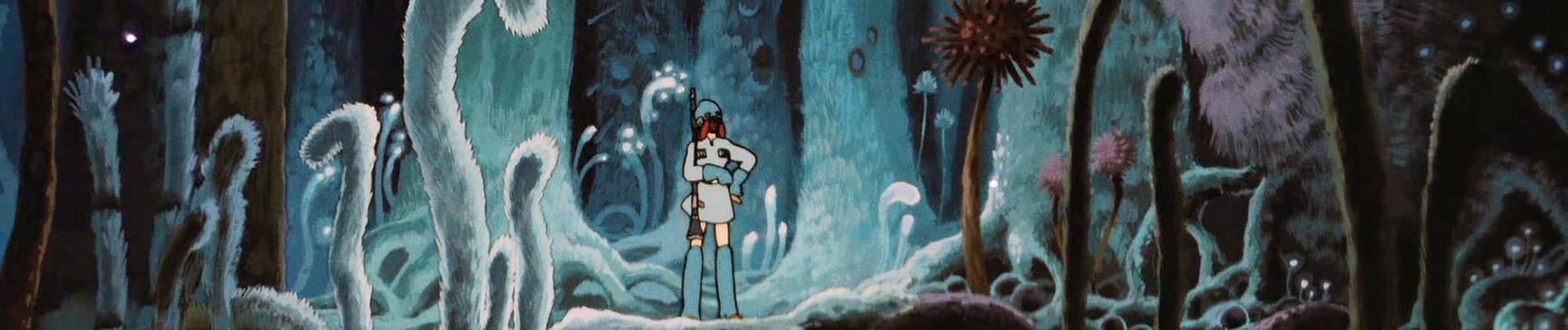
Nausicaä opens with a sequence of her flying with the glider through the desert and landing on the edge of the Toxic Forest. She walked through a magnificent cave filled with strange plants. Nausicaä is overjoyed after finding the shell of a dead Ohmu giant. This one sequence immediately shows how serious it is Ghibli in shaping the audience's perception of the world in which this film takes place. In an era where other animated films compete to create cute and cartoony characters, Nausicaä uses its opening sequence to show an imaginative and visually rich world. Not only visually, the background music from Joe Hisaishi also arouses emotions. These first few minutes of Nausicaä demonstrate an important process behind other Ghibli films: the worldbuilding. With this process, we are invited to understand and observe how the world of this film works, Nausicaä fascinates the audience as if they have entered the story. And from these few minutes, we can also know that the Toxic Forest and Ohmu are part of nature that cannot be disturbed by any human efforts to defeat them.
The theme of human relations with nature, such as Nausicaä, is widely applied in later Ghibli films, especially those directed by Miyazaki afterwards. Princess Mononoke (1997), Ponyo (2008), and Castle in the Sky (1986) are strong examples. It turns out that the environmental theme in Nausicaä is not just Miyazaki's work. He admitted that he was inspired by the Minamata Bay disaster in Japan. Thousands of people have died over decades because their water was contaminated with chemical waste from factories. After fishermen avoided Minamata waters because they were poisonous, the fish population there strangely increased drastically. Miyazaki shuddered when he heard the news and was amazed at the concept that nature could absorb poison and still survive. This is what he brought into the Toxic Forest. The forest, along with the insects in it, turns out to be a natural mechanism for repurifying the Earth after being damaged by humans. So when the Tolmekia Kingdom, with all the ignorance of humans in general, tries to destroy the Toxic Forest with weapons of mass destruction, the conflict then becomes ironic so that it provokes sympathy. Baiting for sympathy because the Tolmekia Kingdom, which was initially depicted as evil, was actually not as evil as the antagonists in general. They have good intentions, it's just that they don't do it right. Moral ambiguity, not being clear about who is bad and who is good, is a case of characterization that is unique in works of fiction, but common in Ghibli's works, which later became Miyazaki's trademark.
Unlike conventional films, Ghibli with the main character Miyazaki portrays morality as not just a dichotomy or separation of good versus evil. Each character shows elements of gentleness (good) as well as cruelty (evil) in a complex manner. Apart from Tolmekia Kingdom who shows their ambiguity, Nausicaä is also like that. Nausicaä is described as a teenage girl who is intelligent, independent, and has wisdom beyond her years. We see her several times as a role model for characters who are even older than her. Even though she was created as a charming character, Nausicaä is also has her own flaws. In an emotional scene, she is shown almost going berserk with a look on his face that wants to kill and take revenge. In sharp contrast to Nausicaä, who is depicted as very gentle and friendly at the beginning of the film. What's interesting then, instead of throwing a tantrum, Nausicaä shows her empathy by restraining herself and trying to understand the situation. In another context, when she encounters insects, Nausicaä shows her softer side by trying to communicate with the insects of the Toxic Forest. Nausicaä's depiction reflects an element of the human self: imperfection. Don't just say because she is a heroine, she is absolutely perfect. Viewers cannot feel connected to characters who are portrayed as perfect, because none of us are perfect. By creating imperfect characters and emphasizing elements from our lives that are similar, Nausicaä and the other characters become like humans, no longer just cartoons. And this effort to humanize animation is Miyazaki's way of creating a bond between the audience and the characters in the film.
Apart from humanizing animation, Miyazaki through Nausicaä also tells stories about humanity. In this film, human civilization is helpless in front of nature. Nausicaä, who is in the middle trying to maintain her identity as a human who has desires and is also part of nature, it is also not depicted as winning because that is not important. What is most important in this story of human conflict with nature is not who wins and who loses, but rather how we humans as intelligent creatures adapt to nature where we live. Nausicaä of the Valley of the Wind is not only a debut that determines what kind of films Ghibli's works are, but is also one of the most influential animated films for the Japanese animation industry to this day. Nausicaä teaches audiences how to protect nature without trying to patronize it. This film is like a showcase that reminds us of the position of humans in their surrounding environment. However, it does not necessarily become a frightening warning, but Nausicaä spreads a spirit of optimism to care for the Earth, that living in harmony side by side with nature is the world we have dreamed of for a long time, just like the Valley of the Wind. And we are his Nausicaä.
29 out of 30 users liked this review