This review contains a minimal amount of spoilers
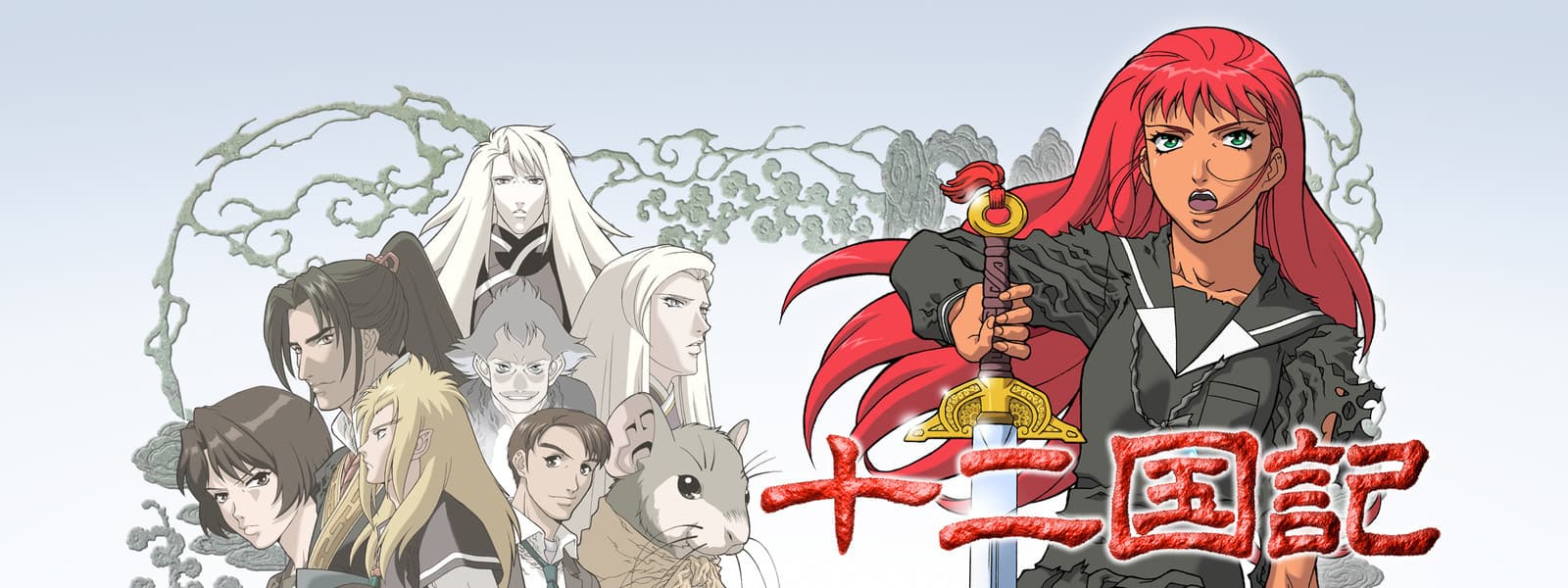
It's truly a shame the Juuni Kokuki anime never got very popular as I can't describe it any other way than as a diamond in the rough, quite literally. Behind its messy presentation, that ranges from extremely stiff animation to awkward movement, wonky character drawings and poorly planned adaptation, lies a great isekai - this unfortunately sounds like an oxymoron - that boasts strikingly realistic characters, satisfying development, extensive world-building, good pacing and charming OST. Its story consists in an epic tale of interwoven fates as it is presented through the lens of multiple characters that eventually come together to achieve a common objective. Juuni Kokuki's themes boil down to two main ones: what makes a good kingdom, and what is destiny?
Following the story of Youko Nakajima, a high-schooler suddenly transported to a different dimension, Juuni Kokuki's introductory episodes are definitely not the strongest part of the show. As she finds herself stranded on this unknown world, Youko must fight for survival as she gradually learns about her new environment and herself. The start of the anime plays off as a standard isekai, but it quickly becomes apparent that it has more to offer than the run-of-the-mill overproduced animes rampant in the modern world of entertainment. First, because, as mentionned, Juuni Kokuki is the opposite of overproduced, but mainly thanks to its carefully built world and very grounded cast of characters. While many isekais tend to tunnel-vision on their main character and a few core aspects of their world, Juuni Kokuki takes the whole picture and shoves it into your face. Despite these qualities, one requires a lot of patience to really get into the show. The two main culprits are the slow development and the very convoluted vocabulary used by the characters; and these two barriers to enjoyment are direct outcomes of the two qualities I just brought up: characters and world-building. While the characters are very grounded, relatable, and receive extremely satisfying development, their growth doesn't come easy, it's never forced and always earned through great hardships and introspection, which can take a lot of episodes. Similarly, while the world of Juuni Kokuki is extremely well crafted, the show expects the viewer to pay attention and remember a great deal of technical vocabulary: from locations - the twelve kingdoms and the regions that compose them -, to functions and character names. It's not unusual for characters to have multiple names, or be referred to by the function they occupy, or even have nicknames. This can turn the anime, especially early on, into a frustrating viewing experience. However, this also acts as a way to create empathy for Youko, as the viewer takes the same learning path as her.
While on the topic of negatives, my main issue with Juuni Kokuki is its production. From a visual standpoint, the series is very rough and action scenes are often awkward at best, but thankfully action only takes a secondary role. Character designs are great, but the animators definitely had some issues with drawing their faces, mainly Youko's, which is a shame since she gets the most screentime, as if they couldn't decide on the shape of her face which is consistently inconsistent. As they say, don't judge a book by its cover, and it's definitely true for Juuni Kokuki. The content of the book is amazing, but the cover is designed by Studio Pierrot... Because of the format of the source material, light novels sill being published today that tend to focus on various characters' stories, which from what I understand weren't finished at the time the adaptation came out, Juuni Kokuki's story is discombobulated to say the least. Out of the 4 arcs, only 2 have an actual ending. If the anime had around 30 episodes instead of 45 the experience would've been much more enjoyable, and the story easier to follow.
Fortunately, under its ugly exterior, Juuni Kokuki's content - in other words its source material - does everything right. A great amount of details and care was put into the world-building which makes it very cohesive and believable. We learn about the twelve kingdoms and their regions, the people that govern them, the social and political hierarchy of the world, the customs, the resources exploited by the different kingdoms, the races and how they're perceived by others, and so on. Everything is carefully planned to naturally drive the narrative forward without it ever feeling contrived. What makes Juuni Kokuki's world especially interesting is the conflict between divine will and human free will. Indeed, everything in the twelve kingdoms is supposedly delibarately organised by a godlike entity in order to create a peaceful and perfect world, but this utopia is constantly challenged and thrown into disarray by egotism and greed. Despite being an isekai, Juuni Kokuki is not about escapism. This new world acts as a setup for the narrative's main themes, destiny and rulership, which are concretized through the characters.
The way Juuni Kokuki's characters are treated, especially Youko, is very interesting. So many isekais try to make their main characters as special and unique as possible, but Juuni Kokuki twists this trend in a satisfying way by making Youko special but ordinary at the same time, and by showing the viewer that what makes her special is equally a blessing as it is a curse. She was brought to the twelve kingdoms because she was chosen to be the ruler of the kingdom of Kei, which sets the stage for her psychological journey as she learns the hardships of being a ruler, but the show also makes it clear that there are many people just like her. Used to living in a patriarchal household and doing what she thinks will make people love her, she must first learn about herself to understand her own desires which will in turn shape the vision of the perfect kingdom she wants to create for her citizens. With the looming shadow of this sword of Damocles above her head, she must learn about her kingdom, its people, its customs and its history to achieve her goal, while also having to deal with corruption and a civil war. The journey is slow and arduous, but the payoff is incredibly satisfying.
Another great aspect of the anime is the way its story is told through the prism of multiple points of view. We thus follow the adventures of numerous characters throughout the show, most of them, especially in the third arc, being extremely well written and developped. The anime never falls into the pitfall of clichés or overused tropes. There is no fanservice, no romance; instead of focusing solely on relationships between the characters, the show tends to explore their relationship with themselves and with the world they live in. One last thing to mention is that the anime takes liberties in the way it adapts the novels. I can't talk much about this since I haven't read those, but I did notice that the two classmates of Youko that get transported to the twelve kingdoms with her felt a bit out of place, and they apparently don't appear in the light novels. I found Yuka to be a fun character as she represents the opposite of Youko's relation with fate, but Asano is a bit of a mixed bag. His character is interesting, as it offers an aspect rarely explored in isekais - being unable to find a place in a new world -, but the resolution of his story felt out of place in the narrative as it goes against what the show stands for, which is ultimately a positive message about accepting your destiny and making the best out of it by being proactive and willing to learn.
Juuni Kokuki is a case where the good vastly outshines the bad. Thanks to its extensive world-building, amazing character development mainly explored through introspection rather than through inspiring apophthegms served on a silver platter by other characters, Juuni Kokuki offers a remarkable experience that is in desperate need of a reboot.
11 out of 12 users liked this review