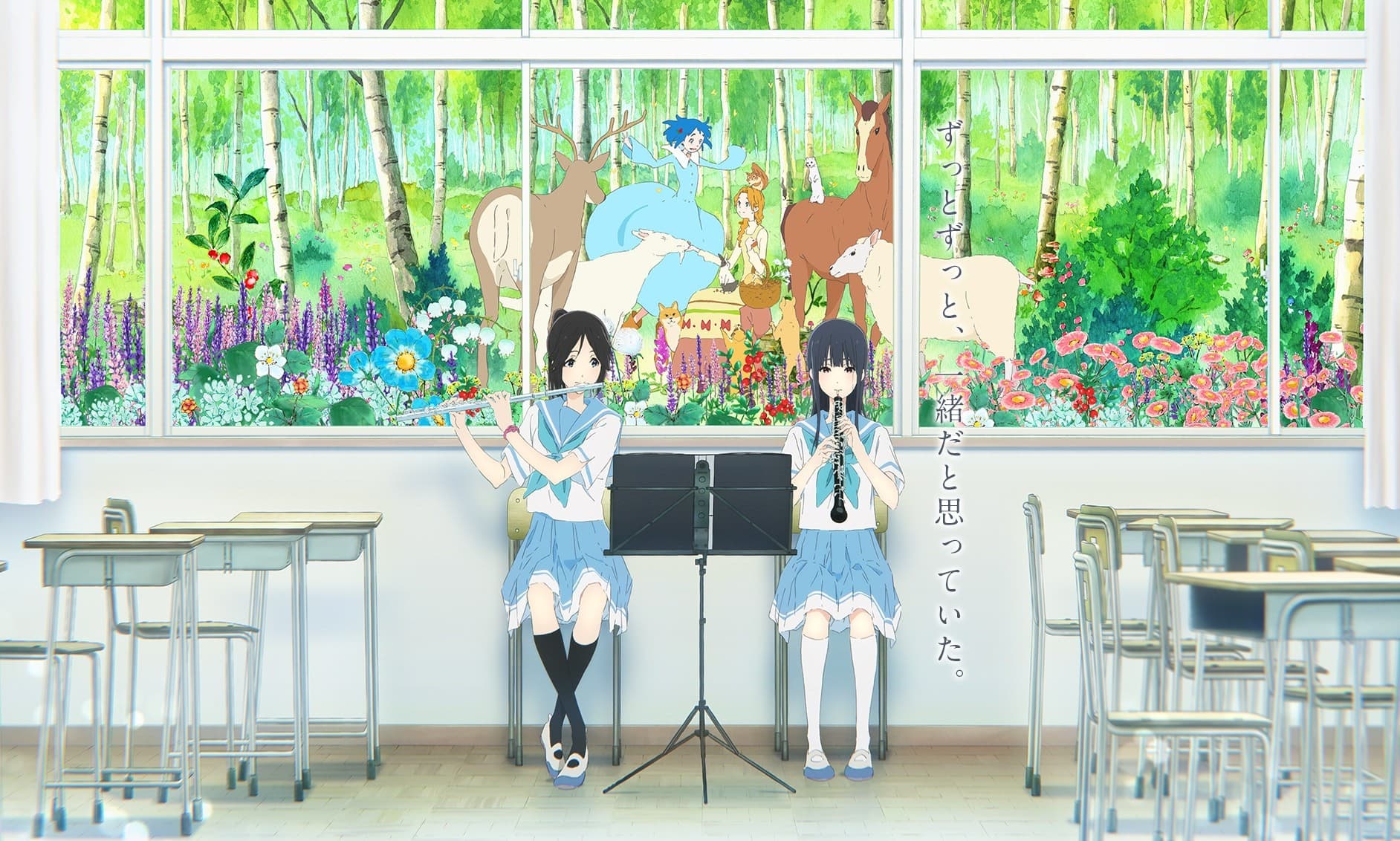
Before we begin, this movie looks nice. I like nice looking things, so it raises the score.
sigh (spoilers ahead)
Kyoani's critically acclaimed Liz and the Blue Bird is a movie that is irreparably tied to another one of their anime "Hibike! Euphonium" so it will inevitably draw comparison. The goals of that show contrast a timid shy girl amongst an entire community that is the Kitauji High School Orchestra. It's intimate and patient with it's character development, concerned not just with Oumae but the people around her. It's directing is quiet and serene, bombastic and heartful, somber and empty. Whatever Tatsuya Ishihara and his team were concerned with when adapting the source material, the story that comes through is poignant in ways that I find hard to see in other Kyoto Animation works, or even many other anime in general.
Liz and the Blue Bird takes some interesting risks in it's exploration of certain characters, but the overall construction falls flat in conveying what makes Hibike's characters and their stories so special.
The movies focus is on the relationship between Mizore, the quiet oboe player from season 2, and her best friend Nozomi, as they have to come to terms with their direction past high school as they will eventually part ways. The direction is handled by the lauded Naoko Yamada, doing what is by far her most experimental work in terms of it's communication of character dynamics. A Silent Voice is what I believe Yamada's best work to be, as it's able to bring out the best in human relationships by allowing a certain level of openness to all the characters in the film. Isolation is a theme, as seen with the X characters that convey Shouya's inability to form proper connections, but the film is just as willing to take them off to show real growth in Shouya in learning to love himself and those around him. It's that vibrancy that many also like in Yamada's adaption of K-On or even Tomoko Love Story, that is completely absent from Liz and the Blue Bird.
I think the first thing that stands out is Liz's character designs, which are generally more rounded and less (for a lack of a better term) moe. The color palette has been completely muted and the lighting used is flat, which is used to match the consistency between the storybook scenes and the classroom scenes. It's unfortunate with certain background characters being completely butchered, Oumae in Liz loses her iconic poofy curly hair turning her into just another anime character. The shinyness of the instruments, the warmth of the lights reflecting across the river, the rays of the sun as the characters go home after a long day's practice, all gone for something that is flat and (im so sorry) soulless. The aesthetic change is not something that will necessarily ruin the movie for me, anything Kyoto Animation makes will at least be good, but I thought this loss of detail was worth noting.
It's Yamada's insistence in having the viewer soak in it's scenes in an attempt to bring out it's characters... that just doesn't work. Yamada isn't Edward Yang, isn't Shunji Iwai, isn't Wim Wenders, isn't Richard Linklater, isn't whatever film auteur she's trying so hard to copy off of. I know that animation can do anything, it's fine to allow room for creativity in a creative medium, but that creativity turns to self indulgence when we spend the first 7 minutes of your 90 minute movie walking to a goddamn classroom. None of the characters in the film talk to one another, one melancholic scene drags onto the next with the pace of a glacier in it's attempt to build character dynamics. The term "show don't tell" is often thrown around in film criticism as a catch all for directors that fill their stories with exposition, but what the opposite arrives at is this right here, a movie that seems to show us everything while saying nothing. Some might have found Oumae's exposition in Hibike to be cliche, I found it deeply insightful into her character. Quiet characters are allowed to exist, it's fine to allow the viewer to infer someone going through deep pain when it is not explicitly shown to us, but watching that unfold is that much more rewarding, in validating in understanding of the character within the conflict of the story.
It's even more unfortunate that the focus of the film is on Mizore, a character who already had plenty of screentime during the second season, which leads the plot itself to feel somewhat redundant. Nothing within Liz is something that can't be predicted in advance if one knows the story Mizore is reading for the performance. Thematic parallels are meaningful, telling stories about how people are effected by stories is commentary that can be enlightening and important. However what happens in Liz doesn't compete as a story to sufficiently breathe life into the themes it's trying so hard to give poignancy. The story that Mizore is reading is a children's tale of a bird that comes to rest within the home of a woman where the two become friends, however the woman forces the bird to leave so that it can pursue a fulfilling life. The book inspired a famous duet that Mizore and Nozomi will eventually rehearse, where the Oboe (played by Mizore) represented the woman, and the flute (played by Nozomi) represented the bluebird. Whether one accepts the role as the woman forced to let the bird go, or the bird who leaves the woman, it's a theme of learning to let go and trace separate paths. The understanding the characters have toward this theme is barely fleshed out, aside from Mizori's interest in the source material being used as a source of tension, but the movie isn't as much concerned with Mizori and Nozomi as it is the symbolism between them. This however leads into the best part of the film itself, the performance which is based from the book. It's a powerful piece with the dynamic directing expected of Hibike. It's just the fact that the movie failed to convey their relationship within it's run time to make me care about the people playing the piece rather than the piece itself.
The end result is a movie that plays into the worse aspects of yuri bait media that Hibike also unfortunately plays into, adding to the confused communication within the film. Consider a scene from season 2, Reina touches Oumae's cheek and brings her face close to Oumae's, the lighting is passionate, blocking out the surrounding world, they are completely alone. This is insane whiplash noting her undeniable love for Taki sensei, communicating mixed messages. Literally no one gets that close to one another without romance being part of the equation, even if eventually dismissed. If someone tried to get close to me cause they felt really strongly about something they wanted to tell me, I'm gonna tell them about personal space. Yes, personal space is important, being able to bypass personal space is a sign of intimacy, intimacy is a core aspect of romance. This is yuri bait. Quite interesting how a large majority of the fanbase thinks that Mizori is a lesbian even though there is literally no canonical proof of such a claim ("daisuki no hug" doesn't equate to "daisuki"), it's because of how the story is communicated. Gay or straight, the end result is still a narrative based in cowardice.
The end of season two, Reina finds the courage to confess her love to her teacher, the concert hall is large and the stakes are on the line for winning gold. It's a powerful scene, this is two seasons worth of build up. Even though they didn't win, Reina meets with Taki again later, and it's made 100% clear what was being expressed, and Taki sensei acknowledges her feelings. It's not pedophilia, it's not predation, Taki is 100% loyal to his late wife, but the feeling is acknowledge for what it is. It's one of the most powerful moments in anime in dealing with a delicate topic. Mizori meets with Nozomi after their performance, the classroom is sterile, and no one is around. Despite trying to convey her thoughts the best she can, to what amounts to a confession of love (in it's communication), Nozomi nonchalantly pushes her off after noting "I love your oboe." Even after the performance is done, the plot of which it's based is followed to it's bitter end.
The next paragraph has light spoilers for the anime Revolutionary Girl Utena and Revue Starlight
The worst part however is that I don't hate Liz as much as I might have alluded to in this piece. It's dull directing didn't quite hint toward any emotion I may have felt strongly for, just simply the ideas of it's story flaccidly filling my screen for an hour and a half of distraction. I will say Hibike itself is excellent and I'm happily catching up on it.
As for a hot take, I seem to be in the minority, so I thought I'd share for anyone curious (also to cure a mild case of writers block). Regardless of such, thanks for reading.
77.5 out of 132 users liked this review