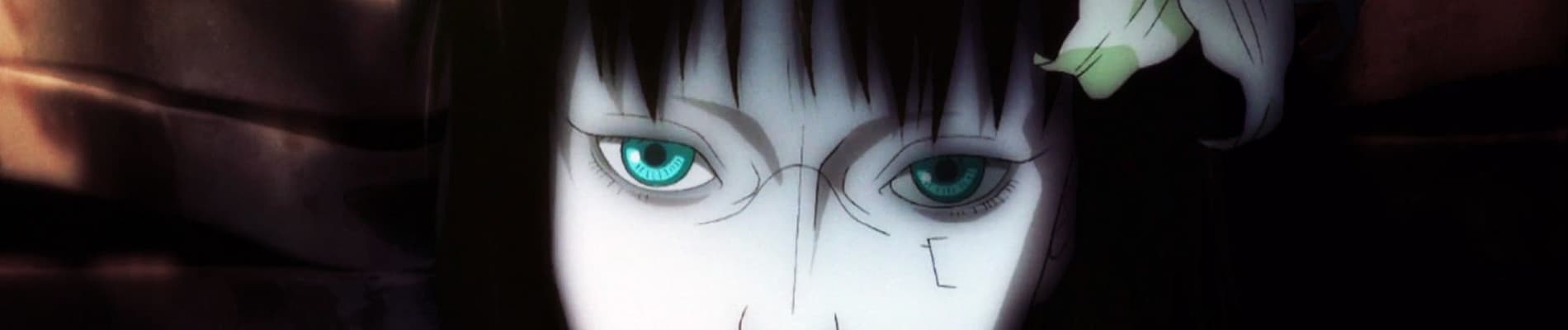
I invite whoever wills to indulge in my ramblings, to read my very schizophrenic interpretation of Innocence (2004).
Clearly, this film is not a sequel to 1995’s Ghost in the Shell; no, instead it is a meta-narrative – a commentary on its predecessor; we just take it for granted that this is a sequel, since Ghost in the Shell was so magnificently brilliant. A critical scene, in understanding this film’s purpose, is that in which Batou and Togusa are trapped within a never-ending simulation of their reality, endless variations (I use this word specifically) of the same. This scene is reflective of the film as a whole – it is even said by one of the characters, Ishikawa, that one ought to change their routine behaviour, as it makes one vulnerable to getting hacked (deceived) , – the film meanders by with an endless variety of set pieces and eventually you’re left with a sense of deja vu after each scene’s conclusion.
Moreover, this film is an idiosyncrasy, a mirror of humanity as presented in the film; an idiosyncrasy within Mamoru Oshii’s filmography heretofore; for whereas his other works are laden with subtlety and intent, reflective, slow, held-back and subversive, this work is self-indulgent – with its constant disregard of the audience’s intelligence and its usage of quotes throughout every scene, at some point it felt as if they gave up on writing dialogue and instead opted to open a random page of whatever book they had lying around, to stochastically copy passages, – and nought more than a streamline, action-packed narrative, contrary to the sparing way action is utilized in Oshii’s more competent works. Here action is not used as a backdrop, an appendage, in order to explore philosophical, psychological, and social ideas (which you usually only comprehend once you’ve experienced the film as a whole, as information is withheld and slowly fed to you over the course of the story; in this film, however, you’re beaten over the head with it ceaselessly) , here the, I’ll admit, on paper tepid themes serve as a placeholder for the action you anticipate in the subsequent scene; we can very much see this in the yakuza scene, there’s no beating around the bush, they jump straight into the action, and that’s all there really is to that scene.
One must wonder then, facing all these damning observations, what salvages this film? It is something I’ve hitherto not seen Oshii play with: Unreliability and misdirection. While the viewer certainly has to often re-evaluate their interpretive stance in almost all of Oshii’s works and shift their views in understanding the concurrent events within a given thematic vantage point, the film is always like Usul – the base of a pillar, stable, – it has a rail onto which you can grab, this film has none of that, it is confusing and though there are scenes early on, which make you question the reality of the situation (memory and reality; human error) , it is, as aforementioned, after the virtual Groundhog Day sequence, that you begin to question if any event succeeding or preceding actually maps with reality, especially since they end that sequence where it began, the floating platform, as it was an indicator for the repetition occurring: whenever our two main characters ended up there, it signifies recursivity; furthermore, there’s the sudden re-appearance of the Major in the last 20 minutes – something we’ve anticipated since the second the film started; – this is Batou’s fantasy, and his, in this case, is indicative of the audience’s. General audiences desire nothing more than a spectacle, explosions, all that, and, as this is a sequel, to behold the main character of the prequel, but fret not, Oshii accounts also for a niche, the people interested in his philosophical analysis, his thought-provoking themes, there’s enough jargon, enough barely related quotes, enough pseudo-philosophy for that ilk, too.
But what then is the purpose of this film? It seems more a soulless product catering to all kinds of viewers, than actual art. But it exists to prove its own thesis; two important axioms are repeated throughout the film: “Let a man walk alone, let him commit no sin. Let him have few wishes, like an elephant in the forest.” “When we face death, our life is like a puppet on a festival cart. As soon as one string is cut, it crumples and fades.” Oshii provokes an unreality and we are to believe it as fact, we are not to question the film itself, we are to consume or question its philosophical ideas, depending on which audience you ascribe yourself to, but not the work itself, the work is put on an untouchable pedestal, like humans put themselves on pedestals, either out of ignorance or obliviousness, unable to question their own consciousness, to consider it an intrinsic flaw, inextricably; we see ourselves in this way superior to all else, but this precisely makes us imperfect, when spelled out, it makes sense, but the fact remains, we never consider it. We see this exemplified in the little girl at the end, thinking herself superior than mere dolls, and if that sentiment is questioned or even rejected, one can’t but help and deny this reality; the film challenges the notion of innocence, how children are idealized and represented as innocence itself, both in society and art, from the grand imposing paintings depicting cherubs, angels, to the commonly expressed phrase (for lack of a better term) : “child-like innocence;” this film present the diametrically opposing proposition: we are inherently horrid beings. The way humanity believes itself above any other entity, the apex predator, the way we justified any atrocity and will always; this film, this little girl, this people is guilty of inconceivable things that mayhap a human being cannot yet comprehend, or never will, humanity is the real horror and our willingness to continue this tradition, to accept it, and to cling to the horror, to decide to stay, even embrace being, human – contrary to the Major’s decision to merge, to go beyond the shell, become entirely a ghost – is the genetic autocracy we have to question, the inherent, fatal flaw that makes us less than a doll.
Since our gods and our aspirations are no longer anything but scientific, why should our loves not be so, as well?
–––Auguste Villiers de l'Isle-Adam
A fitting quote to begin this film, as there is much talk of children, specifically Togusa’s daughter, and as the gynoids are modelled with a child’s likeness; and what else does a parent give a child but love and affection? And what else is art but the brainchild of an artist? It is not something intrinsic, love, unlike the will to survive, it’s a feat one must acquire. We cry to survive, we love to survive, preserving our bloodline is our sole mission. But art is not a human child, it is an imitation of reality, a doll, representative but incomplete. And yet it preserves a part of the artist (like DNA, memory) : a legacy to be remembered by. Thus we are conditioned to love.
The little girl at the end and the gynoids are both representations of this, and this film, also, has no love, its real commentary lay outside of its shell, within our reality, it is a mediocre product meant to be seen through an entirely different lens, which in turn elevates it. It’s no coincidence that we see Togusa’s daughter holding a doll at the very end of the film, the contrast between a being deeply entrenched within consciousness and one in unconsciousness, as Kim defined. Raise the kid with love, and it will grow to acquire that very skill, but we see also what happens if we don’t in the gynoids, they simply rampage.
Innocence thus is the solution to the question of what makes “good art,” for we are bound to compare it to Ghost in the Shell and realize it’s inferiority (“The mirror is not a tool for realizing the truth, but rather for obscuring it.”) .
25 out of 26 users liked this review