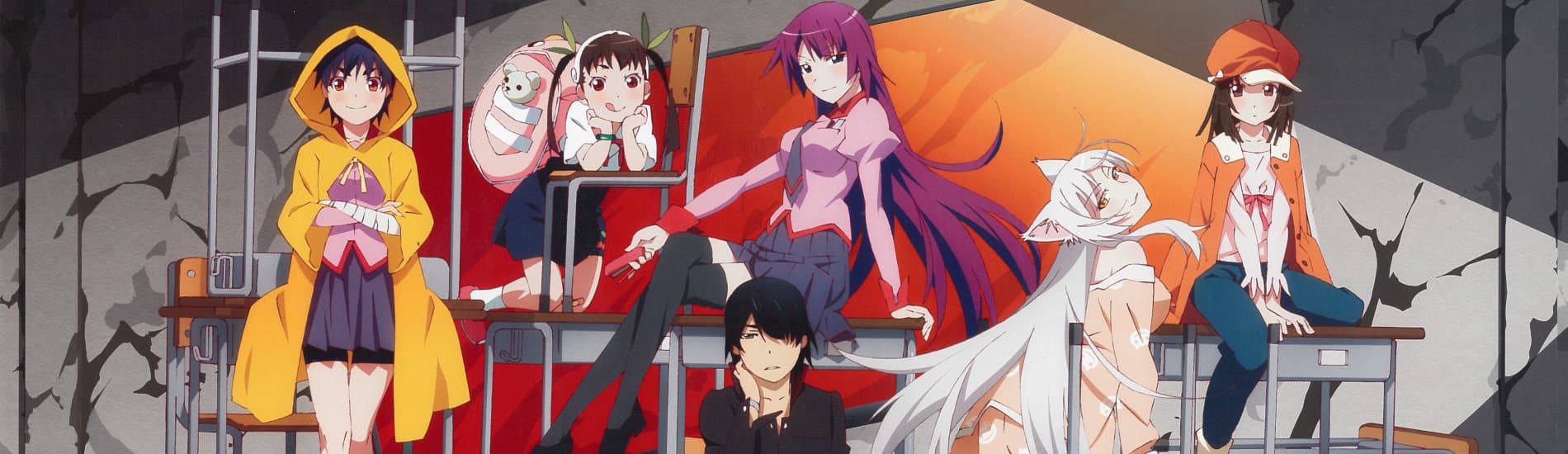
Once upon a time, a highschool junior named Koyomi Araragi was attacked by a vampire. He was able to survive this attack, just barely, with the help of the mysterious Meme Oshino, a strange homeless drifter with an easygoing attitude and a wealth of knowledge about the supernatural oddities that go largely undetected in our everyday lives. Coming out of this encounter with a fraction of his own vampiric transformation, Araragi attempts to live a normal school life, but he instead finds himself paying Oshinos kindness forward by coming to the aid of others who have been supernaturally afflicted like himself. There are oddities everywhere, and whether he’s helping a girl who’s been made weightless by a crab, a ghost whose sense of direction has been stolen by a snail, a middle schooler who’s being constricted by a snake, or any other manner of bizarre curse, it’s up to Araragi to save the day.
You really don’t have to look at Bakemonogatari twice to know what it’s all about, at least from a visual standpoint. Maybe it looked new and unique back in 2009, but in 2024, you’ve definitely seen this style before. This sort of experimental visual style is often referred to as the Shaft Style, although it would be more appropriate to call it the Shinbo style, as while Akiyuki Shinbo has done a ton of work for Studio Shaft, the style in and of itself has always been his signature more than anything else. Actually, going a bit beyond that definition, I have seen other directors and studios employ techniques similar to this, especially around the same time frame, so maybe that term also doesn’t adequately describe it? So for the sake of this review, I’ve decided to come up with a new term for this visual style; I’ve decided to call it Different By Design, or DBD for short. As for what DBD is, it’s kind of like the visual equivalent of Dubstep, and I don’t entirely mean that as an insult.
For those who don’t know(humor me, I’m sure there are a couple) Dubstep is a genre of music that became popular around the turn of the 2010’s, largely because it was drastically different from traditional music at the time. It was mostly composed on computers, and it ignored several of the most common musical tropes, such as repetitive beats, chorus and chord progression. I was never a huge fan myself, but I got the appeal. At a time when emo culture was entering its randomness phase, this was the perfect kind of unhinged, mindless music for club-hopping teenagers to lose themselves to. Of course, like most trends, there was always going to be a downfall, and Dubsteps was kind of ironic. Since it could be composed using only a computer, you didn’t necessarily need any musical talent to get famous off of it(Lindsey Stirling's violin dubstep being one noticeable exception), and thus the market became oversaturated, and the genre that once prided itself on avoiding repetition and tropes quickly developed its own repetitive tropes. Let’s be real, you knew it was fucked when Bronies got hold of it.
How is DBD like Dubstep, you ask? First of all, it ignores a lot of the rules of its medium, especially in regard to framing and cinematography. Characters are frequently depicted off-center for no good reason, and in some pretty extreme ways. Sometimes a character may be just out of shot, with only the top of their head or outstretched hands showing in the bottom left corner of the frame. Sometimes there’s a thin film strip stretching from side to side near the top of the screen, with the action happening in one off-center portion of said strip. Most directors of both live action and animated content know that they’re supposed to be very careful with how much dead space is on screen at a time, but in DBD, this rule is also flouted. Coloring is drab even at its brightest. The art style itself changes at random, and not like normal anime, where some comedy interactions can turn chibi once in a while. Even the most mild interactions in this show in particular can switch to, say, over-exaggerated manga panel cut-outs.
The rule of 180 is also completely ignored, as well as the rule of thirds, and while some shots can be explained away as ‘the perspective of the main character,’ you can’t really say that when a conversation between two characters is happening in the background of a shot of a classroom full of empty chairs. Much like dubstep, where you can’t really tell how genuinely talented the musicians behind most of it are, DBD is the perfect visual style for anyone who wants the audience to have no idea how much money went into the production... In fact, quite a lot of viewers will take one look at this style and assume the material has a ton of depth. Beyond that, not only did DBD become popular around the same time as Dubstep(if we ignore the works of Ikuhara, at least), but it also became more and more oversaturated and repetitive over time. Where the comparison ends, however, is with the fact that DBD never really had the downfall that Dubstep had, and the fact that while it has been used in other productions, DBD became oversaturated and repetitive under the supervision of the same exact guy who made it his bread and butter, Akiyuki Shinbo.
I’m not going to beat around the bush on this, I do not have the most favorable opinion of this style, and I feel like the passage of time has done a lot to prove me right... Maybe not in the eyes of the public, because anime of this style are almost as popular as ever, but I do feel like a lot of what I said about it early on has been vindicated. I don’t want to make it sound like it’s impossible for an experimental, off-kilter directing style to produce meaningful art... Ikuhara used a similar style to amazing results in Revolutionary Girl Utena and a few other titles... But the main use of DBD, that it is most well suited for and used the most for, is to distract the viewer from how boring or tedious a long stretch of dialogue or exposition can be. The Melancholy of Haruhi Suzumiya used DBD occasionally, such as whenever one of the supporting characters was explaining their supernatural abilities/worldviews to Kyon, but this was way more sparing and moderate than anything Shinbo's done.
In my opinion, Shinbo’s best works are probably the wacky random gag comedies from his earlier years, like the second season of Negima, where his directing style actually elevated the material, and I also feel compelled to mention Madoka Magika, which was written by Gen Urobuchi, and if we’re to take Shinbo’s reluctance to let that franchise go as any indication, even HE knows it’s the best thing his name has ever been attached to by a country mile. As for shows like Bakemonogatari, though? Dialogue heavy anime adapted from manga or light novels? I’m not gonna lie, I have a difficult time getting through those shows, the method behind the madness is just so fucking transparent. I couldn’t even get into a critically acclaimed series like March Comes In Like A Lion because of just how needlessly suffocating the visual style was. Every single Akiyuki Shinbo anime looks exactly the same, and if it was possible at one point to believe that his usage of DBD was capable of adding any depth to his work, that time has long since passed.
Having said all that, I don’t know if Bakemonogatari would have been better under any other director, because while it does have some good ideas to work with, it also has some deep seated issues that it never really escapes from. For one thing, as I alluded earlier, this is a very dialogue heavy show, and once you see past the director’s attempt to distract you with his quote-unquote 'auteurist brilliance,’ a lot of this material just becomes tedious at best, and flat out boring at worst. You get huge exposition dumps about the backstories of different characters, telling you how they got cursed or what their lives were like beforehand, and these dumps are only sometimes accompanied by visual representations, a little sprinkling of Show on top of all that bland Tell. The diallogue between characters is mostly aimless and never once feels like actual human conversation, slipping into nonsensical metaphors and unfunny comedic banter that sounds exactly like something from a screenwriter who doesn’t know how anybody other than himself talks.
The worst part of this is probably the reference humor, where it doesn’t matter whether both characters would get the reference being made... The writer gets it, and that’s all that matters! He uses one character to drop the reference, another to either pick it up or call it out, and then maybe he’ll throw in his own observation on the reference he just made, regardless of which mouthpiece he’s using for it. I’ll admit, this show can be pretty entertaining when something is actually happening... When Araragi is actively dealing with an oddity, or even doing an activity with someone other than talking, but scenes like this are not that common, especially in the first half of the series. I’m not gonna lie, I found myself nodding off a lot during the talky scenes, having to constantly pick my head back up and rewind to whatever I just missed.
As for the meat of the story, lying beneath all of that veneer, well, that’s where it becomes more of a mixed bag. The plot of Bakemonogatari is as follows: The author’s self insert fantasy character who is a really nice yet unappreciated guy(and may or may not be a vampire) has to live out his privileged yet dreary existence by dealing with the bizarre problems of those around him, while the people closest to him show their love by treating him like shit. I just described the plot of The Room, and I’m not sorry. Araragi himself is the worst thing about this anime. He is a bland lego brick whose only personality quirks boil down to adolescent hormones and a compulsion to save attractive girls who are haunted by oddities. We know nothing about him except a quirk that he has because of his age, and his role in the plot. I mean, we know he’s like a tenth of a vampire, but at least as far as this season is concerned, that little detail might as well just exist to explain why he’s able to survive the hyper-violent slapstick that gets inflicted upon him. Also, it’s kind of bullshit that being a fraction of a vampire gives him the healing factor and heightened abilities of one, without having to deal with bloodlust or aversion to the sunlight. That’s a better deal than actually being a full fledged vampire.
His presence also hurts the series in other ways, as his usage on behalf of the writer reeks of narcissism. Obviously he’s a harem lead, so everybody is madly in love with him... The idea of a girl falling in love with you because you fixed her problems for her is a staple of male entitlement, but this is a harem, I can't really blame this one show for following a staple of its genre... But then again, quite a few of his girls loved him BEFORE he saved them, and for no discernible reason. Hell, even the lesbian, who openly states that she’s a lesbian, still constantly flirts with him and hangs off him and offers to take his girlfriend’s place. The worst of this is the fact that a lot of the harem members were built on the foundations of really good ideas, but all of their issues are eventually revealed, in some way, to revolve around him. The middle school girl who got cursed by a boy she rejected? She rejected him because of Araragi. The lesbian’s problems began when he started dating the girl she liked. Probably the grossest example is Tsubasa, who’s haunting is due to stress... No, not the stress of her abusive family, but the stress of knowing Araragi is taken! She’s over that other stuff, but not getting any main character dick? Now THAT gave her long term trauma!
I honestly think this series would be better without him in it. He is one of the least interesting and most punchable anime protagonists I’ve ever seen. If there were a version of this starring Hitagi, who gets saved by Oshino and then recruited to save all the other girls herself, I think that would be great. Unlike Araragi, she would probably grow and develop as a character. Without Araragi, those girls’ story arcs would probably feel more rewarding in the end. True, we wouldn’t have the romance between Araragi and Hitagi, but I hate that romance, they’re the worst fucking couple. They have no chemistry, and their reasons for loving each other are lame. She loves him because he looks good and he saved her. He loves her because of “everything,” despite openly complaining about her personality and her treatment of him. She’s also jealous, violent and abusive, and that whole car ride her dad gave them felt like the set-up for a Soprano’s style assassination, but hey, all that matters is that he’s the main character and she’s hot.
Also, unlike the audience, he got to see her naked. Yeah, that’s one more weird little quirk about Akiyuki Shinbo... Shinbo loves fanservice, and look, I’ve never lied about the fact that I like fanservice myself, but Shinbo’s brand of fanservice has always had a weird, creepy edge to it. He’ll basically show you every inch of a nude female character’s body except her nipples, which is apparently supposed to make up for all the gratuitous POV close-ups and sexualized poses in scenes that are pretty exclusively just there to titillate the viewer, almost exclusively framed in the most voyeuristic way possible, and serving no real plot purpose whatsoever. Some of the most egregious examples include the final opening of the series, where one of the girls is being sexually terrorized by a bunch of ghost hands; A scene where a middle school girl is bound by an invisible snake, moaning and writhing, and made to deep-throat it while wearing a school swimsuit; And a scene where Araragi sexually assaults a little ghost girl.
If I remember correctly, he does this even more in the next installment, Nisemonogatari, which I also may or may not rewatch in the near future? I dunno, I’m debating whether or not to continue down the Monogatari rabbit hole, because I have heard things get a lot better in the future, so maybe I’ll keep going if this review does well enough? We’ll have to wait and see.
I'm not sure about Bakemonogatari's current availability. I know it was available on Bluray from Rightstuf for an insultingly exorbitant price, but now that Rightstuf is owned by Crunchyroll, I don't see it on the site, so maybe it's out of print? Either way, the original manga by NISIOISIN is available from Vertical Comics.
I remember the last time I watched this series, maybe around a decade ago, I knew it was bad, but I kinda liked its vibe. It felt wrong the way a seedy back alley dive bar feels wrong... It felt inviting, and comfortable, even though you knew some depraved and possibly illegal shit was probably happening in the back room. I don’t know, maybe it’s the fact that I’m a full decade older, but it doesn’t feel that way anymore. Bakemonogatari was a chore to get through, especially without falling asleep. I don’t want to step on the toes of anyone who genuinely loves this series, but seeing people call it a brilliant masterpiece does kind of irrationally irritate me. Maybe what I’ve heard from all the fans is correct, and things do get a lot better further down the line, but just on its own, this installment is a lot worse than I remember.
I give Bakemonogatari a 3/10
101 out of 169 users liked this review