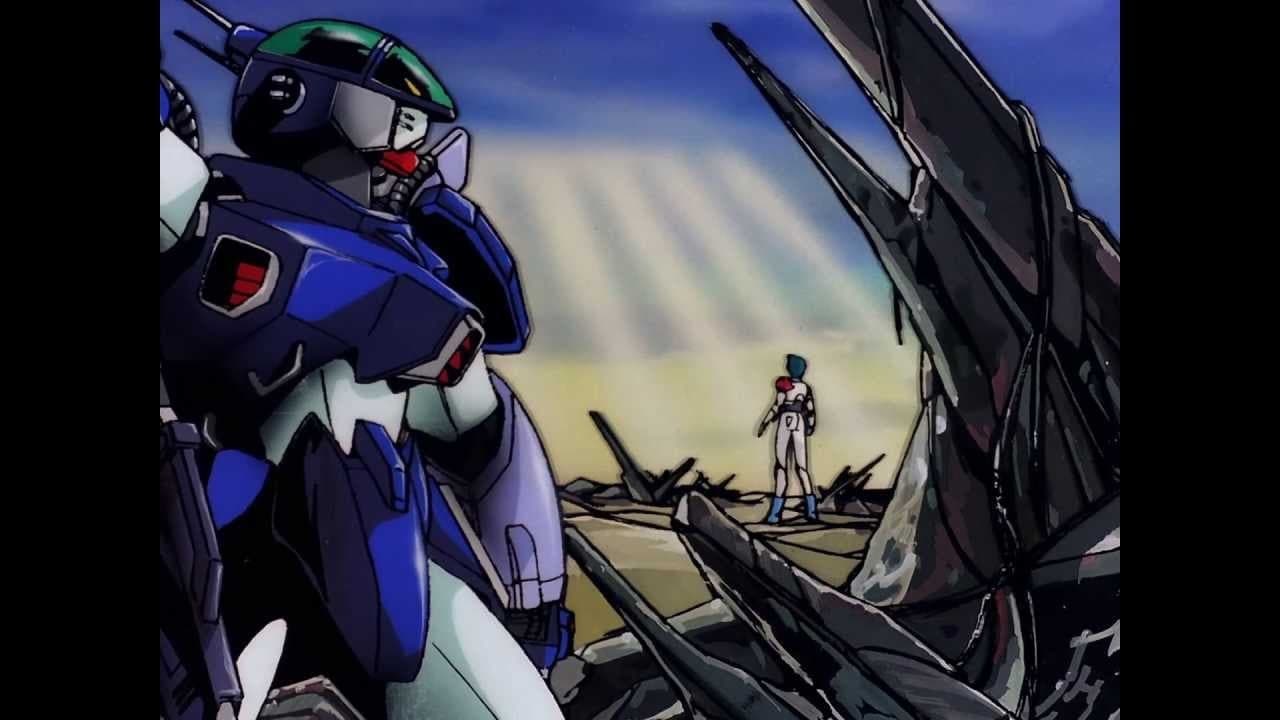


I often joke to myself that Armored Trooper Votoms is Hokuto no Ken if it were a mecha anime, so imagine my surprise when I reach episode 26 of Aoki Ryuusei SPT Layzner and experience one of the greatest pivots of its genre, a shift in focus to the grand ideals of these tall figures that rule over an in effect, post apocalyptic world where the gaze of these great men and surrounding mythology centers around a saintly and maternal figure, 2 of them no less!
Ryousuke Takahashi appears to have an infatuation with faith and prophecies, both Votoms and Layzner pivot in to confronting their protagonists in the back half of their respective series with a crisis of identity and purpose. In Votoms case, it's regarding Chirico himself. Layzner instead frames this idea around Eiji's sister becoming a sort of religious figure, a symbol of maternal love and source of courage for those who remain. In many ways, she represents the mother earth herself especially given the iconography and sentiment expressed in episode 15, that each person has something unique unto themselves that they value above all else. For Gale, it's Julia, for Eiji it's the Earth, a place he feels a strong emotional attachment to despite never visting. Much of the conflict in Layzner is focused on how the Gradosians define themselves by their differences to earthians rather than their similarities. The climax to episode 15 illustrates a mutual understanding between Eiji and Gale in his final moments, a shot of earth in the darkness of space as little more than a speck, yet shining brightly, so small is it, it can fit in the palm of his own hand much like the pendant of his beloved and in that moment he understands, the value of what is being protected.
It's interesting that for much of the first 25 episodes, Anna's character is utilised as an observer, an audience insert to the events at play, almost as if recording history so that it can be passed down to future generations as books, paintings, whatever form it may take, the power of art becomes a strong focus post timeskip, as the central location of New York becomes the basis for an allegory relating to Nazi germany where the confiscation and destruction of art was carried out by a special task force. In Layzner, these acts are performed to reduce mankind's history to ashes and paint it over with the "superior" Gradosian culture, one that is more concerned with sheer technological prowess and the purity of their bloodline (despite them being no different in actual fact).
With humanity all but fully subjugated save for a few rebel bases, there is a lingering sentiment that the only way we can confront such an overwhelming difference in power is through the safeguard of our own culture, even if it were to take generations upon generations to bridge the gap, "the pen is mightier than the sword". It's no coincidence that the event that kicks off the series in episode 1 is our cast being sent to mars as part of a UN initiative called the "cosmic cultural club" with the intent of raising the next generation away from the friction of the cold war.

The other part about the importance of art that fascinates me is how it ties in to the core theme of the series, simply put it is about faith, faith in people, not systems. Layzner routinely criticises the military chain and the politicians who'd exploit this newfound technology in a bid to win the arms race. America, Russia, it's all the same. Both sides are more concerned with getting a leg up on the other despite the impending doom that comes for us all, regardless of affiliation. The best our leaders can come up with is to send our cast of children back in to the action, in hopes that their experience with the invaders and possession of the legendary mech Layzner can thwart an entire race of interstellar travelers. Naturally this doesn't work but it once again highlights the burden we place on younger generations to fix our mistakes.

Faith isn't something logical or grounded in science, yet it is something that fulfills us. When you look at a piece of artwork or a piece of animation, something swells inside of us. We don't necessarily "need" it to survive but life would very quickly lose its meaning and make us mere animals were we not able to believe in something, to feel a touch of sentimentality through connecting with others. "Earth sickness" is a term coined in the back half of the series to refer to Gradosians who fall further under the influence of earth culture and in essence lose their warrior vigor.
Pride could equally be seen as an unecessary human virtue yet it spurs many people throughout the series to take action despite knowing the futility of such retaliation, a virtue that Eiji learns after suggesting unconditional surrender as being preferable to the loss of life. While Eiji's ideals are maintained throughout on a personal level, it is a belief that the rest of humanity, including his closest friends don't share. I believe this distinction in part clarifies the series' intention and lack of an answer to humanity's ceasless history of war. The scene we're left with at the end of the series isn't of putting a bowtie on the conflict but of these characters we've grown to love reminiscing on their encounter with Eiji and believing in him for the person he is, not where he comes from or the blood coursing through his veins.
It's not enough that Rowan betrays Cain in the end and transfers control of the Grados base to earth, it's that Cain's very own ideals of a superior race are proven false. He comes to place value and think highly of Rowan to the point that he opens himself up to such a betrayal, how is it possible for a human to impress and win him over through their ingenuity if they are of such feeble mind? It's why he doesn't kill him and offers words admitting to his own fault, of entrusting his dream to someone else.
I think back to Elizabeth's relationship with her ex, how they were both too immature to maintain their romance, reuniting years later, there's a newfound maturity and understanding between them, of what they lacked and how they failed each other in the moments where they needed each other most. That romance may never reignite but we can still extend an open hand to one another until we can stand on our own again.
"Compared to the age of the universe, humanity are nothing but children."
