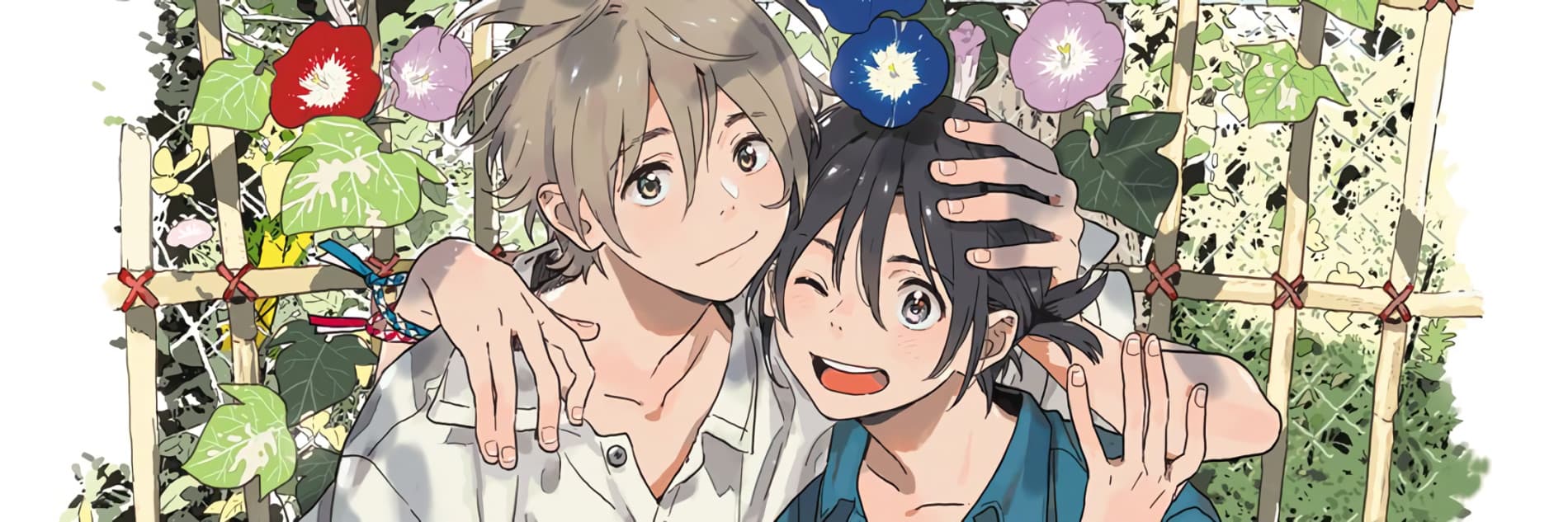
And in what immediately follows, that allure holds. The island’s elegance is portrayed as elegant, yet lived in, perfectly setting the tone for the story ahead. Even settings outside of the primary island, like that of the larger island, are detailed to set a different tone, showing a different variety of vibrance. The watercolor backgrounds only add to this vibrance, with them furthering the immersive experience of the movie. The dialogue does convey many of the surface-level plot details, but the movie expresses many of its more subconscious emotions through color choices and shot composition. The characters themselves express their own feelings through expressive body language, leading to a more dynamic visual journey.
However, this impression that Umibe no Étranger is capable of this type of visual storytelling and glamor leads to greater disappointment as the movie goes on. While its first half is consistently appealing, this appeal becomes more sporadic in the movie’s back half. The color contrast becomes duller, destroying a previously established vibrant color palette. The watercolor backgrounds start becoming blurrier, with many of its more vibrant details becoming muted. The shot composition turns more generic, with much of the visual cinematography becoming far more forgettable. While the visual shorthand for certain emotions stays the same, like with the use of corridors to signify openness vs. loneliness and the use of dark and light as symbols for Mio and Shun respectively, they aren’t delivered through the same level of high production.
This drop in visual fidelity also affects the story. Since the story was so reliant on the visuals expressing much of its subtext, the story doesn’t have the same crutch to rely on. This crutch is needed, because by itself, Umibe no Étranger’s story is nothing too special. From a purely plot standpoint, I’d even call it a bit boring. I personally never found Shun and Mio’s relationship to be the most compelling, although I would understand why many other people would be invested in it. Their chemistry is present enough to not call it totally unbelievable, but not potent enough for any greater personal investment. For non-homophobes, it's a largely inoffensive relationship, putting aside the whole age gap thing (which isn’t worth getting into at all).
Most of the rest of the story is similarly inoffensive, but some questionable hiccups in it are worth discussing. The biggest problem in the first half is how botched the time skip was. Time skips are delicate plot devices, as they let the story radically change characters without taking up too much story space, but they need a high level of commitment on the narrative’s part to make it work. This commitment isn’t really to the level it should be in Umibe no Étranger. With how it is edited, I personally didn’t even realize there was a time skip until Mio showed up as a radically changed person. None of the other characters in the scene, including Shun, showed any obvious changes to their character. While the changes to Shun himself are gradually enumerated throughout the movie, those changes should’ve been clearer from the very start of the time skip.
However, these story problems in the first half of the plot are largely irrelevant due to the visual storytelling picking up much of the slack. The sloppy time skip of the first half can be easily put aside because the very first scene past that time skip is beautiful. Yes, the narrative aspect might be slumping at this moment, but it matters less than it should due to other aspects picking up its weight at this moment. On top of that, the romantic relationship of the two main characters becomes more powerful than it should because of this same high level of visual fidelity. And predictably, the story problems of the movie become less forgivable when the visual quality starts to fall off. And what was once engaging, ends up becoming so unnecessarily tedious.
The sex scene in particular might be the strongest example of how much the second half’s generic visual style works against the movie. It is a scene that was strongly built up to, but I found it to be very boring. A reasonable expectation for a movie that has shown the ability to create strong visual language is that there is a capability to creatively work a scene to extenuate emotions not originally expected from it. But given the visual quality of the second half taken in full, it isn’t surprising that the scene doesn’t come off as anything remotely unique. When I was watching that I ended up focusing more on the piano and violin being used as music. While these instruments suited the intended elegance of the rest of the movie, they were severely out of place in this scene.
Most of the rest of the second half follows suit in this way. It is unremarkable, with less allure and less style. It isn’t exactly worth giving a blow-by-blow of this section of the film, because it all boils down to “I’m disappointed with how boringly this was conveyed”. Even if the sex scene was the most notable example of it, this same mantra still applies for the rest of the back half, even with occasional sparks of brilliance in the flashbacks.
And to say that is deeply unfortunate due to how much the first half of the movie prided itself on how artful it was. However, the final impression of this movie ends up being far more mixed, and at times bitter. It shouldn't have been something that was running so strongly in its opening act and started to slowly collapse due to the fleeting nature of its initial strength. But that’s how it all turned out, very, very disappointingly.
Thank you for reading to the end of the review if you did. If you have any criticisms of how this review was made, you are free to message me to critique what I had to say.
Also, please don’t like or dislike the review without reading it.
20.5 out of 22 users liked this review