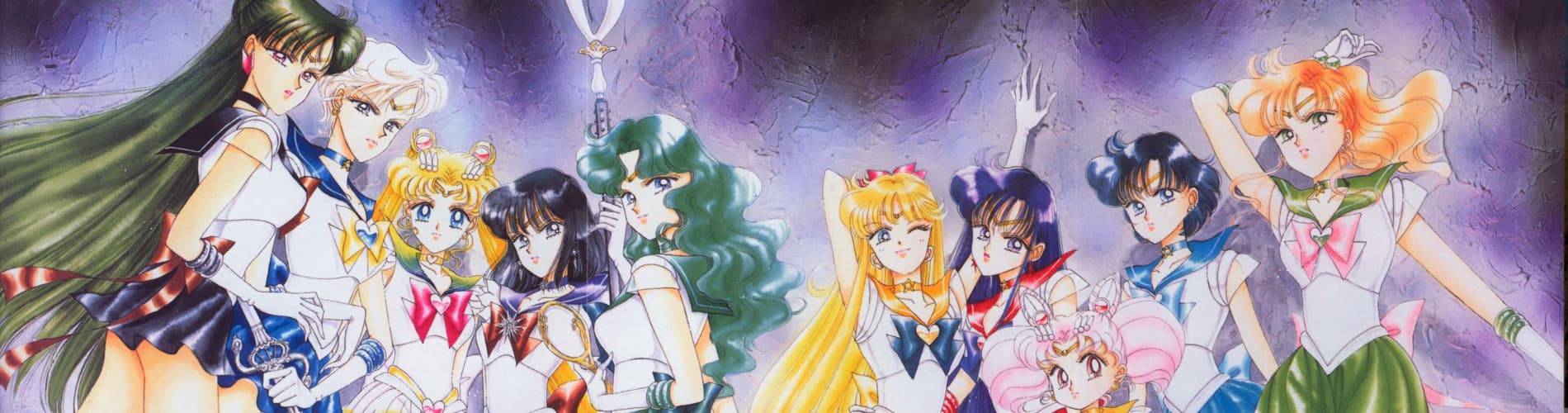
Sailor Moon
a review by baba13
a review by baba13
The Gold Standard of Magical Girl Genre
What can be said about Sailor Moon? It has earned its reputation as a classic. It’s the gold standard of the magical girl subgenre. It’s an interesting series, and I do believe the anime counterpart is actually way more iconic and well-known than its original material. Yeah, apparently the anime is filled with slice of life (due to filler, but I hear its good filler episodes) compared to the manga, which is quite the opposite. Anyhow, I should explain my history with this series. I was sadly one of those folks during my teenage years who looked down on “girly” shows (manga, etc.). However, after some time, I realised that's a stupid assessment to make, and I've grown up since my teenage self. The more I learned about this series, the more interested I became, especially hearing that the author is Togashi's wife. People I respect really appreciate this series, and knowing its cultural significance and legacy, I wanted to do the due diligence to experience it myself. I learned about the Eternal Edition of the series in 2020, and yeah, I just didn't touch it for 4 years. I recently acquired a tablet, and this seemed like the perfect manga to read on a beautiful OLED display, and I was correct.
One element of the author's life I didn’t expect was Naoko Takeuchi receiving a degree in chemistry and becoming a licenced pharmacist. Furthermore, joining astronomy and manga clubs during high school, in this context, really makes the premise and the ability of Sailor Moon make a lot more sense. Being a love letter, to the manga she adored and her studies. Anyway, I should actually talk about the manga proper.
Talking about the plot for Sailor Moon isn’t important at the least.
_“Usagi Tsukino is a normal girl until she meets up with Luna, a talking cat, who tells her that she is Sailor Moon. As Sailor Moon, Usagi must fight evils and enforce justice, in the name of the Moon and the mysterious Moon Princess. She meets other girls destined to be Sailor Senshi (Sailor Scouts), and together, they fight the forces of evil!”
(Source: Kodansha USA)_
It’s a very standard premise that was unique for its time. Like any story, it all really depends on execution, and it delivers. Firstly, the artwork is stunning, it’s very elegant from the beginning and just gets better and better. Especially as it progresses, it becomes more cosmic (particularly the last couple chapters). The amount of screen tones, the soft lines, the amount of visual information on screen without hindering the reading experience, and the beautiful character designs. All of it just works.
It's interesting how the series balances its feminine & masculine traits. Even those that can be regarded as gender stereotypes, the author embraces them in a positive manner and creates a diligent balance. The series is somewhat the epitome of emotions over logic, or love conquers all, it really isn’t a technical series in the slightest (the polar opposite of HxH). Sailor Moon would use her strong emotions as a form of persuasion and force her enemies to reflect on their wrongdoings, expressing her values and wanting to reshape according to their values. This may seem like a cliché or boring sentiment, which you are partly right, but I do think the love or emotion aspect works in its favour. I don’t think it felt contrived or just roll my eyes compared to something like Fairy Tail, it felt pretty consistent and worked with the type of world Takeuchi created. Overall, it creates a powerful image, a rather progressive outlook on female identity. Young women don’t have to settle within society's expectations of women but can aspire to be courageous, intelligent, and powerful. Though speaking as a guy, I don’t think its obvious target market detracted from my experience.
One aspect I found really interesting was the LGBTQ relationships and certain characters not having a fixed gender. This is definitely not unique in Sailor Moon’s case, as this is shown quite often in Josei and Shojo manga, but it probably introduced people to this subject matter. It’s interesting seeing how this element more prominent in Josei and Shojo manga slovely woven into shounen or seinen manga. The most obvious example would be Togashi’s Hunter x Hunter..
The main aspect of the series that makes it work is Usagi. She is the foundation of what makes this series work. It’s a coming of age for her, and seeing how she grows with her friends is wonderful to witness. If there were some complaints, I would wish it were a bit more psychological. The series has its moments, but when it’s very good, it often deals with a character’s psyche. It’s particularly what makes the last arc the best, in my view. Another complaint would be the antagonist; besides maybe the last one, they don’t really have much depth. It is only the last antagonist who's a bit more morally grey, and the scenarios Usagi has to deal with. It also has a bit too many characters for its length. This aspect the author seems to recognise. So, in these Eternal Editions, you have short stories within the main narrative, and when the arc demands it, she does attempt to focus on the other characters, which is often successful. The main cast is rather charming, and I especially appreciated that one slice of life chapter with Haruka, Michiru, Setsuna, and Hotaru. It's just not enough focus at times, however, this complaint is relatively minor considering the focus will be Usasgi and it's her coming-of-age story.
The writing is pretty good, there are a ton of puns, allusions and symbolism that I would have missed if it weren’t for this exceptional translation and its valuable notes. I didn’t expect it to take so long to read Sailor Moon, but each arc had a natural stopping point, a lot of translation notes to read, and I took it all in.
Overall, Sailor Moon empowers young girls to be more courageous and show they can do better. It tackles the themes of love and family earnestly, explores the uncomfortable realities of the world to a degree, and asks us if it is all worth it. Sailor Moon inspired a generation and continues to inspire people to this day, it’s a classic for good reason. It inspired Cardcaptor Sakura, Revolutionary Girl Utena, and Puella Magi Madoka Magica. Overall, it’s great, it has a wonderful final arc and caps it off with a bang.
Note: Reading Order is the Eternal Edition of Sailor Moon, as it contains everything. However, it’s my recommendation to read Codename: Sailor V (Eternal Edition Vols. 11–12) any time after Eternal Edition Volume 4. I think it’s best to finish the series with the ending and the accompanying short stories rather than going back to the prequel, which can feel repetitive at times.
14.5 out of 16 users liked this review
