Silver Spoon
a review by onionbubs
a review by onionbubs
I remember when I watched the Silver Spoon anime for the first time. It happened to be the summer of 2020. Like a lot of people in those months, I was spending most of my time at home. Online college classes gave me something to do, but it definitely wasn’t the funnest time. But when I watched this anime, it reminded me of a lot of the simple pleasures of life. Like seeing a brilliant starry sky. Or eating delicious food. Or the excitement of rooting for your school’s baseball team. Watching Silver Spoon at that time made me feel more alive than I had in a while. It was a light in the darkness. The show was funny, it showed me new perspectives (I grew up in the suburbs, so the daily labors of farming are foreign to me) and it had characters I really wanted to root for.
Before long, I started reading the manga. And I gotta say, the manga is funnier. Don’t get me wrong, the anime is good. But there are just a few certain panels that are toned down in the anime, for whatever reason—and I just can’t let it go (mostly in chapter 33 to be honest but there are others). Still, it's good! Anyway, the manga finished in 2019, and realistically, the anime is not gonna get another season, so might as well jump into the manga, right?
Silver Spoon follows the high school journey of a young man named Yuugo Hachiken, who wanted to get far away from his parents and Sapporo after being unable to measure up to the competition (presumably, he didn’t pass the entrance exams for the high schools he hoped to attend). So, he ends up at an agricultural high school with dorms, in the middle of nowhere. As a city boy, he knows nothing about farming.
Now, mangaka Hiromu Arakawa, best known for Fullmetal Alchemist, draws from firsthand experience when writing about this rural life, as she grew up on a dairy farm in Hokkaido. So she’s uniquely qualified to write in this setting—and that’s on top of her being just a fantastic writer in general.
She is wonderfully thoughtful about characters—most of the characters in this series, I may not be able to tell you their names right offhand, but I can absolutely tell you their personalities and what they’re into.
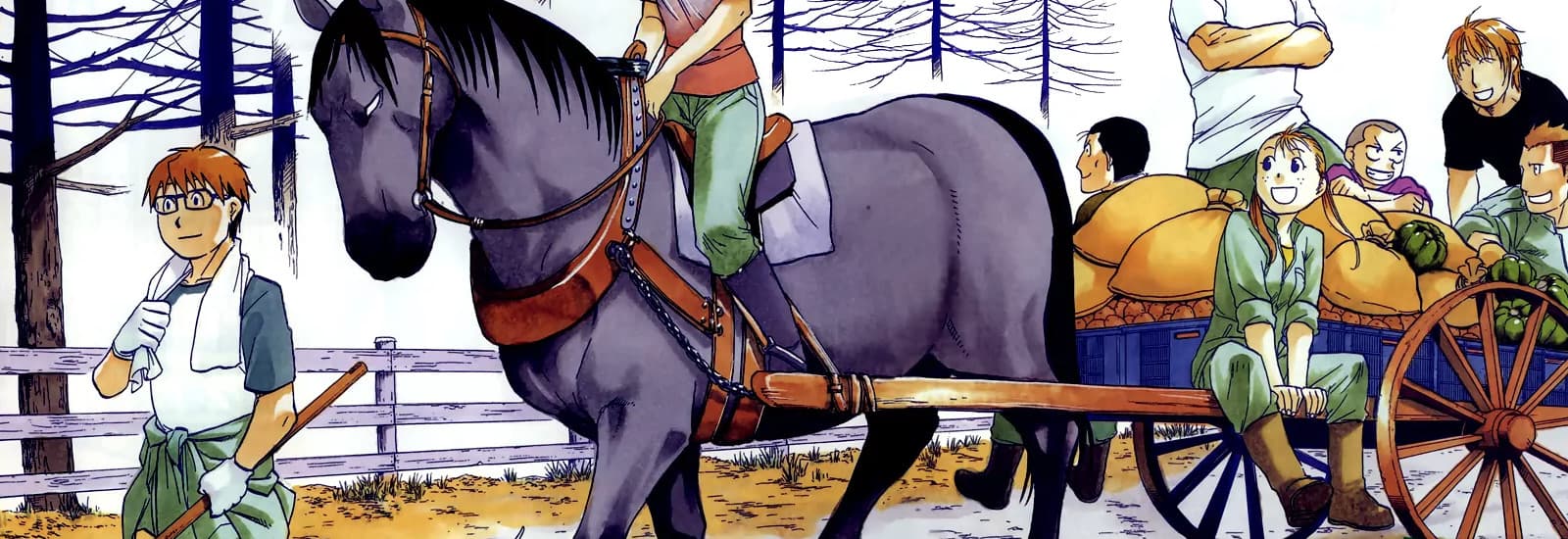
Our main character Hachiken is kind of an uptight guy, and a lot of the realities of life at his new school are quite shocking to him. Practically all of the other students have agricultural backgrounds already, so he’s a real fish out of water—but even though he has a lot to learn, his unique perspective influences the other students, too. Unlike the other students, Hachiken has no idea what he wants to do with his life. But he’s certainly a hard worker—in fact, he soon ends up with a lot on his plate because he never says “no.” A girl invites him to join the equestrian club—and well, clubs are mandatory, and he definitely is thinking this girl is cute, so, he joins.
Learning to ride a horse is just one of the many little adventures he’ll get into in this series. But the series isn’t merely a collection of “This month we're going to learn about this farm topic”—though don’t get me wrong, many chapters are very educational. You can learn how cheese is made, for instance. There are even discussions on the ethical issues in agriculture. But the focus of the story is first and foremost on Hachiken’s growth. And that means sometimes the challenges he encounters are gonna be more relationship-oriented. I mean, the dude’s main goal in the beginning was to get far away from his parents—that’s definitely something we might want to unpack, right? And rest assured, we will.
Personally, the highly human-focused stories that sometimes explore that classic question “why is this person like that?” are where I got the most invested. But the great thing is, the hands-on farm stuff and the personal stuff are, in most cases, connected in some way. This is a series people might call “slice of life,” yet it has a great sense of forward momentum, and that’s because of the way events like preparing bacon or competing in an equestrian competition can link back to characters’ growth.
There are a couple scenes that are just filled with raw emotion, conveyed with only a few words, with the artwork—which is not gorgeous, but is effective at conveying what it needs to—doing most of the heavy lifting (I will always remember chapter 56. The anime did great with it too).
And man, there’s a lot of comedy in this series, and it’s super goofy and absurd, and I absolutely love it.
It’s probably not surprising to learn that a series about a dude’s three years of high school will have some romance elements too. This is done so incredibly naturally and with such sweetness—if you enjoyed the small pieces of romance present in Fullmetal Alchemist, trust me, you will love it in Silver Spoon too, where it’s a little more prominent.
The series goes through Hachiken’s first year of high school at length, but the next two years happen at a much quicker pace—which felt a bit jarring at first, but overall I think it was a logical decision. It's better to get to a few key moments in those last two years rather than try to go at the same pace as when Hachiken was still learning everything about farm life.
By the end of the story, it’s not like Hachiken ever had a grand revelation and suddenly knew what he wanted to do for the rest of his life. It’s more like he’s found a path one step at a time, because he stayed open to possibilities he wouldn’t have imagined.
Silver Spoon is an uplifting tale that can remind you of the joy in life’s simple moments and give you the courage to face its challenges—or not, because sometimes you need to run away to survive, as a wise principal taught Hachiken. Hiromu Arakawa may be famous for excellent fantasy manga, but her first attempt at a realistic one is a masterpiece I will always treasure.
33 out of 33 users liked this review
