
▶ Video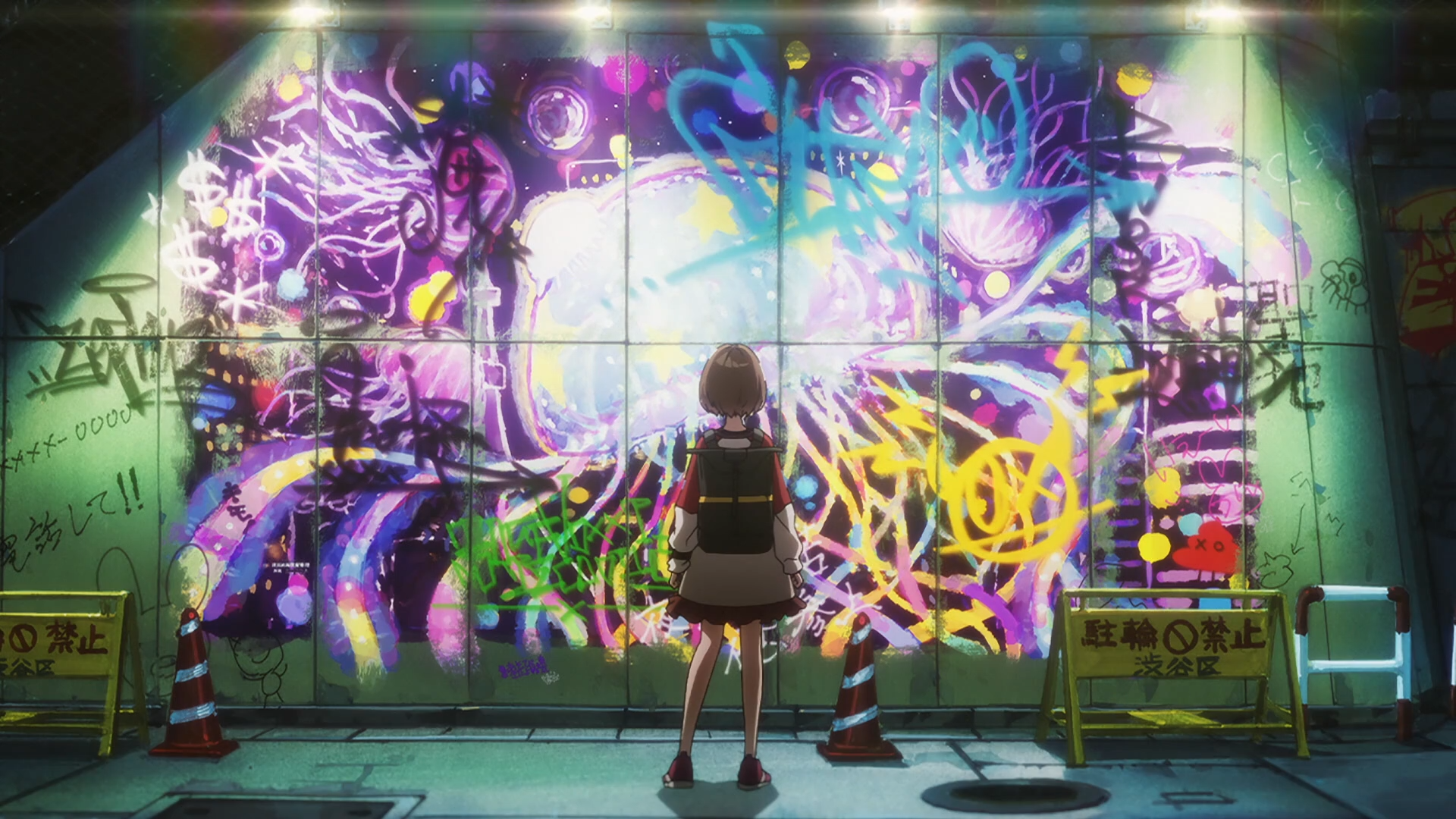
(Credit to Asuka Suzuki, Takahashi Mizuki, Saurabh Singh, Shinnosuke Ota, Shuu Sugita, Anzu Yasue, Ayano Satou, and Kazuma Nakao for a great showcase of colours, camera angles, and vibrance for an excellent Shibuya-esque aesthetic. I would have wanted to see more opportunities for this to shine through.)
Music anime with girl bands or groups being the focus have never been more prominent in the anime sphere, with recent hits like Bocchi the Rock, and old hits like K-On. In this season alone, we saw the revitalization of another old music hit in Sound! Euphonium Season 3, and new kids on the block in Girls Band Cry, and Jellyfish Can’t Swim in the Night. There’s so much that writers can do with this type of show, from stories of inspiration, stories of young people trying to find their passion, or in other cases, more comedy-oriented shows that serve to brighten up one’s day. In the end, the formula remains similar, to showcase the growth of the characters and their differing personalties, through their involvement in a music group.
(Although formulaic, this genre and formula of girl bands is a canvas filled with so much possibility, just like Mahiru’s mural, which was pure imagination splattered on such a blank canvas, which is also what media creation is all about.)
Jellyfish Can’t Swim in the Night is a bit of an odd case to me, because while it has its share of light-hearted moments, and the comedy is snappy and quite honestly, amazing at times, it also goes down the slippery slope of leaning into heavy melodrama. With the limited runtime that this had, with just twelve episodes, it was a bit of a questionable decision to me. In the first number of episodes, it was all about how people motivate each other, rather it was through art, music, or any other expressive outlet, and it was indeed very interesting. As the characters got introduced, they were characterized through various backstories that showed how tough their pasts were, or how they got to know other characters in the show. I’m not always a big fan of that story structure, as while it might provide great emotional highs, I’d much rather see the characters get characterized with how they act in the present, which this show does eventually do as well.
I call this an odd case, because each individual bit of character drama was honestly handled quite well, with very realistic and relatable struggles, for example, wanting to enjoy and behave in a way that people think is “childish”, or having one’s path to stardom broken because of a response to injustice. It led to some brilliant character chemistry between the members of JELEE for sure, but I also don’t think the drama contributed to the big picture of the story well enough, and also got in the way of what I expected the show to be more like, which was seeing the creative process of JELEE’s music.
To do all this in twelve episodes is no easy feat, and I just do not think there was enough time here to flesh everything out. The messages were really good, the pieces were there, but with twelve episodes, it was virtually impossible to fit in the progression of JELEE and the character drama, leading to various aspects feeling contrived and rushed, lacking the organic growth that we could have seen if this series had more of a runtime. JELEE gains a following in almost no time at all due to a timeskip, Mahiru’s art is suddenly highly respected from being mocked just a few episodes prior. Suddenly, a performance at a venue happens with not much build up. A career is put to a halt because of one single internet warrior. The antagonistic character suddenly goes along with what the protagonist proposes. You get my drift. Could this all have been fit into twelve episodes if the script was just a bit tighter? It’s hard to say how this anime should have went, because on the one hand, if you don’t have the comedy and light-hearted moments, the audience would not have as much of an attachment to the characters and their respective personalities, though on the other hand, if you don’t have the drama, the plot does not move forward. The best anime series are able to balance both the aspects of character building and pacing effectively. I do believe that the script could have been a bit tighter with the removal of a few characters, such as Baba and Koharu, so that the eventual drama could be less contrived. Again, I want to emphasize that the individual stories were good, but they just did not mesh well enough with each other. Some emphasis of side characters took away from Kano and Mahiru’s issues, and led to the overall storyline being resolved rather haphazardly.
Visually, this anime is stunning. Props to Ryouhei Takeshita for directing this as well as he did. It had a very snappy feeling in the editing made it a great vessel for comedic timing, which I still believe is the strongest part about this anime. I might not have agreed with some of the drama, but the way some of the dramatic scenes were directed was superb, along with the sound direction, to illicit as much emotion as they could out of the viewers. Furthermore, the voice acting performances here were excellent. Shout out to Rie Takahashi, Miyu Tomita, Miku Itou, and Miyuri Shimabukuro for their incredible work as Kano, Kiui, Mahiru, and Mei, respectively. There were also several music videos from JELEE that served as special ending themes, and you could see the improvement in the visuals with each passing music video. That type of subtle growth was what I wanted this anime to be like, but obviously, it went in a different direction.
▶ Video ▶ Video #####With how solid the first few episodes were, I think it really showed that sometimes, things do not need to be deep and hugely thought-provoking to be good. The message was there, the characters were perfectly fine, the growth was JELEE was being seen, the comedy was snappy and funny, but the decision to go into heavy melodrama was one step I feel this anime did not need to take. The sheer energy of the show, the vibrance of the characters, all of that was sucked out with the melodrama, because even though the comedy still remained throughout, there was always that bit of drama that loomed large over it all, leaving it less fun than it could have been. It lacked a proper identity, and tried to do too much in a short amount of runtime.
In the end, it was like a slightly overcooked steak. It tastes good, but it is chewy, and leaves you slightly underwhelmed. Occasionally, some anime just have that sort of a fate. Oh, what this could have been…