WIND BREAKER
a review by OrielBel
a review by OrielBel
The best way to look at Wind Breaker is as a sort of postmodern delinquent anime. I know that sounds high minded for an otherwise simple show, but Wind Breaker's main goal is to directly interrogate the genre's relationship between strength, violence and self determination. In a romantic sense, the Japanese delinquent isn't a lowly crook but instead are rebels against a society that seeks to hold them down. The fantasy comes from the idea that once you're strong you'll be free to do whatever you want.
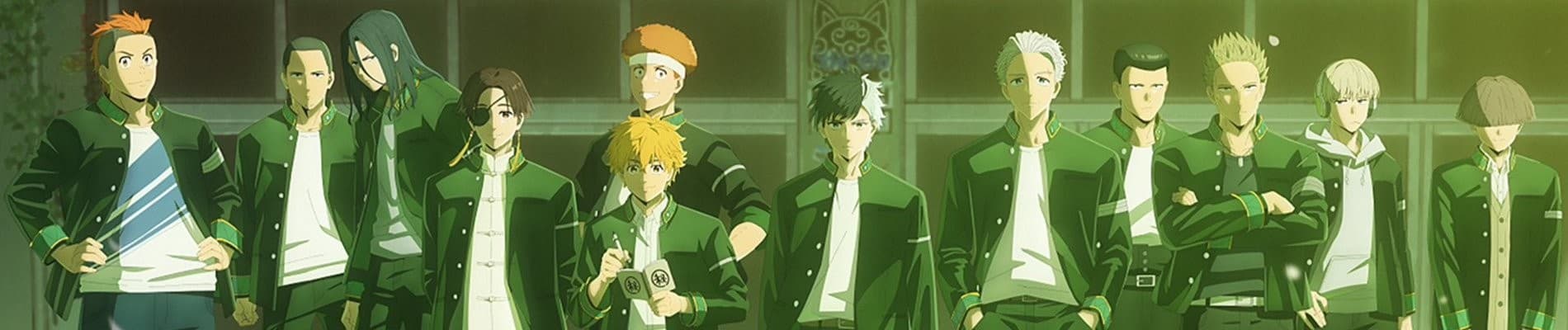
But what does it mean to be the strongest? To be free? Protagonist Sakura thinks he's on the fast track to becoming the cool mysterious badass at the top of the wild school (think Yusuke Urameshi from Yu Yu Hakusho or Oga from Beelzebub) only to discover it's been reformed into some sort of paramilitary style community outreach program and everyone from his classmates to the townspeople are weirdly nice. Seeing Sakura go from Mr Billy Badass to a quivering tsundere now that he actually has to make friends and actually reach out to people is one of the series more entertaining and charming aspects.
The bulk of the show is the impromptu tournament arc between Furin and rival gang Shishitoren and it's where the show highlights its strengths and weaknesses. For one thing, it's got some serious animation chops for its hand to hand fighting scenes. Fluid, well choreographed and weighty you really feel every punch kick slam and throw. It's admittedly a bit too liberal with geography (the use of spinning 3D backgrounds is thrilling and impressive but sometimes ends up making you lose track of where exactly the characters are in relation to each other) but the animation and choreography make up for it. Some moments feel like the punch exchanges from DBZ except every individual hit is animated instead of on a loop.
Characters have their own unique fighting style, from Sakura's emphasis on weighty kicks, Touma and Sugishita's no nonsense beatdowns, Taiga's German suplexes and Suo and Kiryu's free flowing martial arts styles. Cloverworks and in particular animator Kazuyuki Asaka did a fantastic job adapting and expanding the series myriad fight scenes, and the show in general displays solid effective directing.
But just as important to Wind Breaker as the fighting is the drama, and it's where the show is somewhat shakier. The majority of the fights in the Shishitoren arc soon reveal themselves to actually have an added level of personal drama beyond just simple fisticuffs. Fights climax in big emotional displays where characters show their capacity for empathy and shout earnest stuff at each other like "What are you really fighting for!" or "This isn't the you I know!" On the one hand I appreciate the attempt at added complexity and use of striking symbolic imagery even if it isn't subtle (they're literally having a tournament where every character is pretending to be someone they're not in a movie theater on a stage) and I like how the characters operate as foils for Sakura. But it does end up feeling melodramatic at times as the show can overdo it with all the heavy music and big flashbacks. Having the tournament arc so early on is understandable; you want a big fight arc early, you want to show off all the fighting styles and you want a big event that establishes what the status quo is like afterwards. It just needed some more breathing room to establish all these relationships it clearly wants you to feel are important.
The episodes after the big tournament arc, despite being slower and less action packed, refocuses squarely on Sakura and his burgeoning arc into becoming a leader and it feels less heavy handed going from there. Sakura's feelings are actually pretty complex and say alot about both his character and the expanding cast around him.
Like Sakura himself, Wind Breaker's got a big heart but it needs a bit more maturing to do before it reaches its full potential. Thankfully, it has all the tools to get there.
33 out of 39 users liked this review
