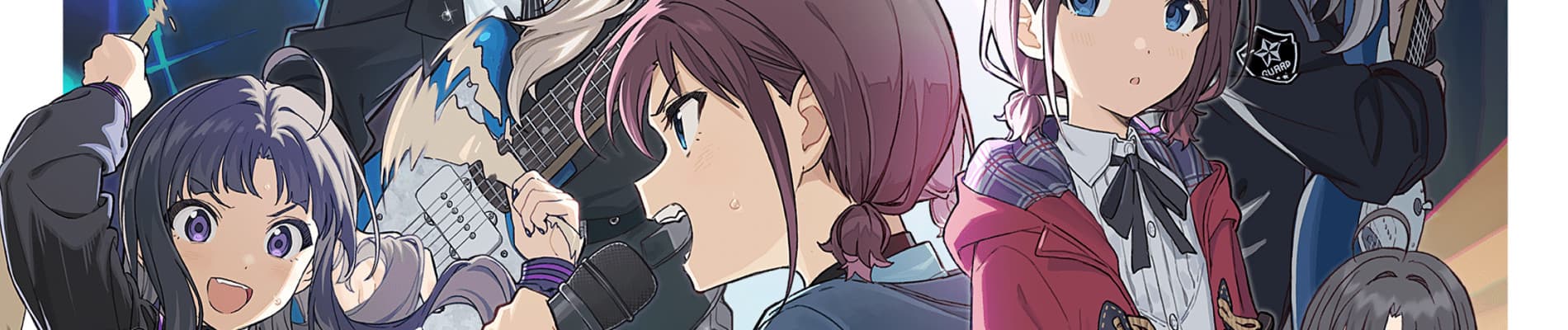
Girls Band Cry
a review by roselayed
a review by roselayed
It gladdens me to see people on this website fighting the good fight by arguing for this show’s presentation. I personally find the ‘3D computer-generated imagery (CGI) versus more traditional methods’ debate far too banal of a discussion for my tastes so hence why I will spend no more time on it than this in this review. There are many benefits to using CGI for band anime, and this show utilizes the tools they are given brilliantly. From dynamic performance sequences, vibrant character movement and facial expressions as well as accurate instrument-playing, it oozes charm. I say take it or leave it.
As I stand on this shore, having crossed the river of time in which this anime named Girls Band Cry (GBC) aired, I’m reminded of a song. It’s a bit of a somber song that I came across a small number of years ago. The circumstances are inconsequential, but what is important is that in those days it may have become something like an anthem to me. Looking back at its lyrics and my interpretations of what the song means derived from my ego, I can’t help but feel it fits this current age we live in. The song’s name is Hated by Life Itself, or, in romaji, Inochi ni Kirawareteiru by Kanzaki Iori, sung by Hatsune Miku. It sings of hopelessness, lament, apathy, suicidal ideation, cynicism, and a final something else. I mention it here because it feels like a song that I can hear Togenashi Togeari sing, with a number of lines capturing the essence of the Girls Band Cry anime and its values. Perhaps that song itself was just a prelude for this today. Something I can only notice now, as they do say retrospect is 20/20. I am not the first to interpret life as cyclical in nature, but I am glad I return to the song now that the current zeitgeist fits it much better than the one of some years ago. That song is now part of my life again with an entirely new context; an entirely new way of enjoying it. Perhaps, in a few years, I will return to GBC as well, reinterpreting it and elevating my sentiments, like how a fine wine ages in a cellar. I think I would like that very much, but in order to reinterpret, you must first interpret. Good essays have clear thesis statements it will try to support with its full-body. Unfortunately, I do not think I have something so clear-cut. If I was forced to put it into a sentence, I would say that I wish to share. I wish to share why I enjoyed this anime, so that someone else on the other side of the screen can enjoy or hate this show in an entirely new way. It is my celebration for this anime and my reason is singular and selfish: I do it because it feels like the correct thing to do.
Many people would agree with me if I said GBC features a stellar cast of characters. To me, they are stellar because they are so intrinsically flawed: we have a coward idealist, an apathetic twenty something year old, a whimsical liar, a jaded idealist, and a bassist. This stands out because in plenty of girls band/idol-adjacent series of a similar nature to GBC, characters often have a dominant character trait that defines who they are. In series where the character count reaches over twenty, this is done so characters are clearly distinct from each other and makes it easy for consumers to recognize the traits they enjoy in a character and allows them to pick favorites. A result of this type of character design however is that it might make characters seemingly one-toned or flat. This is not a phenomenon exclusive to idol-adjacent series and it can be found in any show, as character archetypes such as -dere types exist for a reason.
In light of this, GBC offers us humans. Plain, flawed human characters who are round, make mistakes, have hang ups, who don’t always do the right thing, and have things they believe in. We watch the members of Togenashi Togeari grow and develop, but GBC does not pretend deep rooted traumas can be fixed with simple pep talks and a resonating conversation on a random Tuesday afternoon. Nina still has her all-or-nothing no compromises attitude, Subaru has a rotten personality, Tomo is still extremely rough around the edges, and Rupa plays the bass. Momoka Is the character that goes through a lot in this show, as much of its runtime is dedicated to her past with the rival group and her hangups with going pro once more. She starts as someone who loves music but is ready to give it up. She blames herself, believes herself to be wrong, and is absolutely terrified of properly facing music again. At the end of the show, it’s mostly the same. She can still lose herself in music and she’s still unsure as she retreads the path to becoming a pro together with Togetoge. Even after she receives the affirmations of her past self in the form of Nina that she isn’t wrong at the climax of episode eight, she remains uncertain. This, to me, showcases the essence of being human. Momoka does not do a perfect 180 and jumps at the opportunity to become a professional again. She’s hesitant, but she believes in the ones who support her. We humans are far from perfect creatures. We can delude ourselves into believing the worst of things, shaping us into the people who we are today. We can change from this; we can heal. However, healing is gradual, and the scars will most likely remain with us for life. It’s a struggle and we might not ever do it perfectly, but that’s fine because we’re human. We all have thorns.
It should be noted that on top of fantastic character writing, it’s how the characters interact with each other that brings out the best of them. Given the haphazard collection of personalities Togetoge has assembled, interactions with the whole group are lively and they play well off of each other: bantering, having fun, making jokes at others’ expense. One needs only look at the shenanigans during their stay at Subaru’s place in episode nine among other highlights to know what I am talking about. It is obvious they enjoy being with each other. However, the individual bonds are the true spectacle. GBC deeply cares about the bonds that exist between the members of Togetoge. I won’t pretend and say all bonds have been presented in equal measure, but the dynamics are undeniable. The Shin-Kawasaki Trio have an unshakable bond born from throwing drinks at each other, with all three members still taking the time to talk to each other individually even when the group grew to five. Moreover, as a group of five they genuinely do seem like a ‘group of five.’ Subaru is the first-person Nina talks to for help. Momoka is Nina’s savior and also drew the vocalist to music. Momoka and Subaru are the ones best at handling Nina. Tomo is just a late-stage Nina who has grown jaded with her own music ideals. Rupa is the voice of reason and mood maker for the group, offering key words of wisdom coming from her life experiences. Nina, Subaru, and Tomo are the hot-headed young ones in the group, constantly verbally going at each other. Momoka and Rupa are the adults keeping them in line. Finally, of course, Tomo and Rupa are never beating the allegations. Not all individual character relations are as fleshed out as others, but GBC convinces me that Togetoge are genuinely a group of five friends.
“We don’t want to be wrong.” “Nobody wants someone to be better than them.” It is hard to watch GBC and not learn of Nina’s motivations as a character. She is an idealist. She has a clear sense of justice and of what she finds right or wrong and despises being wrong. She finds fault in this complacent society where all we do is tolerate and cope as common sense clips our wings. She is, however, also a coward. She can barely face her own ideals, flip-flops and just malds over them before she finally found her release in music. All five members of Togetoge can probably subscribe to Nina’s attitude. No, I think every person in this twisted world could. It’s a very simple message, but widely applicable. Some of us may be apathetic twenty something year olds with little passions in life, but within those rare passions I bet there’s definitely something we would fight for with our entire being on the line.
I have a worthless little anecdote I would like to share. A trivial experience in the grand scheme of things, but one that stuck and let me resonate with Nina and Togetoge. There is this game I play with friends, although I wouldn’t say we are as cohesive as Togetoge. In any case, there was something I was fully convinced I was right about, that being what conditions to fulfill to trigger some specific events in-game. I, however, was denied. I was told I wasn’t right. This annoyed me. After all, I knew I was right. So, I proved it. I recorded a video and everything, to prove that I was undoubtedly right. Nobody acknowledged it. Worthless, isn’t it? But it let me resonate with GBC, so it might have some value on top of the fact that I wasn’t wrong after all. We don’t want to be wrong, because otherwise we would be encroached upon, compromising our knowledge, experiences, and skills; our ‘selves.’ I could have accepted it, let myself be gaslit into believing I was less than I actually am. To lose sight of who you are, becoming a mindless drone, and losing all that makes us ‘us’, is a fate I would not wish upon my worst enemy. It’s already hard to become somebody as it is.
What is ‘rock’? In recent years this word has come up a lot recently in my life given how I hold Bocchi the Rock in such high regard too. To go back to the definition of the musical genre and what it stands for, it could be simple non-conformism among other things I am not quite qualified to talk about. Non-conformist is definitely a phrase I would like to use in a review of GBC, especially given Nina’s ideals, Momoka’s past, Subaru’s duality, Tomo’s ideals, and Rupa’s position in the nation of Japan. GBC is a show that has non-conformist values. It tells us to go against the grain and fight for what we think is right; our ideals. It tells us to gather everything we hate and love about this world, this society, this age, each other and to throw it out there. It tells us to reject the values born from this complacent society of tolerance and to not be limited by ‘common sense’ and what is ‘correct.’ It tells us to shoot far and not be scared, to take the leap no matter where we end up. However, in the midst of this GBC still embraces pure notions. It is not contrarian for the sake of being ‘rock.’ Conventional sentiments such as ‘value your family’ and ‘it is okay to be scared’ get brought up and are done right by GBC. The show is not mindless self-righteousness. Yes, absolutely, fight with no compromise or escape route when you or someone dear to you gets wronged by someone or this society. Don’t let the false winners with wrong answers write history. However, ‘compromises’ are not in and of itself rejected, if they’re made out of a pure consideration of another’s happiness and feelings as in the case of episode four. In this episode, Nina herself prevents Subaru from quitting acting because she learned how much Subaru’s grandmother valued her granddaughter’s decision to act. Nina is being a hypocrite here given how she wants things to be right, so Subaru’s lie had to be straightened out, but GBC shows that what’s right isn’t always so simple when purer emotions are involved, and I find that a mature and realistic showing.
As time moves ever forward and we move on from these wonderful thirteen weeks this brilliant show accompanied us, I wonder how this show will be remembered. I once may have jokingly said that if this show flew under the radar, anime would be truly over. Of course, that’s not the fault of the show or the people. I’ll blame the distributors. By writing this review, I hope to have made even the slightest of difference. Was I able to reach you in the end?
At the time I am writing this, the future ahead seems grim. The planet is being flipped upside down. Us individuals will struggle coming to terms with it, and finding a place in this unstable world is harder than ever. There seems to be more hate than ever in this world like it’s some kind of fashion, and by extension the internet grows darker by the second. It is lamentable. Once again, I am reminded of Inochi ni Kirawareteiru. It sings of hopelessness, lament, apathy, suicidal ideation, cynicism, and hope. This society might beat us down with its ‘correct common sense’, time will ceaselessly wither away all things with no rhyme nor reason, and things will happen that makes us wish we died. We’ll struggle, we’ll curse this emptiness, but someone somewhere just like us might sing, throwing it all in there, bringing about catharsis. In the end I think that’s the final sentiment I wish to share. We can’t live perfectly. There will be pain. There will be things to cry over. But as long as we do our best staying true to ourselves and fight for what’s right, we might just be able to keep on living (to keep on singing). At the very least, it’ll certainly be our own ‘rock.’
58.5 out of 62 users liked this review
