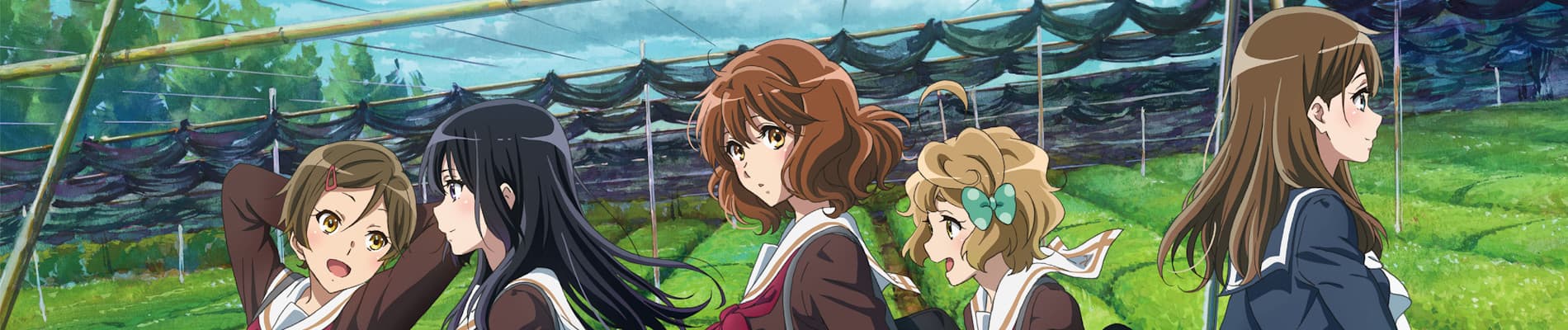

It was a foregone conclusion that there would be a Season 3 of Hibike! Euphonium. If not now, then sometime later, and fans who saw Seasons 1 and 2 almost 10 years ago were right not to give up hope. I’m not one of those. I had barely any knowledge about anime - let alone that something like Hibike! Euphonium even existed - back then, and it didn’t occur to me until much later that this medium was full of surprises. More than I could imagine.
Knowing the situation of earlier seasons, going into the third one was always going to be an uphill climb. Much like the conversation between Taki-sensei and his wife, achieving results with high school bands is like piling rocks on River Styx. Only, they’re people - in our case, characters. This revolving door of members coming and going was always going to be something we’d have to deal with sooner or rather.

#An Uphill Climb
Kumiko’s first year is covered in Seasons 1 and 2, while her 2nd gets no more than 100 minutes, so about 4 episodes. Characters from those two seasons have had time to develop and leave their mark, but their departure was always a given. Asuka, Haruka, Kaori, Natsuki, Yuuko, Mizore, and Nozomi are notable, established characters that would now be reduced to a passing mention at worst, or a brief cameo at best.
Characters leaving like this would cause a gulf in their wake sooner or later. But this was also an opportunity to come up with something new. If you can’t break new ground, then rebuild the pavement. And Hibike! comes up with a colorful cast of first-years, with Suzume, Yayoi, and Sari being the standouts, while now-second and third years such as Kanade, Ririka, and Motomu have started coming into their own. While admittedly not the same, they still gave us something to look forward to every new episode.
Aside from the usual band duties, Kumiko is now Club President, along with Shuichi as the VP and Reina as Drum Major. This was a tough legacy, not only because those that came before had an arguably better lineup to work with, but they carried themselves with such conviction. If the going got tough for Haruka, there was always Asuka to pick up the slack, and the same was likely true for Yuuko and Natsuki, what little we saw of them anyway. Aside from the human factor, the number of members has drastically increased, leaving Kumiko with lots on the table.
While earlier seasons would put an emphasis on the performative aspect of music, deftly marrying it with potent character drama and powerful introspective moments, the final season takes a decidedly sharper turn in favoring the human aspect, and consequently, Kumiko’s transition into adulthood.

The Third and Last
National Gold is the goal once more. This is Kumiko's last year and third shot at the Nationals. She doesn’t get a fourth one. The three-audition format marks a departure from the one-and-done approach of past years, and as it turns out, it’s hardly a morale booster as members have to constantly up their game and put their best foot forward.
Understandably, this causes a ruckus at Kitauji, and to quell all doubt, Kumiko has to reassure, reinforce, and consult with any affected band members. This format causes its own set of problems, and if the goal of the journey is to get Gold at Nationals, band morale is the pavement they have to walk on to get there, with Kumiko shepherding everyone to victory.
This is no easy feat. Add the new third-year transfer student into the picture, and the composition becomes all the more difficult to balance out. If promotional material is anything to go by, Mayu Kuroe is not to be trifled with. As it turns out, she is every bit as talented as it is suggested, but does bear her fair share of burdens.

Mayu is a vexing character. She is everything Kumiko was and isn’t. There is no sense of self within her as she always chooses the path of least resistance and goes with whatever everyone else is saying. True to herself, she is skilled, precise, and never wavers when she’s on the euphonium. When she’s not, she’s a blank slate, a people-pleaser that just goes with the flow.
Yet she’s honest to a fault. She only wants to enjoy the band and play for fun, which directly clashes with Kitauji in more ways than one. While some members would happily concur with this idea, they would be a minority. We get a first peek when her viewpoint directly opposes Kumiko’s no band member left behind policy: if someone wants to quit, let them.
This is further compounded by the soli problem, where Mayu repeatedly advances her intention to forfeit in favor of Kumiko. Kumiko’s Kitauji is meritocratic, a core principle that defines her journey through the third season, so she naturally refuses. In order to win, they need to field their A team, and to do so, only the best will get chosen irrespective of seniority.

So let’s recap some of what Kumiko has to deal with: growing unrest among first and second years due to the pressure exerted by the three-audition format and the questionable decisions of their advisor, and a third-year transfer student that is talented, but also a handful.
What’s next? Reina. The later half of the season brings to light the disparities between her and Kumiko, as well as her abrasive nature, which causes a massive rift at Kitauji. That there would eventually be friction was known, but it didn’t make it any less difficult to deal with.
The OP hints at them growing apart from one another as they’re shown standing back to back with teary eyes, and we see more tinges of that as Reina goes scorched-earth to uphold her Taki-sensei infatuation, even going as far as to call her longtime friend a “failure of a president.”
The shock comes with Mayu taking the soli part away from Kumiko furthers this uncertainty. Is Kumiko enough? While prior seasons would often show her practicing undisturbed, that’s not the case anymore. It’s where Mayu’s framing becomes increasingly deliberate as she, knowingly or not, encroaches on Kumiko little by little. Mayu is a great foil for Kumiko in that sense, as she challenges Kumiko’s beliefs at a fundamental level.
Episode 12 exemplifies this difference between them. Reina says she wants to play with her friend, but when push comes to shove, it’s Mayu she chooses. She is assured, precise, clinical in her playing, setting the stage for Reina’s trumpet, whereas Kumiko’s euphonium is expressive, commanding, and wants to be heard: the former accompanies Reina, blending into her sound, while the latter speaks to her, responding in kind.

Wants and Feelings
Hibike! Euphonium 3 thus addresses its characters’ convictions with greater clarity than ever before, testing Kumiko’s ideals and wants by putting her in situations where the easier choice would be to renege on those goals. Incidentally, this also stresses her relationship with Reina, who expects nothing less than perfection and is never one for half-measures.
The show has been setting this up for a while, and while Kumiko winning was never a given, you’d have hoped to see her get a reprieve of some sort. A lifeboat in a sea of defeat. While unfortunate for optics, it isn’t all bad. This is not a traditional hero’s journey: our protagonist fails time and again, then picks themselves up to face defeat once more. Yet her victory is arguably much greater: she’ll be remembered as the one who led Kitauji to glory. Not Reina, not Mayu, and certainly not Taki-sensei.
Kumiko is a people’s person. She convinced Natsuki to continue playing, mediated Nozomi and Mizore’s reconnection, and was the one people counted on to bring Asuka back into the band. And as their ideals are challenged in Season 3, the road taken by Reina and Kumiko is a rocky one.
Reina is a solemn, almost mythical being in Kumiko’s eyes, and picking Mayu over her friend is her own twisted way of upholding their promise: being true to one another, because it’s the only way this thing of theirs can last after high school.
I find their relationship profoundly beautiful. Kumiko wanted to win on merit, but Reina couldn’t lie to her. The Mt Daikichi scene broke me. It made me physically sick. These two teenage girls, knowing they’re about to plunge into the unfeeling world of adulthood, still chose to cling to this utterly silly, noble ideal, even when it didn’t favor them, because that’s how much it mattered. And they wept to see each other suffer.

All good things must come to an end, and Hibike! Euphonium was more than good. While I still have a few misgivings about Season 3, most of which have to do with the 13-episode format not being quite enough for this kind of material - a 2-cour season would have given it all the breathing room in the world - this was nevertheless something to remember. I know I'll be thinking about it for a while.