Revisions
a review by closetlover
a review by closetlover
Revisions is 12 episode sci-fi and mecha anime focused on time-travel set in a post-apocalyptic world. The pitch of the show is interesting, the entire city of Shibuya gets transported to the far future of 2388 and it's up to 5 high-schoolers to save the day. However, as I hope to demonstrate in this review, the writers have failed to build a convincing world or to develop a captivating story from this base.
The show is done in full CG as opposed to the traditional means. And while coming out in 2019, it holds up pretty well. They even have good visual effects. Sure, the character movements are stiff and expressions feel forced. Yet, after half an episode of "adjustment", your brains gets used to the style. And most certainly, a world of holograms, futuristic gadgets, and action scenes featuring robots fits right alongside the more jagged and mechanical look produced by the animation.
With the more emotional scenes, it falls a bit short. And production has tried to move away from more dynamic human action for this reason. Characters don't jump from joy and slap each other out of frame. Food and drinks are conveniently tucked away and animals don't make an appearance.
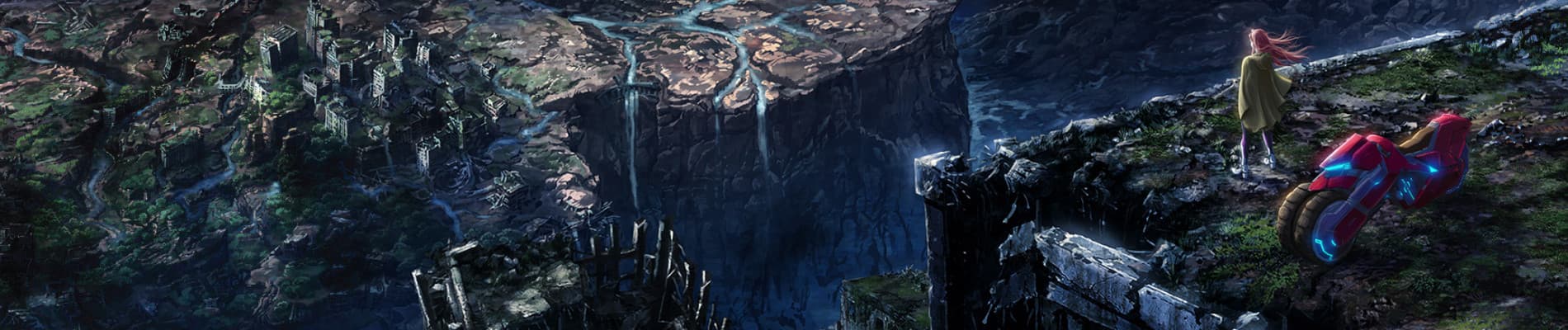
The setting is unique amongst anime, which is a rare title to claim. As I mentioned in the introduction, the story centers around a city as a whole getting transported whole into the far future one fateful midday. Where, the city inhabitants find themselves without contact to emergency services and facing a vast desert. What's more, an alien-looking robots approach and wreak havoc. The anime is surprisingly realistic in the first few episodes as the people seek to establish a provisional government and the two faction of the future establish contact: Revisions and the AHRV. What follows is a power struggle in the face of uncertainty.
The anime presents a believable and puzzling choice as the interests of the city don't completely align with either and scared inhabitants sometimes make quick and uninformed decisions. Still, despite the initial setup and some moral quandaries later on, by the end, the audience isn't left with much more. That is to say, they don't develop the world itself. We only ever meet 1 person from the AHRV and 3 from the Revision. That's it. The in-world explanation is that the resources of both sides have been stretched far. Yet that is hard to believe from the gigantic towers and armies some later present. Furthermore, taking a look at the absolute lack of wildlife, the empty deserts, and the lack of variety in terms of enemies and settings, it's obvious that either the budget was constrained or the production didn't care to build up a complete world.
Coming back on topic, while the government building aspect is presented, it is not really explored. We only ever see changes from the perspective of the constant circle of leadership. There is talk about food and electricity rationing, yet we don't see any community projects or impromptu contraptions. Even as months pass by, the city gets a few extra graffiti (only as it's important to the plot) and everything becomes a bit more brown. When there is civil unrest in the beginning, we are mostly just shown disembodied voices coming from outside. We see some shelters and temporary accommodations here and there, but they fail to present a state of a city living in emergency for multiple months.
The main plot follows a group of five teenagers whom have been childhood friends with each other. There isn't much substance to any of them. The central figure that emerges, whom you could call the main character, is Daisuke. He acts like a 5 year old, there is no other way of putting it. His thoughts being bloated by his ego oftentimes results in bad or outright destructive behavior from the very onset. Later on, he starts flipping back and forth between "I'm the greatest men ever to live and it is my destiny" to "I'm a useless scam" in what can only be described as a failed attempt at character development. While ultimately he solves his issue, we are left with an empty husk of a character since that issue was the only thing to his character.
The rest of the cast aren't anything interesting either. The friend-group's mutual friendship is decorated by practically none except some unexplored crushes. When character development does happen, it is superficial and feels directionless. The villains have some spice added to them, they aren't plain anime evil and have some genuine motivations. Some are driven by fear, others by self-preservation. The representatives from the Revision are stylized especially well, with each having some creative attribute to them.
The time-travel aspect is one of the more interesting in the show. That sort of thing to me is always a bonus to see. However, they fail at it. For any media to be successful in utilizing time-travel, it must properly explain its function sooner or later, or at least give the viewers enough to figure it out. Coherence is key to time-travel stories. For a good while the anime hand-waves it away, saying that time is a like a swirling string (swirling where exactly?). But when it comes to the later episodes where its put to full effect, it falls short. A certain scene in the past which provides a constant underpinning to the plot is incoherent. The cast's memories change or they don't. We can't exactly tell, because the writers are never explicit about what actually happens. We are presented with a singular timeline, but at the same time we talk about alternatives. And the icing on top is that the space "outside of time-space" has air.
Otherwise plot is well paced. Revelations are followed by time given to the audience and the characters to process them. And otherwise, the plot twists are sensible and are tied in well with the rest of the plot.
I'll keep it quick, it's too much and it's too bad. What's even worse than fanservice is which is misplaced and particularly distracting. The use of CG alone is somewhat detrimental to the emotional value of important scenes. But they make it worse by shoving the rigid ass of one of the female characters in the viewer's face. I've watched shows which lean on the side of ecchi, I know how to deal with fanservice, and even say when it's done in a tasteful manner. But Revisions completely fails to jump that bar.
I hoped this anime would be something to recommend, I really did. There are unique and engaging ideas that fill the beginning of the anime. Yet those that had hoped for more are left thoroughly disappointed by the end. There is a great deal of potential and, if properly executed, Revisions would've been a classic CG anime by now. But that potential isn't taken very far. What you will be left at the ending is questions rather than a sober reflection. What's worse is that they intentionally set up for a second season. And they've done so in a manner which isn't really unified with the rest of the events that unfolded.
The sentiments expressed in this review might feel excessive, but that is only because I am partially angered at the wasted concept. So from a scale of 1-10, with 1 being unwatchable garbage, and 10 being timeless masterpiece for all, I have to leave the following score. If you feel like you can stomach some bad writing and a cliffhanger at the end of it all, I say go for it. Otherwise, don't.
7.5 out of 8 users liked this review
