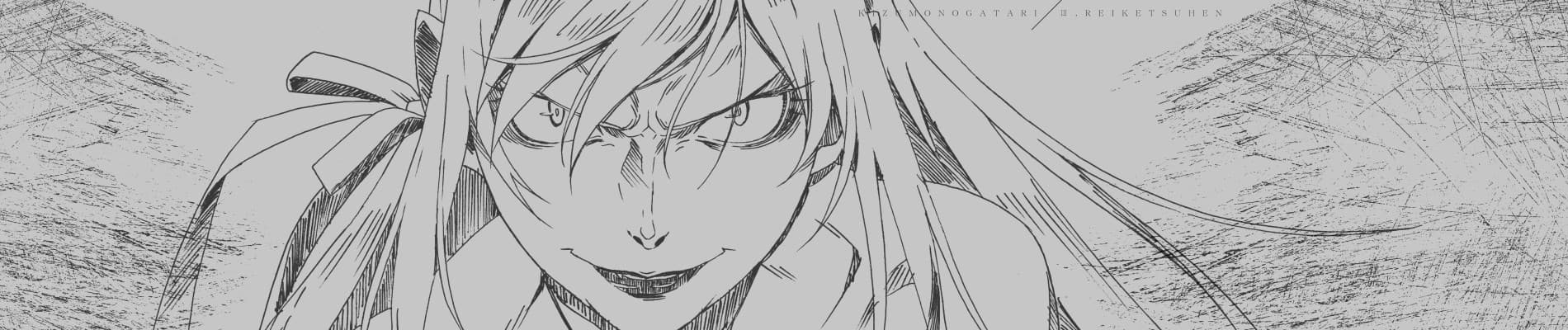
Reiketsu-hen was always going to be the toughest film in the Kizumonogatari trilogy to talk about. It does many things that are tough to analyze from a critical perspective, most of which are due to the way the adaptation has prioritized character development across its three parts. While Monogatari as a whole has many dark parts, I would easily call this the second darkest part in the entire series. Character motivations are either not made entirely understandable or otherwise vague. The grand, powerful final fight has a mix of different tones and emotions that are tough to sort through the first watch or two. And despite being the final film for a series obviously intended to be watched as a whole, it arguably feels the most like a full stand-alone film, putting it in an awkward position get a hold of, also resulting in some weird pacing. On top of all that, it has two polarizing scenes to drive home its theme of misery. One is the scene right after the long-awaited fight.
The other is that scene.
You know. That scene.
It's my belief that talking about and sorting through that scene helps make it easier as a whole to decide how to feel about this movie. Or in other words; why one likes/doesn't like the scene influences how one feels about this movie (and Kizu as a whole, really). I believe it's that important to the film, and even if it isn't, it's inspired me heavily enough to critically analyze and write about it, so spoiling it to some degree feels like a must. Having watched anime the past ten years and coming from a nearly-unwaverable "ecchi is bad for an anime" viewpoint, Monogatari has always been a tough series to fully immerse myself in, but each of the Kizu films has their own specific moments of ecchi fitting for the films they're in, and the moment in this film is intense, to say the least.
Before getting to that however, it's important to stress how fucking fantastic this film is with its commitment to its themes and lessons. Of the three films, characters feel the most complex and explored here. Even though Shaft's approach to the Monogatari series has always been artsy and indulgent, this feels the most artsy of the Kizu trilogy (or even the series) by stripping away the flashy layers and getting right into the ugly nature of the characters' predicaments and motivations. Vampires are cruel, possibly not worth saving, and people can easily be just as cruel. In the most dire of situations, there's no way for everyone to be happy; only misery. Wounds run deep. The consequences of your mistakes can be eternal, born entirely from personal flaws. No matter how you look at it, the entire story of Kizumonogatari has no firm uplifting outlook for nearly anyone. They can only go uphill, in other words.
So about that scene. The exact nature of how the ecchi/fanservice plays out in this movie takes on a different context from either the previous films or the rest of the series. Such moments are usually intended to be comedic and played for laughs, regardless of how far they go, and are generally surrounded by either light-hearted or neutral moments of the show. But in this case, total darkness and despair surround it.
It's this kind of incredibly complex mess of emotions that makes this scene feel so vital. I have to admit that I would have liked this whole series a lot better (or a lot more readily) if it wasn't so open to ecchi and fanservice, sometimes pretty intensely. But with what the series has given us, this is maybe the most they justify it beyond "Araragi is perverted" and also the most enjoyable (besides, even if the series had way less ecchi they probably could have justified this still). This moment is hugely important for both Araragi and Hanekawa and defines aspects of their relationship and interactions down the road, and does so as wonderfully directed as it is. And because it goes intentionally over-the-top, it manages to paradoxically feel way less gross. The classical piano right when Araragi has his realization is not only perfectly timed and fitting, but combined with his face manages to make it incredibly funny.
But as much as I talk about one scene, so much about this movie is eloquently done. The absolute one-two sucker punch of Araragi and Shinobu's (now fully Kiss-Shot) conversation followed by the very next scene is so beautifully done and cruel to the viewer that I can't think of how much better it can be done. The tense escalation in the first scene with Oshino and Araragi, culminating in the reveal of the full extent of his involvement in everything, is brilliantly done and sets the stakes well, especially with the foreshadowing. The final two scenes crushes the viewer's hopes that this story has a positive ending so swiftly and quickly, as if the movie never gives it a second pause, works fantastically in placing them along with the characters. The bittersweet monologue from Araragi at the very end. Each scene itself could warrant paragraphs of analysis and praise.
I only have two complaints about the movie. Despite the fight ultimately making itself worth the payoff, I can't help but feel Shaft may have gone too overboard. At points it feels like slapstick harshly interrupting the action so unnaturally, and threatens to spoil the mood the movie worked for. Perhaps there was a different way to handle the humorous aspects or make it flow better into the action.
My second complaint, a bit oddly, is with the story itself. Characters in the series can end up being real inscrutable and thus makes everything nonsensical. Given how the show's universe works, this ends up in its favor. However, some revelations that get unearthed end up making things super convoluted and hard to hold up to scrutiny, or are otherwise just total headscratchers. It's maybe one of the most convoluted plot points of the entire show, if not one of the most convoluted parts in the entire series, which definitely says a lot. Thinking too hard about it could probably lessen the impact it has for you, but even then it's not such a big deal; it almost makes what happens even more tragic for those involved.
Somehow, even with its faults, even with its incredibly polarizing moments, it pulls it off. It pulls it off in such style that I can forgive the second part for feeling a little bit like a drag. I end up crying during moments of this, and feeling so engrossed in the action. No other part of the series has made me like (or at least sympathize with) Araragi nearly as much as this does, and it manages to do so much and be successful. But this part really pulls out all the stops in making itself worth the watch, garnering respect without even trying. While the first part is more easily watchable whenever one wants and by itself, as well as feeling more loose and benefiting from it, the third part is how everything ties together and tries to answer all the questions remaining by it. It makes Kizumonogatari my favorite part of the entire series.
159.5 out of 171 users liked this review