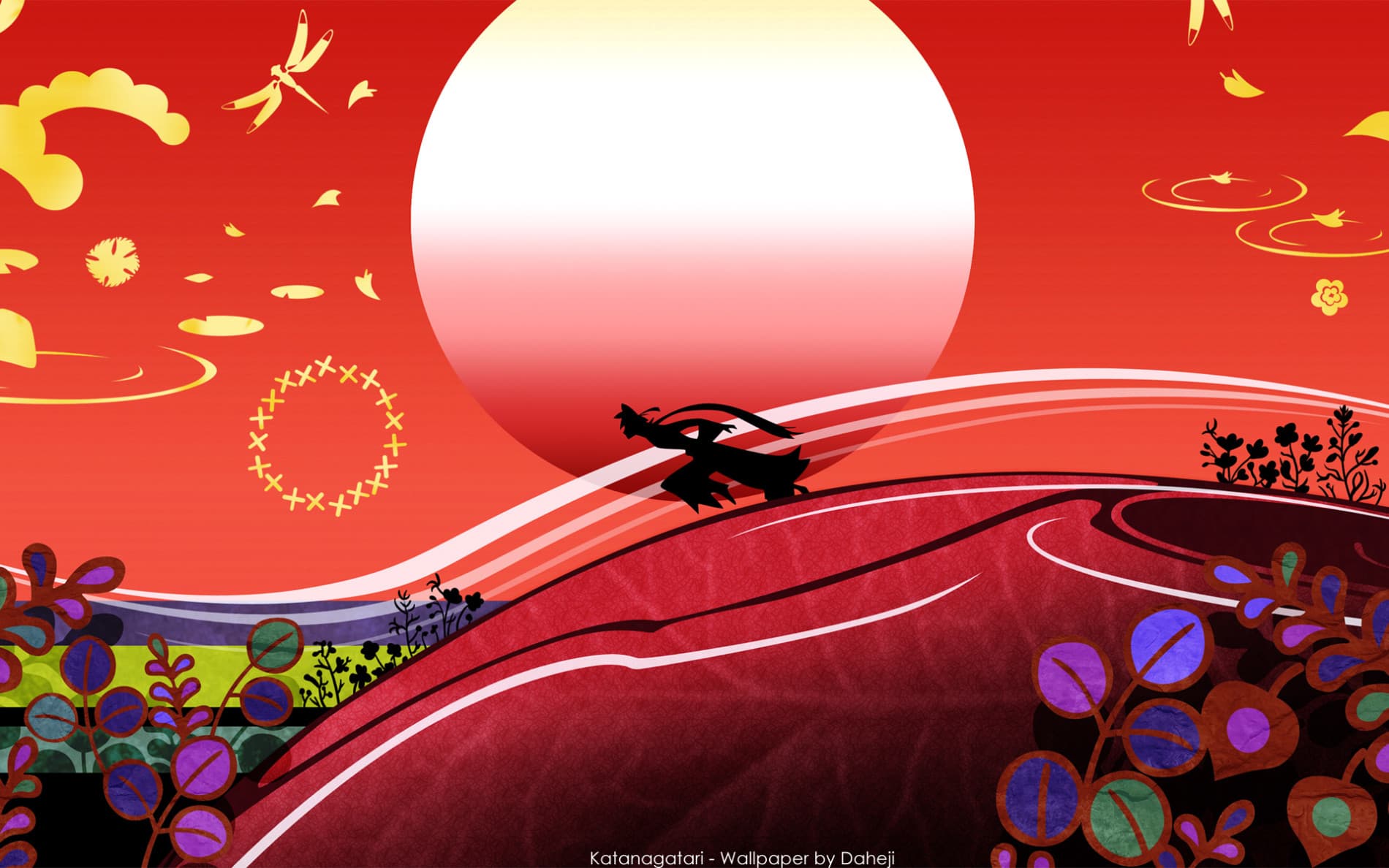
Katanagatari
a review by GrandMasterWaifu
a review by GrandMasterWaifu
A tale of two unlikely souls, distanced by the deeds of their fathers, Katanagatari is an adventure shaped by the dichotomy between one’s perpetual and stagnant self. The story unfolds as follows: a calculated encounter on a remote island brings together two heirs, each hailing from a dissimilar lineage, who embark on a journey bound only by the promise of love. Moving in tandem, Yasuri and Togame traverse the vast expanse of Japan, collecting the Twelve Deviant Blades. Forged in iron, these works are said to possess insurmountable power—each capable of catastrophe, able to decimate entire armies and nations. From beginning to end, we uncover the truth behind these blades: their purpose, their origin, and the transcendent intent hidden beneath the subterfuge of their creators’ will.
Clandestine as the thirteenth blade, Yasuri was the culmination of a soothsayer’s ambitions. Shikizaki crafted instruments of destruction that embodied Japan’s weaponized evolution, anticipating the inevitable arrival of the Western states. Using his unique foresight, he conceived a plan thousands of years in the making—one designed to save Japan from the eventual threat of foreign invasion.

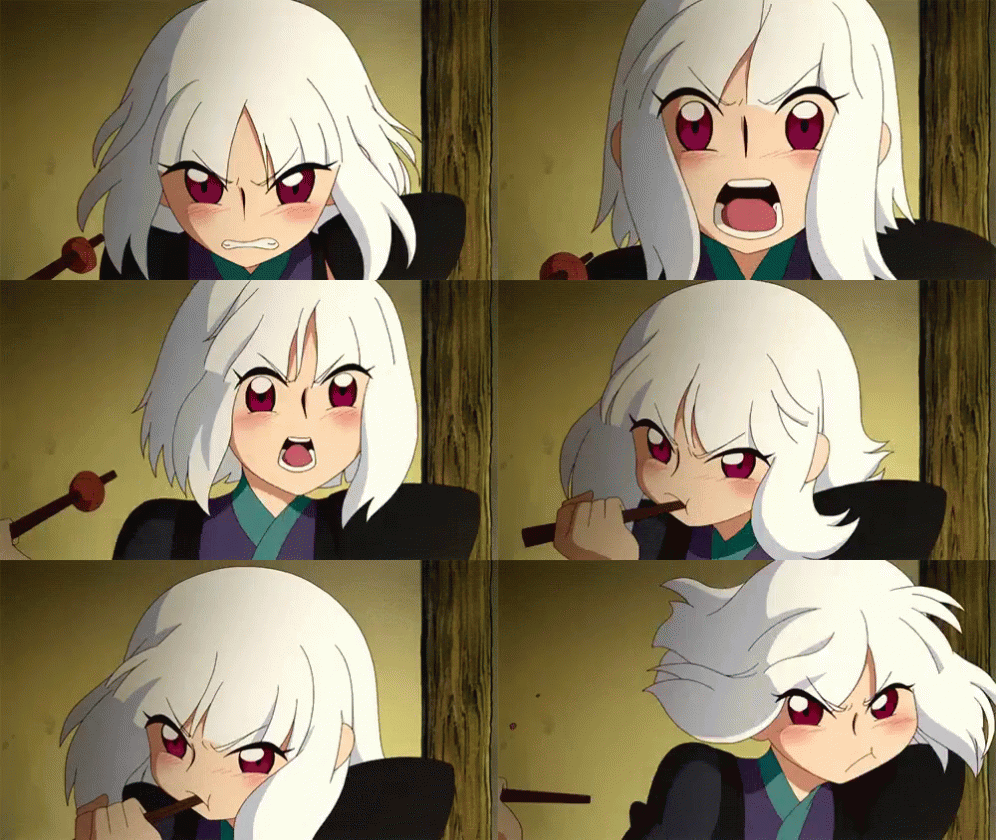
Witnessing the beheading of her father at the hands of Yasuri’s father, Togame develops Marie Antoinette Syndrome—a fictional affliction in which one’s hair turns white from sudden trauma or stress. Losing not only her father but also watching her nation burn in conquest, Togame is forced into a life of desperation. Clawing, scratching, climbing—she lies, cheats, and betrays those closest to her, never allowing a bridge to go unburned in pursuit of her ambitions.
Devoid of ethical or moral conscience, by the time Togame looks down, there is no longer any ground beneath her feet. This upbringing of loss, coupled with her relentless drive for vengeance, forges the calculating monster we see before us. She no longer perceives herself as a whole being, but as fragments—pieces to be moved across a board. Her emotions, her words, her body—all pawns to be sacrificed, each advancing her one flagrant step forward at the cost of another self-deprecating step back. In the end, she becomes the reckoning of her own design.
We receive hints from other characters describing her as a cold, calculating witch; however, her demeanor suggests genuine change and emotional growth. It seems, for a time, that she might be capable of diverging from her self-imposed isolation—capable of moving on from the past. Ultimately, though, it felt as if a plot bomb were dropped on us in the end, with little structural buildup beyond fragmented character remarks.
The strangest part is that we never actually learn what her ambitions were. It’s as if she boarded her own train to the end of the world and lost the ticket somewhere along the way.
Upon Togame’s arrival, he immediately falls for her; she embodies the allure of something new, awakening within him a longing for change. Yet Yasuri possesses no true desires of his own. He has always been a tool for others’ purposes, never the master of his own. Deprived of individuality, he clings to Togame as both his purpose and his meaning.

The curse of the Kyotouryuu style is that of a solemn, lonely life—one defined by love and loss, often at the hands of oneself. The Shichika clan murders its own—not out of disdain or prejudice, but out of necessity for others. The previous head is said to have killed his wife for the sake of his daughter; Yasuri kills his father for the sake of his sister; and, as fate would have it, eventually kills his sister for her own sake.
The outcome feels like a grim realization reached at different stages of each family member’s life—always too late to amend. Devoid of family ties, we’re left at the end of episode seven with a lingering melancholy, a hollow ache in the pit of our stomachs.
In the end, Togame is killed—not by Yasuri, but by another. Though her death is not by his hand, he claims that his weakness is what killed her. This loss is framed as a metaphorical one: a death for the sake of himself.
With no worldly ties remaining, Yasuri is finally free to choose his own path. In doing so, he becomes the completed thirteenth “Deviant Blade” by destroying the others—defeating them sequentially in the order they were obtained throughout his and Togame’s journey, a poignant homage to the adventure they shared.
Having at last freed himself from a destiny thrust upon him millennia in the making—and from those who sought to wield him as a tool—Yasuri becomes self-reliant, forging his own path forward.
From a viewer’s perspective, this character comes across as rather linear. While a clear romantic maturation occurs as he begins to distinguish between lust and love, other aspects—such as Yasuri’s power scaling—feel inconsistent. Though he harbors deep attachment for Togame, this passion represents the extent of his limited character growth. It almost feels as though the story uses a playful guise to make us think he’s evolving.
It isn’t until the final episodes that the narrative attempts to convince us otherwise—“See? Look how far he’s come!”—yet there’s little evidence of that growth actually taking place beforehand.

Episode 11 drops a bombshell with no supporting details, no foundational buildup, and leaves the audience asking, “What the hell are you even talking about?” After Houou is possessed by the phantom of Kiki Shikizaki, a diabolical truth is revealed: apparently, he is a soothsayer who can see into the future and constructed each blade after historical weaponry. Up to this point, we’ve only been told he’s a legendary swordsmith.
Kiki then has the audacity to ask, “Haven’t you noticed something strange about the deviant blades?” To which the cast responds, “Oh yeah, they are kinda weird.” To the audience, it’s clear that these blades resemble weapons spanning Japanese history, yet the cast never genuinely questions why such blades exist—they merely acknowledge their peculiarity.
The monologue then launches into an explanation of a multi-millennia-long plan to rewrite history, claiming that Togame’s father rebelled against the shogunate to restore the world to its “true timeline,” supposedly thwarting Kiki’s intentions. Somehow, Togame’s father realized an inconspicuous plan set long before his time. It’s a lot of convoluted exposition, reinforced nowhere else in the story.
As wild as this “plot twist” is, the show could have been far stronger if this climactic event had been properly built up over the series. Instead, the final fight lasts all of ten seconds, instantly erasing any potential tension or buildup.
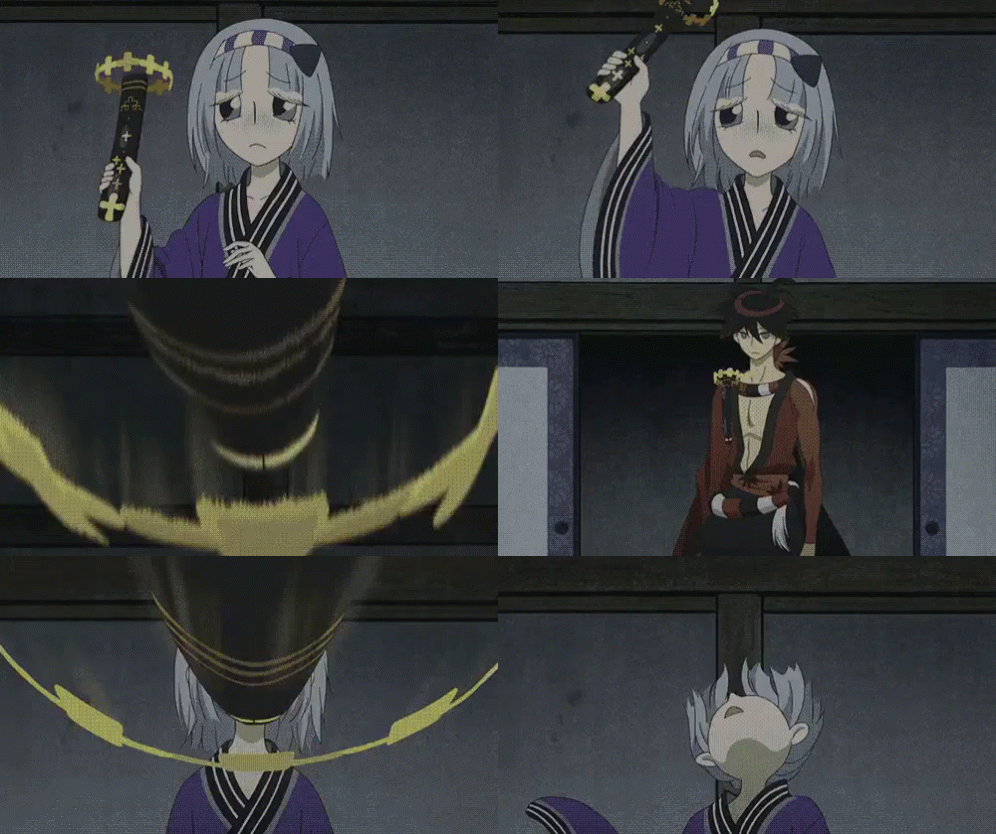
The final moments attempt to signal Yasuri’s growth, but the execution falters. Togame’s arch-rival kills her, and Yasuri asks, “You never hated her, did you?” She hesitantly replies, “I didn’t… dislike her.” Meanwhile, she and Yasuri are now traveling together as the curtain falls. We’re supposed to sense Yasuri’s growth, as he tells her, “You can do what you want,” meant to counterbalance his previous blind devotion to Togame. Yet, without evidence of meaningful growth earlier in the series, this moment feels undercut and unearned.
Typing this out hurts because I loved the base characters and the story’s premise. Unfortunately, it was diluted by too much unfounded complexity that wasn’t properly reinforced. In the end, it is a story of nature versus nurture: Togame had to survive on her own cunning and thus became singularly independent and manipulative, whereas Yasuri was raised to be nothing more than a weapon, leaving him without a sense of self and overly trusting. Essentially, they serve as foils to one another.
14 out of 16 users liked this review
