Mononoke
a review by Mazomonogatari
a review by Mazomonogatari
Part the 2nd: An interpretation
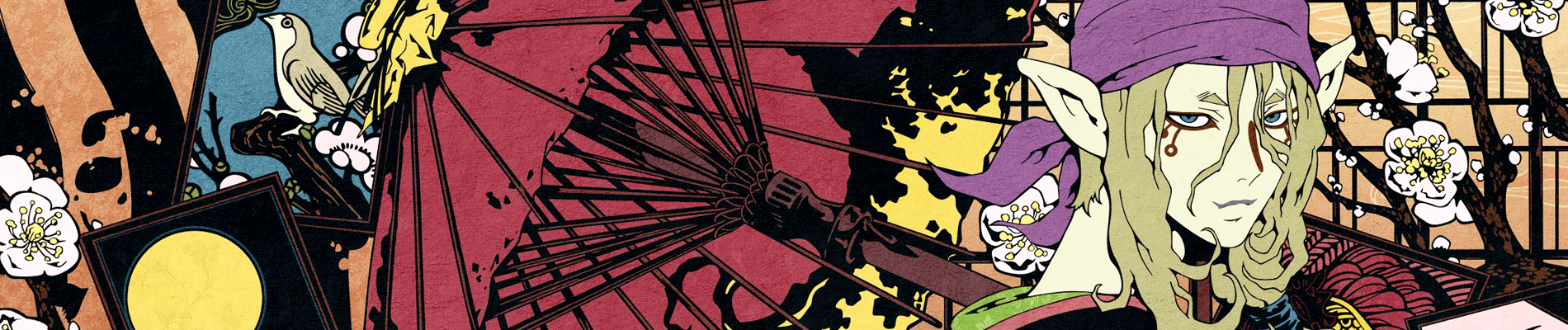
Mr Kusuriuri-san is a fascinating character. Ever stoic and implausibly unfazed. Weather they are unwavering in their mission to strip the world of mononoke and completely uncaring of the individuals they attach themselves to is up to interpretation. Seemingly omnipresent and possibly omnipotent, weather they are completely detached from are perceptions of reality and consciously choosing to simply remain in our state of existence is up to interpretation. So with a character so incredibly vague it's only expected that people view him/them differently, but how do I view Mr Kusuriuri-san?
I believe Mr Kusuriuri-san is a former bodhisattva, but rather than merely having been on the path to Buddhahood, Kusuriuri has previously become a buddha and choses to dance between the two states. utilising his attainment of awakening to continue staying in are world as a gilded beacon and restricting himself of Nirvana, he refuses to completely release oneself of suffering so he can continue relieving humanity and those stuck in the material world. Kusuriuri can’t conventionally be labelled much and whatever label’s I’ve thrown their way is merely out of perception. But Kusuriuri is undeniably a traveller venturing throughout the land of the rising sun repelling the darkness that looks to completely extinguish the light that can be found within.
In living this way Kusuriuri is constantly having to adapt to the universal truth that life is impermanent. Kusuriuri often travels with the bare minimum, the clothes they fashion, and the tools required to banish Mononoke. Kusuriuri witness first hand those who hold dearest their “self” despite the plague that curses their soul showcasing just how unknowingly we can be changed, despite having seemingly taken on a courageous task Kusuriuri is more complicated than your average enlightened hero.
Kusuriuri is an ever-ending contradiction and an ideal bodhisattva they are not, I do believe enlightenment starts with the individual and if the soul is truly constantly changing and if there is no eternal then the concepts of a Heaven, Nirvana and even Hell are as contradictory as the pipe Kusuriuri smokes. Meaning enlightenment ends with the same individual but a completely altered perspective. It isn’t weather Kusuriuri achieved Buddhahood, but how Kusuriuri decided to use this achieved state that's important.
And in using his achieved state he shines like the sun coated in a flame of purity, knowledge, enlightenment, and his own 3 universal truths: Katachi, Makoto and Kotowari. the evil that hides in the deepest depths and rises with the greatest desire is revealed and banished by a unconventionally handsome, undeniably stylish and exceedingly cool medicine seller... who for some reason has elf ears which I hope doesn’t tie into Buddhist philosophy or really have any semblance of meaning for being other than it looks cool. To be honest after everything I write this wave of existential dread crashes down upon my consciousness destroying the carefully constructed sandcastle that is this review. And in the aftermath an echo can be heard reverberating “Elf ears, elf ears, elf ears.”
Under the new rule of the Tokugawa Shogonate Japan isolated itself from the rest of the world, a strict, exploitative and vicious class system was introduced and anyone practicing Christianity was mercilessly killed. The trade-off peace form brutal, unrelenting civil war. Alongside all those admittedly pretty significant negatives was some strong positives, financially Japan was an extremely healthy country which was agriculturally evolving thanks to also technologically evolving. The population was growing at a stable and maintainable rate helped by the fact not everyone was dying horrifically in battle. And education focused more on the individual being literate than removing people’s individuality and uniting them under a glorious and blood-soaked banner. Thanks to this art flourished, being that a greater amount of people were trained with the skills and had accesses to the tools to create art.
Ukiyo-e was basically created form the same circumstances that birthed the Pop Art movement, in fact the parallels between the two are uncanny. Both were born form nations growing after an extended period of war and complete distress and both being born form the newfound indulgencies of the lower to middle classes. Entertainment at a reasonable price made music and movies an accessible luxury, also the vile luxuries once concealed in the shadows of grimy back allies burst out into the main street and the mainstream. Both challenged the preconceptions of art by focusing on imagery of popular/mass culture rather than selling itself as a restrictive and oppressive medium for elitist with a close-minded view on what art can and should be. And both art forms evolved beyond their original means thanks to creative geniuses who dared to push the boundaries and in doing so created some of the most thought provoking and emotionally provoking pieces of art to bless humanity.
Edo becomes New York
Kabuki actors become Hollywood actresses
Woodblock printing becomes screen printing
Time may force us forward, but the past moves us forward. And just like how Pop Art wouldn’t exist without Ukiyo-e, neither would Mononoke. See that did all have a purpose.
The team behind Mononoke
I truly believe in my humble opinion that if you don’t like Akira, you don’t like animation. Conceptually this statement applies to Mononoke except it’s rephrased too, if you don’t like Mononoke, you don’t like art. Once again, I must stress that’s just my humble opinion of which there are many and most of them are correct.
Mononoke is a lovingly crafted idiosyncratic visual masterpiece. The show is worth watching just based of its outstanding visuals. Every fantastically crafted facet of Mononoke standouts to such an extent it’s impossible to visually appreciate everything it has to offer on just one watch. Much like how Akira takes countless rewatches to notice some seemingly insignificant yet extremely detailed piece of background animation. Mononoke too is perplexingly densely layered with mesmerizing patterns and creative flourishes that would seem insignificant, but because some incomprehensibly talented individual poured, they’re everything these microscopic details have more meaning than some series do in their entirety. I’m going to focus on 2 arches of Mononoke and try avoiding simply saying “iz good cause it da best.” I’m also going to spotlight a third arch which iz good cause it da best. But first I want to talk about some of those incomprehensibly talented individuals I mentioned earlier excluding one significant exception I’ll get too later.
Takashi Kurahashi and Yumi Hosaka handle art design, I’ve knida already praised these two to high heaven in the previous section but why not some more. Mononoke is special because it manages to maintain a visual cohesiveness whilst constantly experimenting. And these two are the adhesive keeping it together.
Takashi Hashimoto is the animation director and character designer for Mononoke which is handy because it doesn’t mean someone has to be tortured by trying to animate his highly detailed and exceptionally unique character designs. The character’s personalities and designs go so perfectly hand in hand and easily identifies what piece they play in the story. For instance, Kusuriuri’s design offers so much intrigue and mystery. As for side character’s Ochou of the Nopperabou arch Gives of the airs of a pristine trophy wife, but the dark circles around her equally dark and lifeless eyes revels something far more sinister about her predicament. Hashimoto clearly didn’t have an archetype to follow when designing the characters and that allows him to bring them to life and have the freedom to animate them as he pleases.
One department that normally receives nothing but scorn and is often considered a plight upon the industry is a department that allows Mononoke to excel visually more so than any other. This department’s efforts cannot go understated, I can’t believe I’m about to say this but... thank God for the CG department. Know I’m only against CG in relation to laziness, but nothing about Mononoke is lazy and the CG on display is still ahead of it’s time, The only thing that artistically rivals not just Mononoke, but Toei's (of all companies) CG works of the late/early 2000s is Trigger’s Promare. The CG patterns that bring the backgrounds too life and the rain/snow in the 1st and 4th arches are completely mesmerizing. in ep9 the background extra’s being represented by manikins adds a creative stylistic touch that is infinitely better than some clunky looking people that are as lifeless as manikins. Credit is due towards CG director Nobuhiro Morita and CG producer Takeshi Himi but it’s Yukiya Imamura’s involvement that interest me the most as he did some phenomenal work on many other series too.
But none of these people’s work would have any meaning if Mononoke had a rubbish script, so thankfully it doesn’t. as primarily a horror series Mononoke is a deeply unnerving, yet emotionally gripping series. It knows how to build and mess with your expectations; it surrounds itself with so much mystery but will explain itself in a satisfactory manner which respects the viewers intelligence. As I mentioned earlier Mononoke values your view of the show so it often leaves things open to interpretation whilst giving you plenty of material to piece the answers together. One script writer for this series whose involvement in any series is worth mentioning is Chaki J Konaka, and don’t let that J fool you it literally means nothing. Mr Konaka has worked on some great series such as Lain, Princess Tutu and Kino no Tabi. Although I would hesitate to call him a great writer. Chiaki J Konaka’s scripts are often thematically dense and puts the focus on exploring cool concepts rather than structuring a comprehensible story or character’s that are remotely interesting. He functions best with a great director such as Ryuutarou Nakamura
And lastly Yasuharu Takanashi composed the music for the series he does a fantastic job perfectly complementing the visual action with unnervingly eerie compositions as well as some deeply emotional compositions. Yasuharu Takanashi's job must of been an incredibly difficult and daunting one, yet he did a masterful job giving Mononoke the soundscape the story deserves. And now we’re a bit more acquainted with the staff let’s get back to the Arch’s I mentioned I would talk about some hundred and a bit words ago.
Nopperabou
The Nopperabou Arch focuses on the aforementioned trophy/housewife Ochou. However this trophy is very rusted, and the house they are confined to is more so their prison than home. We don’t learn this immediately in-fact the first thing we actually learn about Ochou is that she has recently become a murderer. Having painted the walls of her prison with her husband and family, Ochou is sitting pretty awaiting execution when Kusuriuri confronts her and as expected where Kusuriuri wonders a Mononoke lurches. I’m going to focus on Ochou’s emotional state and how the art of this arch directly correlates to such.
The colours inside the house Ochou finds herself confined to is extremely flat. The matte backgrounds somehow manage to remain exciting whilst being highly oppressive, a joy to look at form the perspective of a piece of background art but with the perspective of Ochou’s predicament they become a bleak and depressing reminder of Ochou’s confinement. The beige walls are decorated with prints in the styling of Ukiyo-e typical of the era. On the walls a tree serving as a sanctuary for birds to come and go as they wish; an image of freedom cruelly surrounds Ochou. We also find a large Ukiyo-e print depicting quite brutally Ochou’s current predicament.
But all this changes when Ochou snaps flat enclosed colours find themselves blood-splattered with vibrant blues, pinks, yellows and most importantly reds. A spectacular explosion of colour to accompany a fantastic explosion of emotions. Yet, this quick release of emotion only looks to find Ochou in another state of confinement, if Ochou want’s freedom then this event won’t be how she achieves it.
The nature and flow of the colour in these crime scenes can’t compare to that of when Ochou is freed form jail By a masked Mononoke and Ochou finally gets to wonder the world she’s been hidden form for so long. It’s during this scene that Ochou is at her happiest and during this scene there are no black borderlines confining the beautiful water colours that fill the serene sky as the sunset’s on Ochou’s past. The leaves are every colour they decide to be some stay attached other’s float form their branches looking as if CG confetti celebrating Ochou’s new-found freedom. In ep7 the brushstrokes give off such a liberal attitude and create a character rich descriptive backgrounds, unfortunately it is at this point Kusuriuri must truly set Ochou free. From here on Ochou’s emotions still play a factor in the art direction but they are at the mercy of Kusuriuri.
I’ve come to believe that this arch can be seen as an allegory for The Edo Period, the downfall of the Shogunate and Ochou’s imprisonment being representative of Japan’s self-imposed seclusion. A strong piece of evidence for this is Kusuriuri mentioning how Ochou “could have left at any time.” Ochou being a victim of her mothers desire to raise through the class system is forced into an arranged marriage. Because of this her husband views her as nothing more than a trophy wife of which should be eternally grateful towards him, after all he the son of a noble samurai who protected the honour of the glorious empire has raised her and her mothers social ranking and given her a life she could have never achieved otherwise. Obviously, none of what I just stated is true, It wasn’t through lack of effort commoners weren’t able to ascend the social ranking but because the government kept them there. Ochou’s husband is not only abusing her but a corrupt system. Kusuriuri's statement may seem extremely cruel on the surface, but as with everything in Mononoke what appears on the surface is often superficial and the truth can only be found by searching deeper. A search that is worth going on yourself as I don't desire to spoil this or any arch of Mononoke so before I revel too much I'm going too move on to...
Nue
This arch manages to look equally as amazing as the other’s whilst mostly using nothing but grey tones, it's a monochromatic masterpiece. Colour is reserved for items of significance in relation to the character’s such as a samurai’s sword, the woodpecker nose of man who goes around poking said nose in other’s business and a funny man’s funny hat. The only exception to this rule are beings that transcend the boundaries of are mortal plain, beings such as Mononoke’s and Medicine Sellers.
This arch focuses on a game of Genjikou a scent-based game which is very complicate and very Japanese. With every inhale the character’s light up along with the world that surrounds them. These brief flashes of colour tell a story of themselves, and support are understanding of each of the three character’s this arch focuses on. But what is really impressive is how the scenery they fill never manages to lose itself, despite the lack of colour. the backgrounds are still full of life you don’t feel like you’re missing out on anything despite the fact something is obviously missing. It shows that Mononoke is more than flashy colours and fancy patterns. Nevertheless, they do help, because as I previously mentioned there is one arch in this series that is simply “good cause it da best.” And why is that, because flashy colours and fancy patterns.
Umi Bozu
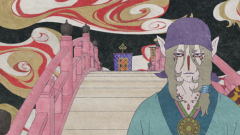 Watch
Watch
 This
This
 Show
Show
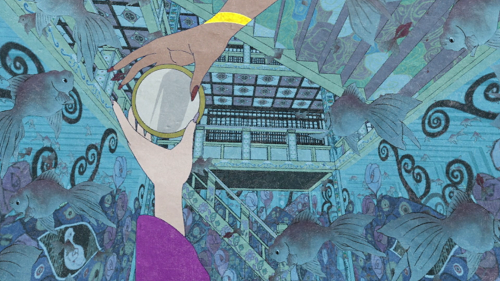 Please
So Pretty.
Hopefully this was readable and worth your time and if you didn’t like it then damn you and your opinion that you’re entitled to.
33.5 out of 34 users liked this review
