
Spoilers ahead
Disclaimer: I will be using he/him pronouns for the Gems since that’s what the translations use so bare with me

Change is the only constant that exists in the universe. Change replaces the old, and brings forth the new, whether on a minute or grand scale. However, change itself is a double-edged sword, capable of improvement, and deterioration. When is change necessary? How much of yourself are you willing to sacrifice to achieve your goals? Land of the Lustrous has become one of my top 5 mangas of all time with stellar world-building thanks to the mystery surrounding the Lunarians and Kongou, stunning artwork, and some of the best character development I’ve seen in fiction.
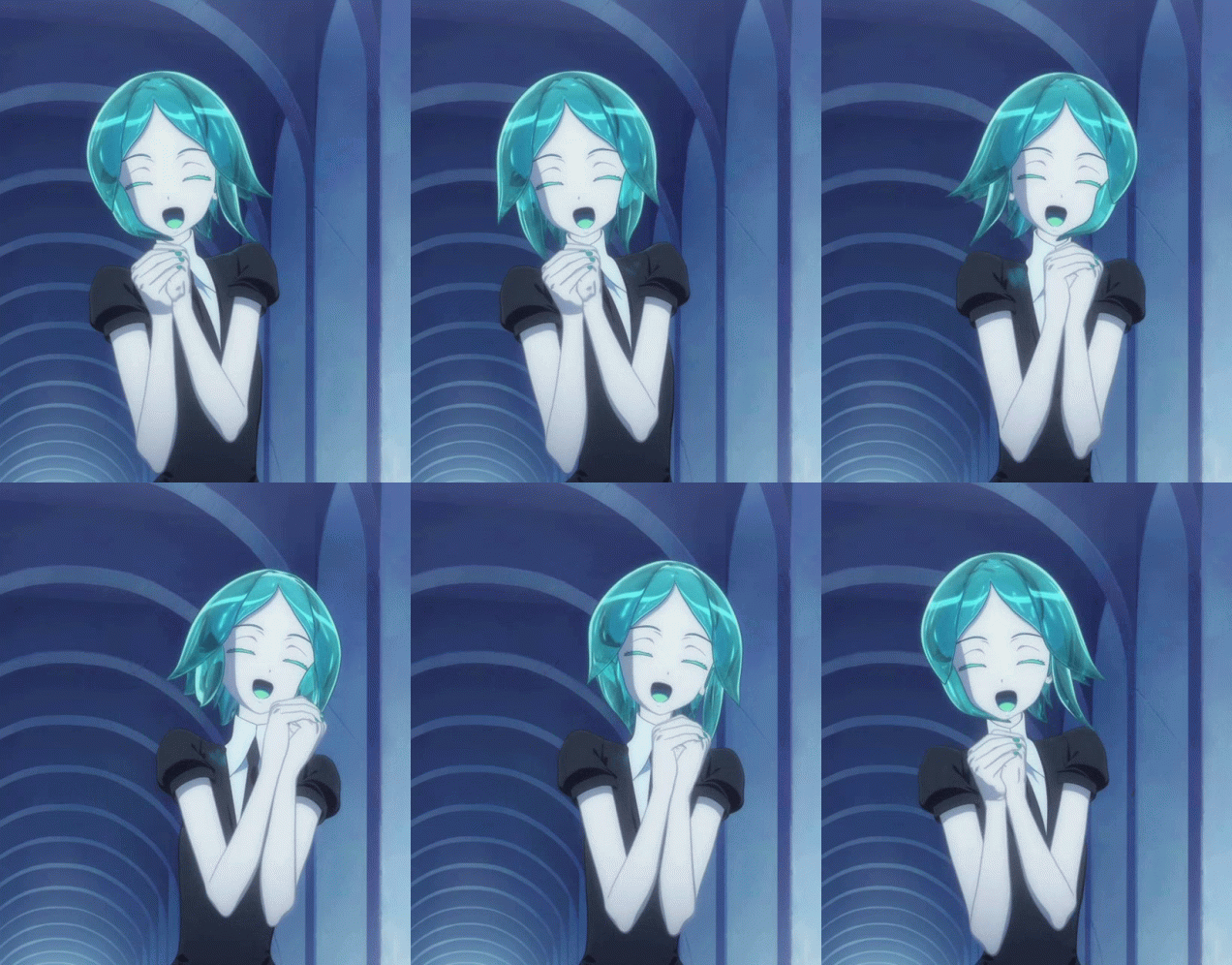
Land of the Lustrous is a tale about immortal humanoid rocks, or Gems, fighting off entities called Lunarians, who kidnap the Gems and send them to the moon. The Gems themselves are immortal since whenever they get broken apart the microorganisms or inclusions allow them to reconnect their bodies together. Whenever a Gem loses a fragment of their body, they lose parts of their memories, literally and figuratively losing a part of themselves. Also important to point out that humanity was split into three life forms: Flesh (Admirabilis), Bone (Gems), and Spirit (Lunarians). The story centers around Phosphophyllite, aka Phos for short, a Gem who is initially weak since he can’t even handle a sword, rendering him useless in battle. His hardness is a 3.5, and his shiny bluish-green color makes him attractive to the Lunarians. Due to his handicaps, many of the Gems accuse Phos of being lazy and wish he were different, despite his efforts to become a valuable asset. This makes the concept of change a focal point of the story.


In the first half, LOTL shines at building up the mystery surrounding the world, and the origins of the characters. It raises intriguing questions about Sensei’s secrets and his relations towards the Lunarians, the Lunarians’ fascination in collecting the Gems, talking ice flows, what lies on the moon, etc. However, in the 2nd half, beyond the anime, things take a dark turn so quickly over the span of a few chapters, that it feels like you’re no longer reading the same wondrous story about a naive Gem seeking a job he’s useful in. Just like how Phos undergoes significant change, so does the plot. It shifts from a story focusing on growth, and Phos learning about the world around him, to a tragedy that delves into existential dread, betrayal, the sacrifice of one poor soul for the sake of everyone else, and what it means to be human.


Although the manga is rich in plot and world-building, the strongest aspect of this manga is definitely Phos and his journey of change throughout the story. As others have pointed out, he’s pretty much the personification of the Ship of Theseus paradox, which questions whether a ship that gradually replaces all of its parts overtime is considered the same ship. Phos’s character arc is more tragic, and less redeeming compared to other examples of development in fiction, since his changes were the result from trauma, betrayal, and abandonment by his peers. I can’t emphasize this enough: I don’t think I’ve ever seen a main character catch this many Ls in my life.



I think for Phos’s character arc, betrayal and change go hand in hand. Remember that humanity was split into three parts? Aside from the gold alloy and Lapis Lazuli head, he was already made of bone. It all started when he lost his legs due to Ventricosus’s betrayal, but was given parts of her brother’s shell as replacement for legs. Thus, making parts of his body the Flesh. Afterwards, he gains the artificial eye from the Lunarians, ultimately transforming Phos into a human. I think it’s ingenious that Ichikawa went in that order. Flesh can’t hold by itself, so it needs bone as the foundation, and the soul can’t settle anywhere that isn’t a body. The most heartbreaking aspect is that Phos’s transformation was orchestrated by Prince Aechmea, the ruler of the Lunarians, so that Phos could embody the most human emotion: vengeance. Vengeance for all the betrayal he’s suffered from the Admirabilis, the Gems, and the Lunarians. Showing that humanity itself turned its back on him.


So after Phos commits gemicide onto the Gems, Adamant breaks apart upon Phos’s orders, and leaves behind his right eye, containing his knowledge and power. With Adamant rendered useless, the Lunarians can no longer rely on Adamant anymore to pray. They then socially isolated Phos on earth for, constantly witnessing humanity’s downfall for 10,000 years, so that there’s a chance he could send them to heaven. The way I see it, a human is incapable of achieving such godlike feats. To make Phos a god, the Lunarians needed to strip what made him emotionally human. Since humans are social creatures, so completely isolating someone from the world is what’s needed to turn him into a god. Adamant said it best: “Power comes with a measure of loneliness.”


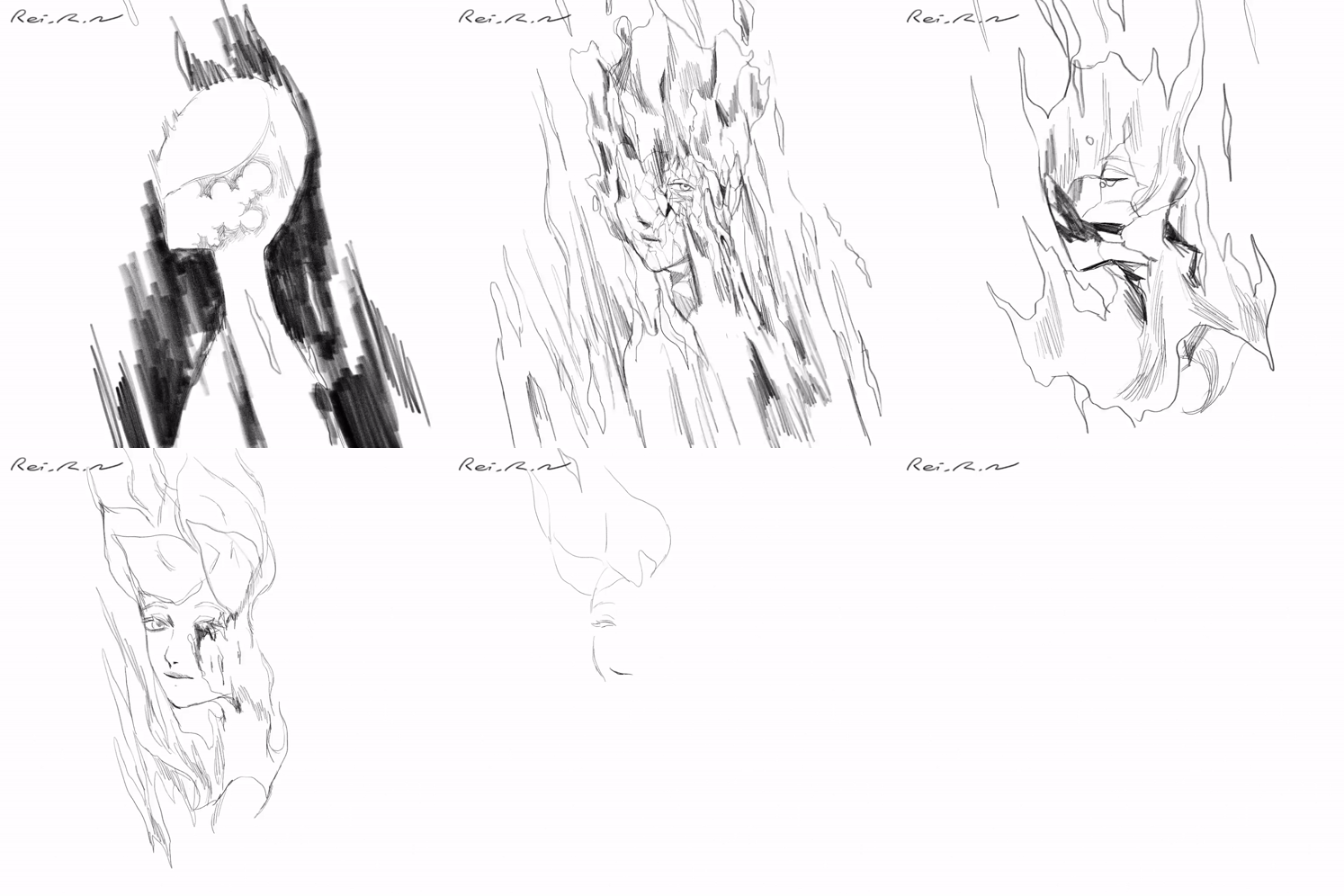
The Pure New Land arc is probably my favorite arc in regards to Phos’s development, as it shows us an entirely new side of the narrative. After 10,000 years, despite all the betrayal, loss, social isolation, and existential suffering, rather than choosing to torture these sinners an eternity in hell, he instead decides to pray and forgive everyone. If a human reaction to betrayal is vengeance, then a god’s reaction would be forgiveness. In the end, Phos remains alone, from the beginning till the end…or at least that’s what they want you to think. Phos discovers a bunch of rocks and an eyeball that turns out to be Adamant’s younger brother. These lifeforms actually understand Phos’s feelings, and for the first time in his life, he finally finds true companionship (man this story’s bizarre). Then, billions of years pass, and the sun closes in on earth, threatening to reduce it to ashes. Thankfully, Adamant, Aechmea, and Euclase were thoughtful enough to leave behind a ship for Phos to escape in. However, Phos stays behind to eliminate any traces of humanity left within him to end this cycle of suffering, and bids the rocks farewell (PHOS NOOOO). However the eyeball bro is a real homie, and snatches the last pure fragment of Phosphophyllite within his body. As Phos disintegrates into dust, thankful he’s finally useful for something. Character development in my eyes is neutral; a character can change for the worse, or for the better. In this case, Phos finally understands that his own company, and his kind demeanor is enough to bring people happiness. He never needed to become a fighter, or a hero, because despite all of his weaknesses, kindness is his biggest strength. I believe Phos’s death is the moment he finally achieves enlightenment. As each panel shows the different stages of his character, he reverts back into the innocent Phos we love because that’s the part of his life he’s the happiest (at least, that’s my interpretation). Allowing the original Phos to live the rest of eternity in paradise, with friends that genuinely love him, brings a lot of closure to his character.


Of course Phos isn’t the only character in the story. While the Gems inhibit their own personalities, aside from Phos there’s one thing they have in common: being selfish. Take Cinnabar, for example. Phos’s other goal is to help the lonely Cinnabar, a fun job that only he could do, which sets up an interesting relationship dynamic. The way I see it, Phos and Cinnabar in a way juxtapose each other: Phos desired a job so that he could help others, while Cinnabar sought it for selfish reasons. The reasons why they're alone are also different, as Cinnabar chose to isolate himself, while Phos was forced into it. Another example is Rutile. Despite Padparadscha coming back to life, Rutile still harbored great hatred for Phos. Rutile only cared about being the one to heal Padparadscha, and didn’t genuinely care about him. Lastly, the most obvious example is Cairngorm who abandons Phos to live a married life with Aechmea (ew).
“Don’t be a hard rock when you really are a gem” is a lyric I borrowed from Lauryn Hill’s 1998 lead single Doo Wop (That Thing) that speaks on self-worth. Though I’m sure Hill never read or heard of Land of the Lustrous, and the story has nothing to do with empowering women, I find that the same sentiment resonates with my interpretation of Phos’s character arc.
I guess you can say Sensei was Adamant about refusing to pray lol. Ok I’ve been typing for a few hours now. There’s definitely more I want to unpack, but that’d probably take an hour long video essay to cover.