
Persona 4 and How a Good Adaptation Can Enhance the Overall Experience.
First of all, while not being the best way to experience this story, because it is impossible for an anime of 10-ish hours to convey all the aspects which a game of 70 hours provides, such as the exploration of the characters, the setting, and the inherent connection that is created thanks to the medium (videogame) itself. Persona 4 (and Golden) relies on how you as a player can interact with everything surrounding you and because of this, no anime can replicate this feeling and that's not a negative trait per se, it is just a limitation that other types of medium suffer. With this in mind, it is logical to ask ourselves: "Is it worth getting into the anime? Will the anime give me something extra in my experience with Persona 4?" To these two questions, I think that the answer is a resounding yes.
Let's tackle this with different sections, shall we?
1. Plot and Rhythm.
In my opinion, this is the pivotal point of the adaptation. The plot of Persona 4 is not complex. The protagonist (a city boy) arrives in Inaba, a rural town. In this place, he will start bonding with the rest of the cast and try to solve a supernatural crime that involves the use of rumors and a parallel world called the "Shadow World." As a result of this, both in the game and in the anime, the plot can be set aside, and we can just enjoy seeing the characters living their daily lives. Persona 4, at its core, focuses more on the characters and their daily struggles than on providing a deep story full of twists and philosophical questions about life choices. The anime does an excellent job of telling the story while maintaining the goofy essence of the game. It achieves this without adding elements that could feel unnecessary or out of context. Something that surprised me is how they handled the secondary social links (the ones outside the main group). Some of them are adapted in groups while others have individual chapters, adding depth to all of them and giving us fresh air in their re-telling. This, along with how they got rid of the dungeon crawling, gives wonderful points to the adaptation itself. It can be complicated to re-tell a story from another medium and maintain what makes it special in the first place. The decision to make the true ending into an OVA is weird. I don't know whether this was intentional or not, but the content of the OVA itself is excellent, and when "Never More" hits at the end, it truly felt like playing the game for the first time.
2. Characters and Characterization
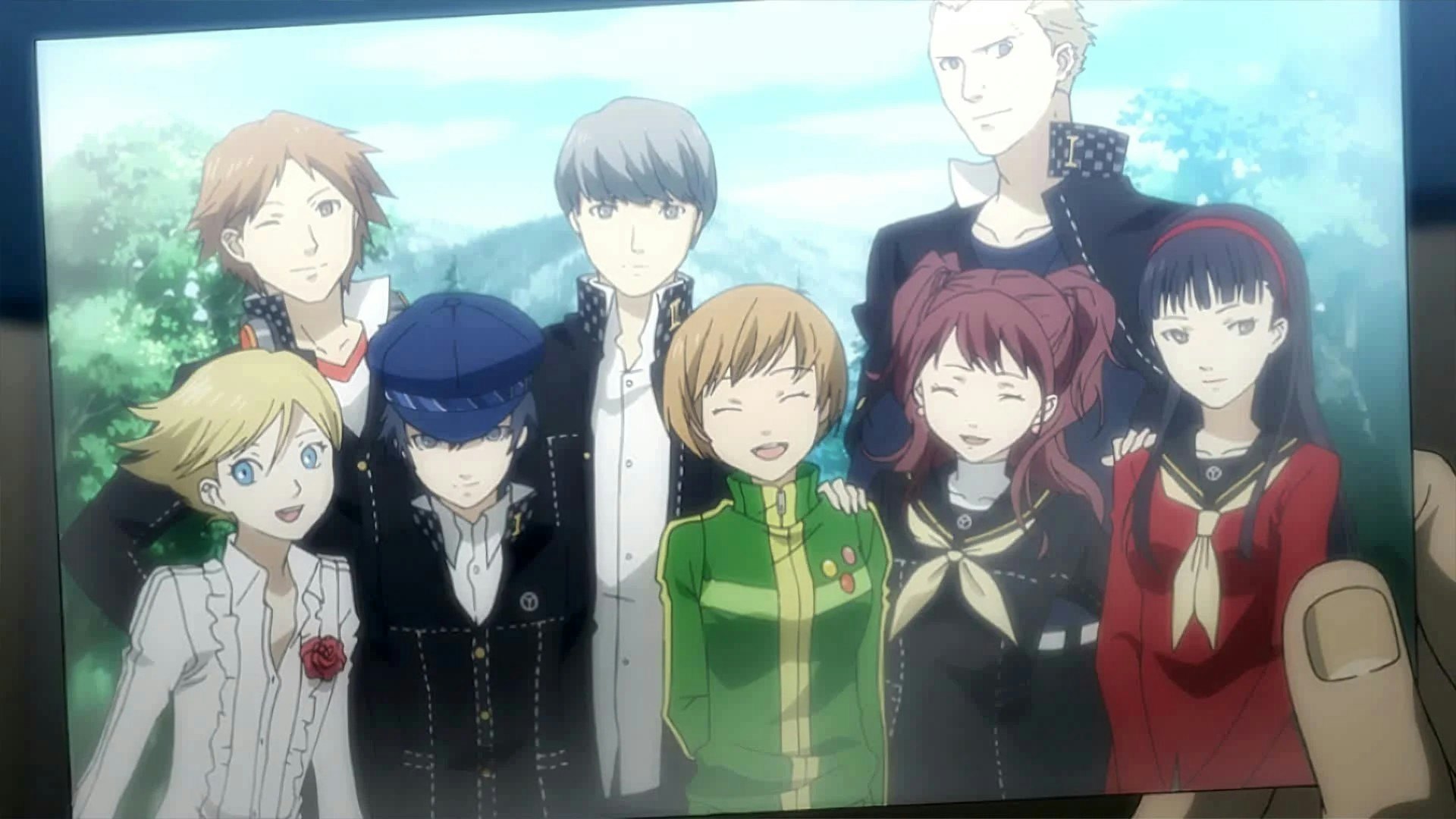
Kudos to the anime for this one. As an adaptation, one of the critical aspects that should remain faithful (if not better) to the original source is the characters. While maintaining their design is relatively straightforward, capturing their charm, nuanced writing, and depth in a different medium is often a challenge for many video game adaptations. However, Persona 4: The Animation does justice to its characters, allowing us to delve deeply into their arcs and growth.
Yosuke: The anime poignantly portrays Yosuke's grief over losing Saki and his initial jealousy of Yu. His journey of self-discovery and overcoming his insecurities was successfully translated into the anime.
Chie: Chie's storyline with her internal conflict and jealousy towards Yukiko was perfectly intertwined with her own chapter, giving us a beautiful scene between these two.
Yukiko: Yukiko's arc about coming to terms with her life in Inaba effectively showed her struggles and eventual realization of why she loves her hometown and friends so much in the anime.
Kanji: Kanji's storyline can be particularly touching (and kind of misunderstood by the fans), as he grapples with his hobbies and how they affect his sense of masculinity. The anime handles his journey towards self-acceptance with a touch of humor and excellent direction.
Rise: Rise's character is beautifully explored as she navigates her dual identity. Recognizing that while Risette is a part of her, she is not solely defined by her idol persona, adding layers to her character.
Naoto: Another problematic one, Naoto’s struggle with her femininity and her role in the police force is handled with care. The anime showcased this in a perfect way, showing us how she does not have to pretend to be something she is not (a boy).
Yu: Finally, we have Yu Narukami, the main protagonist. In the game, Yu serves as a blank avatar for player self-insertion. Thankfully, the anime fleshes him out into a fully realized character. Yu is calm, friendly, and overall a good person. His character arc revolves around his transient lifestyle due to his parents' work, which prevented him from establishing meaningful relationships. It is in Inaba, a small town, where he finds happiness and a family that accepts him just as he is, helping him realize that he is not alone.
Persona 4: The Animation succeeds in translating the essence of its characters from the game to the screen, allowing viewers to connect with and appreciate their individual journeys and growth. This faithful adaptation is one of the highlights of the series, making it, for me, a must-watch for fans.
3. Slice of Life and Comedy.
This is where the adaptation was sold to me. While the game had its fair share of comedic moments, they were often limited to static portraits, as the character models were not particularly expressive. The anime, however, is a complete contrast, with characters moving fluidly to match the rhythm of every joke, enhancing the comedic timing and delivery. Almost all of the comedic scenes are retained and even expanded upon, with greater expressiveness and the brilliant addition of Aika, a new character who frequently appears delivering food, adding a fresh layer of humor. (Seriously, her gag is awesome; I hope we can get her in the eventual remake of the game).
A standout element that adds to the comedy is the anime’s interpretation of Yu. Now he can actively participate in the jokes themselves and not be only a model who laughs in the background because of his avatar status, all of this going accordingly with his established personality in the anime. One of the moments that show this is when he manages to convince his friends to join in the beauty pageant (and not forget the scene of him interpreting a girl in the event of his class). The comedy was one of the key concepts of Persona 4, and thankfully, the anime managed to deliver this in a good way.
Final Thoughts.
As I said at the beginning, while not perfect, this adaptation is genuinely something special. The anime was loyal to the original source and at the same time gave us little details making use of the medium, which only enhanced the experience. The comedy was fabulous, the characters were in context, and the serious moments were treated with respect as they should. Not a lot of game adaptations can manage all of that and be able to stand on their own as Persona 4: The Animation does. In a world of awful adaptations (of any medium like games, mangas, novels), we should be grateful that we have this wonderful piece. Now, should you play this game or watch the anime? Honestly, you can do what you think is right. I always recommend the game first, but if you do not have either the money or the desire to play it, you can always watch the anime; it is really good.
Doesn't matter how far apart we are. The bonds we made will remain strong.
Everyone's heart is connected to the people they know and trust.
It's those bonds that let us all search for our purpose in life.
As long it's a purpose you believe in, there'll always be someone who can help you fulfill it.
For you, me, and everyone else... There are no barriers. Our hearts are one.
-Kuma