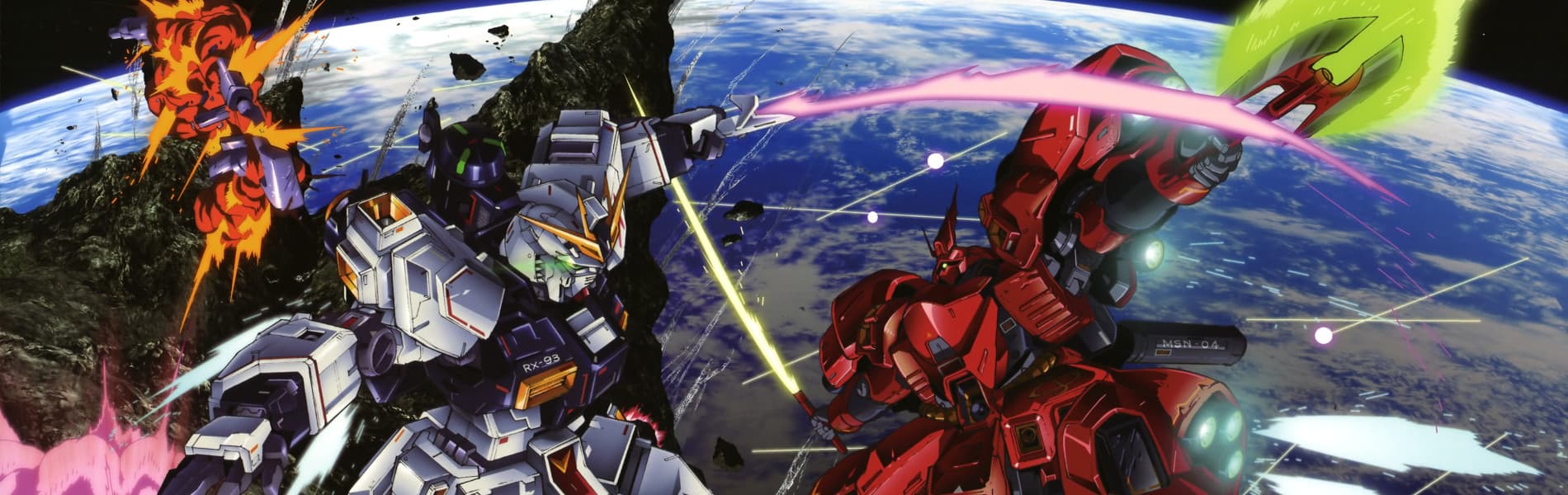
Mobile Suit Gundam: Char's Counterattack is the culmination of the franchise up to that point, and a suitably grand capstone to the early era of Gundam. The movie wastes no time establishing the stakes: Char Aznable is back, in control of the Neo-Zeon forces, and plans to drop an asteroid on the Earth. For the entirety of the film, the looming threat of Earth's destruction is pervasive, as is the more personal and philosophical conflict between Amuro Ray and Char Aznable.
When I first began writing this review after rewatching the film, I intended for a review of similar length to my past Gundam movie reviews. However, as I was writing, I felt the need to address a certain part of the movie in extensive detail, especially after seeing it within the full context of the three preceding shows: the characterization of Char Aznable.
__
PART I: THE RED COMET HIMSELF__
By the time of this film, Char Aznable has wholly descended into megalomania, pursuing destruction on a scale like never before. But why? That topic has been debated by many Gundam fans over the decades, especially since the film leaves the details on Char's whereabouts between Zeta Gundam's end and the beginning of this film vague. For one, there's the argument that his main motive is to get one last duel with Amuro and settle the score once and for all, with his Zeon ideology merely being a pretense. While he absolutely has a desire for a final battle with Amuro, to dismiss any ideology behind his actions is to dismiss all the hints otherwise. As far back as 0079, Char increasingly speaks of viewing Newtypes as the future, the core tenet of his late father Zeon Deikun's ideology (before it was co-opted by the Zabi family for political gain).
In Zeta Gundam, after Four Murasame meets a tragic end echoing Lalah Sune's demise, Char bitterly remarks how humanity repeats the same mistakes and how "warriors are destined to fight as long as they live". Just one episode later, he partakes in a televised speech in which he publicly outs himself as the son of Zeon Deikun and wholeheartedly endorses his father's ideas, declaring that humanity must leave Earth for space instead of clinging to Earth and draining its resources. These two episodes back to back paint the picture of a man who has tried to have hope in humanity as it is, failing, and starting down the path of wanting humanity changed by any means necessary.
In Zeta Gundam's finale, Paptimus Scirocco and Haman Karn accuse Char of harboring a desire to have the world in his grasp contrary to his claims otherwise and question what he plans after defeating his current enemies (the Titans and the Zabis). His response is to claim that even if he does nothing, "humanity will change as it awakens to Newtypes" and he'll wait for that time to come. Despite his claim, it sounds less like the truth and more like another instance of his reluctance to lead others or have responsibility, with the implication that he views his protégé Kamille Bidan as his hope for the future. Of course, this episode and the show as a whole ends with Kamille reduced to a shell of himself, the Zeon wars back and fiercer than ever, and Char once again pulling a disappearing act. While it's never outright stated in Char's Counterattack, it's reasonable to assume that Kamille's fate compounded by first-hand experience with humanity's failure to improve was the final straw for Char. In fact, a [link spin-off video game]( https://www.youtube.com/watch?v=lV5nwlHeY9Q) strongly suggests that Char personally witnessed Kamille's fate and lost all hope in humanity on the spot, lending strength to this theory.
One last piece of evidence lies in Gundam ZZ, despite Char making no appearances in that series. In the penultimate episode, his sister Sayla Mass talks with Bright Noa about Char's whereabouts, speculating on where he is or what he's doing. In their conversation, Bright suggests that Char hates how Newtypes are still merely a concept instead of a next evolutionary step for humanity and that he may be preparing to take action. Sayla's response is that Char is guided by "ambition and delusion", as if he thinks "he must obey some sort of cosmic will". Sayla, who grew up with Char in their formative years and would later hear him espouse his ideas of Newtypes during 0079, is the character most likely to understand what Char's true ideology is. With all the scenes described taken in mind, it feels inevitable that Char Aznable would ultimately descend into nihilism, misanthropy, and demagoguery. After everything he has experienced up to this point, he has come to believe that humanity as it is now can never be saved, and that the only way to fix things is to kill everyone on Earth while the people in space survive to achieve the next stage of evolution. Yes, he desires a grudge match with Amuro and even supplied the opposite side of the war with the technology to make it happen. But having watched all of Char's story from 0079 to Char's Counterattack, I cannot say that his grudge with Amuro is the sole or primary reason for his actions in the film.
PART II: THE REST OF THE REVIEW
On a technical level, the film is downright stunning. The animation is stellar, looking even better than Encounters in Space or Zeta Gundam did. The battle scenes are quite possibly the best of the entire Gundam franchise, with frenetic action and spectacle befitting the capstone to the first era of the franchise. The music is also strong, especially the closing theme “Beyond the Time”.
For all my praise of Char Aznable and his character in this film, the story is not perfect. Yoshiyuki Tomino is a highly ambitious storyteller, often biting off more than he can chew and needing to heavily condense or compromise his original vision due to executive mandate and/or simple practicality. Char’s Counterattack is an especially big example of this, with the final product throwing the audience into a status quo much different from its predecessor Gundam ZZ with minimal explanation. The film also has few characters from the preceding three shows, primarily focusing on entirely new characters who often have only the bare minimum of background or characterization. With the film seemingly missing a proper first act, it’s apparent that Tomino had to make compromises on his story to make it feasible.*
There is also considerable time spent on the characters Hathaway Noa and Quess Paraya, both of whom are notoriously divisive. Upon my first watching, I felt both characters were annoying, shallow, and distracted from the main conflict. However, upon rewatching with more mature eyes (and the benefit of hindsight with the first Mobile Suit Gundam: Hathaway movie out), I feel more generous towards the characters. Quess’ immaturity and impulsiveness are more understandable given the combination of her spoiled upbringing, the pain she feels over her father leaving his wife for a mistress, and her latent Newtype abilities leaving her unable to connect to others. Furthermore, Quess’ issues over her father serve to complement Char’s own issues stemming from the loss of his mother**. Meanwhile, Hathaway’s character can be best described as tragic. He follows in his father’s footsteps by getting involved in the war despite being warned not to and naively assumes that he can be the hero who saves Quess as she falls deeper into Char’s manipulations. Hathaway’s youthful idealism is shattered when Quess is killed on the battlefield, having never come close to being saved by him. This moment sets the stage for Hathaway to go down a darker path in the Hathaway’s Flash novels/movies, much like how Lalah and Four’s deaths both contributed to Char’s final descent.
The final act is a stunning piece of work. The action and animation reach the pinnacle of spectacle, with Amuro and Char duking it out in not just a physical battle but a philosophical battle. Char firmly believes there is no hope in the people on Earth, and given everything that’s gone down in the past three shows, it’s easy for the audience to see his point. Decades later, it feels even easier to be swayed by his point than ever, as the world continues to be ravaged by needless military conflicts, pollution, pandemics, and selfish politicians who fail to take necessary action to save lives (often knowingly making things worse). Like Char, Amuro has had a rough past, with much of his life from his teens and onwards being spent at the frontlines of war. And like Char, Amuro is no fan of the Earth Federation politicians and knows how bad things are. However, Amuro has one thing Char does not: hope. Amuro still believes that with time, the people on Earth can learn to change for the better and improve things, no matter how bleak things seem. For that reason, Amuro cannot let the people on Earth be killed. With the power of psychic-powered mechs, Amuro and Char clash over the Axis asteroid plummeting to Earth, in a struggle between hope and despair.
In the end, hope wins. Through the literal power of humanity’s will, a massive burst of psychic energy empowers Amuro to avert the Earth’s destruction at the cost of his and Char’s lives. The people on Earth get to live another day and have a chance to change for the better. And with that, a saga of 140 episodes and a movie comes to a close. After revisiting Yoshiyuki Tomino’s first stretch of Gundam works for the first time in years, I have learned to appreciate them to an even greater extent than I previously did. In the past, I felt Char’s Counterattack was merely good, not quite up to the standards of 0079 and Zeta Gundam. If the length of this review didn’t tip you off, I no longer think this. In fact, I now believe Char’s Counterattack is among the highest points of both the Gundam franchise and Tomino’s career as a whole***. Any qualms I have over Char’s Counterattack are outweighed by the sheer technical triumphs, impeccable character work with Amuro and Char, and gripping themes. Char’s Counterattack has more than earned its place as a classic of mecha anime.
Notes:
*Notably, Char’s Counterattack was preceded by two novels by Tomino that followed the same plot but contained differences, effectively acting as the early two drafts before production began in earnest: High Streamer (his first version of the story which expanded on the first act) and Beltorchika’s Children (a revised and expanded draft containing several plot elements that were excised from the final film). The latter is easily the better-known, as it has a complete fan translation in English, a manga adaptation currently being published in North America, and was directly followed by Hathaway’s Flash (a novel trilogy adored by Gundam diehards that is currently being adapted into a film trilogy).
**As infamously exemplified by his final line about how Lalah "could have been a mother to me”, not helped by the strong implications that he likewise views his current lover Nanai as a replacement maternal figure.
***For anyone who wants to know, Tomino’s pinnacle in my opinion is Turn A Gundam, a distant successor to the entire Universal Century Gundam timeline and comfortably in my list of top 5 favorite anime in general.
39.5 out of 43 users liked this review
