Girls' Last Tour
a review by Faytanix
a review by Faytanix
A series about two of the last humans trying to survive day by day in the decaying corpse of a world isn’t what I would typically associate with feelings of relaxed calmness, yet this is the odd blend that Girls’ Last Tour attempts to find. The series uses its seemingly juxtaposed elements to create a series that instills the viewer with a melancholic but soul-calming reflection over humanities history, culture, and life, then eventual death. I found that the series excelled at creating an excellent atmosphere for an iyashikei through solid design choices but felt shallow with characters, narrative elements, and most importantly, the show's attempts at profoundness. This overall made it difficult for me to connect with the series beyond a surface level.
Creating an engaging atmosphere
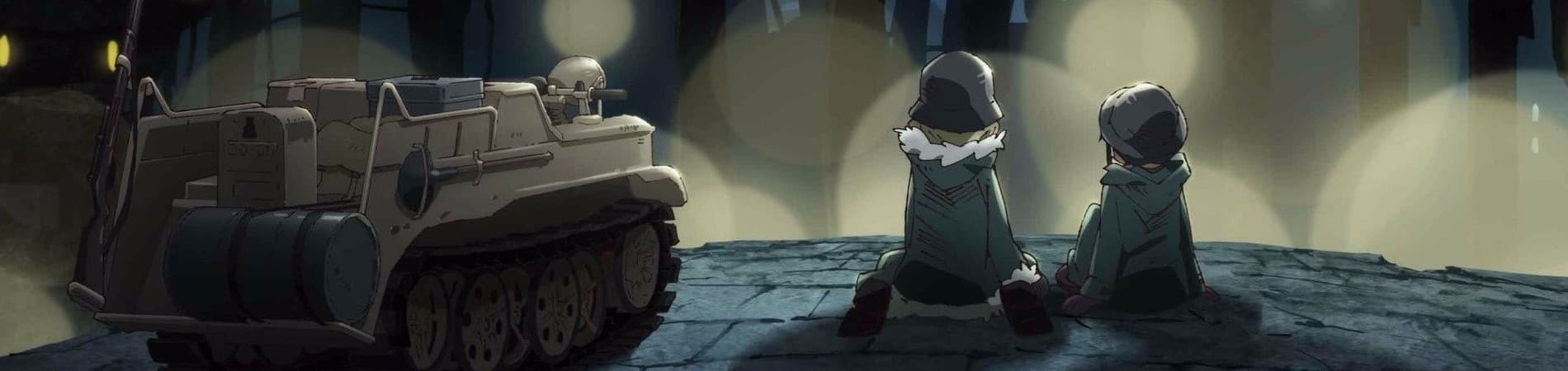
Girls’ Last Tour’s best feature is in how an engaging atmosphere is created through competent design choices. The art excels at expressing the series themes with haunting sceneries of an empty, endlessly sprawling series that constantly remind you that death is imminent and constantly highlights the struggle to survive and press forward in the journey and muted colour palettes to add emphasis to the bleakness of the world. Most of the series audio elements were exceptionally crafted and absorbed the viewer into the scene. For instance, from my chair, I could really feel whenever a frigid gale was blowing in the show. Or when you could hear soft echoes of machinery at work, either as a hollow reminder of what was or meaninglessly working for a purpose long lost. It really added a fine touch to the atmospheric intent of the show. The only audio decisions I’m a bit torn on are the ‘cosy’ tracks, which occasionally play over scenes that are somewhat intense. It’s that juxtaposition the show is trying to go for, but in some regards it also removes tension, which could be gripping. You could argue either way for those tracks, but I’m not sure what would be better. With that said, these combined design choices make an interesting world that draws the viewer in, and if the series narrative, characteriszation, and philosophical elements were as strong, combined would have made a very memorable title.
Notable flaws
The few side characters met in the world are fairly empty and devoid of all personality due to the limited time spent with them, but also as they are designed to serve as a representation of a theme rather than an actual human or character. Their concepts don’t lack intrigue, but once again the series chooses a shallow path of exploration, making them lacking in execution. But more importantly, the two central characters, despite being with them for 12 episodes, felt zero connection to them. They have fairly defined characters from the start, which is a good decision so the audience can understand who the characters are from the beginning and distinguish them from one another based on their values, fears, etc., but over the duration of the series, there is little to no meaningful expansion or growth of these personalities, which would make me attached to them as people and their struggles on screen. They feel more like a vehicle for the viewer to look through their eyes into an unfamiliar world than actual human characters that develop.
A common expression is often exploited in the show, which is either “I heard this” or “read this in a book,” which is used by characters to supplement otherwise lacking knowledge, which, in a post-war torn world, would be hard for children to obtain. While there are in-universe reasons to explain this, it often feels like the series is cheapening out at what could be a more interesting series of events where the characters have to discover more for themselves. This is even done in certain episodes, like when the characters are learning what a camera is and how it works, and this I found to lead to more interesting discoveries for the characters, consequently creating more entertaining sequences for the audience.
As I mentioned earlier, I felt that the various philosophical discussions the show presented were fairly shallow, offering little insight into the topic of the episode or scene. There are a couple reasons as to why I feel this is, and I find the series Kino’s Journey to be a perfect comparison to Girls’ Last Tour as their themes and premise are very similar, but Kino’s Journey is able to discuss philosophy, morality, ethics, etc. to a more meaningful level. The first comparison being the pacing of episodes. Some episodes focused on three ideas, items, or concepts, leading to their simply not being enough time to go into depth, as additionally the show's overall pacing is towards the slower end, meaning things including exploration and discussion take time before getting anywhere. This is fine for an iyashikei to do; it's part of the genre to take things slower, but Girls’ Last Tour feels a bit greedy in trying to balance both precisely. Whereas Kino’s Journey typically has a whole episode around one concept, allowing plenty of time to communicate to the audience the meaning of what they have watched. What is explored is another distinguishing feature, where in Girls’ Last Tour part of the shows charm could be considered in its discovery of the simplistic ideas and items, such as alcohol, a camera, a temple or a graveyard, etc., and then seeing Chito and Yuuri’s response to these; however, they are already concepts that the viewer would already be familiar with, whereas Kino’s Journey chooses to explore more niche complex ideas and perspectives that the viewer may not have considered before, keeping the viewer more interested as Kino’s Journey is an exploration not just for Kino and Hermes but for the viewer as well. The final main difference is setting. Whilst I have highlighted that Girls’ Last Tour’s setting is the best feature of the series, it does lack variety, which can limit the perspective provided to some of the themes and concepts, whereas Kino’s Journey has free reign over where certain discussions are had. Hopefully this comparison provides context as to why I feel that Girls’ Last Tour is sufficiently limited in its exploration of humanity, which I believe to be a core focus of the series.
Perhaps more of a nitpick than the other points, it still bothered me nonetheless. The use of 3D in scenes with the main vehicle unfortunately stood out too much, with cuts between characters in 3D and 2D being relatively awkward, and the placement of the vehicle and character models in the 2D environment felt cheap. I understand that the series likely did this due to funding reasons, but regardless, as a viewer, it did remove me from the atmosphere of the scene at times.
Conclusion
I didn’t hate this series, but I didn’t love it either. Which leaves me with some lingering feelings of mild disappointment, as it is a series I wish I enjoyed more. Additionally, I find this series to be a difficult sell to most anime watchers, as many will check out early due to the slow pacing and overarching lack of plot direction, and those looking for a profound series will likely find it lacking in depth, which I find myself aligning with the latter. However, for those interested in the niche atmosphere that this series can immerse the viewer in at its finest, this can certainly be an enjoyable experience that inserts itself as a memorable addition to the Iyashikei genre.
37.5 out of 66 users liked this review
