Born in Oogaki in 1970, Kenji Nakamura would get his start in the animation industry in 1997 working as a production assistant for Toei Animation. This role would quickly evolve into an assistant episode director role. Fortunately Kenji didn’t restrict himself to Toei, and thanks to his ventures away from the house of Mr Izumi Todo-san, Kenji would get the opportunity to work with future collaborators such as Chiaki J Konaka. He would also get the opportunity to join the long and illustrious list of Akiyuki Shinbo protégés, putting him in fine company alongside Yasuhiro Takemura and basically everyone who's ever worked at Studio SHAFT. Through working with Shinbo on The Soultaker and Triangle Heart Kenji Nakamura would learn how to create an immersive atmosphere through unique and distinct direction whilst working with a tight budget.
Continuing his freelance adventures Kenji would find himself working as assistant director to Mamoru Hosoda on Howl’s Moving Castle for Studio Ghibli. I would love to step into an alternative reality where Nakamura and Hosoda’s vision for Howl was fully realised. I controversially think Miyazaki taking over the production of Howl was the biggest mistake Ghibli has ever made. It showcased the studio’s resistance to invest in new talent and signifies the beginning of the end for the Studio. Howls production is one of the most fascinating ones the animation industry has to offer, and Kenji Nakamura’s involvement is yet another maddening development in the troubled history of Howl’s Moving Castle. I can only speculate but I personally believe the hellish production of Howl’s Moving Castle is what caused Kenji to return and ultimately settle down at ironically the studio Miyazaki once fled and co-lead a mass exodus form, Toei.
Shortly after returning to Toei, Kenji would be intrusted to direct the final arch of the Ayakashi series entitled Bakeneko which focuses on a travelling medicine seller who seeks and banishes Mononoke. Following the success of the Bakeneko arch Kenji Nakamura would get the opportunity to prove himself as a series director expanding upon what he had started with Bakeneko. Continuing the tale of The Medicine Seller, Kenji Nakamura’s Mononoke would become one of the more notable series in one of the most notable years in anime history. Just as successful as the short it was based on Kenji Nakamura would round up almost the exact same team 2 years later to create, Kuuchuu Buranko.
2nd patient / 1st example: Tetsuya Taguchi
Mr Taguchi-san wakes up one morning form the ultimate power fantasy to find he has the ultimate power boner. But morning glory remains in the evening’s inventory and Tetsuya is forced to face the brutality of what some men would wish to be their reality. This abnormality finds Tetsuya in the holistic hospitality of Dr Irabu. Aside from invading every aspect of Tetsuya’s personal life Dr Irabu's treatment consist of a sloppily administered mysterious vitamin shot form his possibly untrained and equally as mysterious nurse, Mayumi. Which, given the intense glare and perfuse sweating, probably leaves Dr Irabu in a similar state to Tetsuya. Alongside resupplying Tetsuya with some vitamin X this shot reveals the form of the condition and the face Tetsuya hides form the world. The anthropomorphised form Tetsuya’s condition is represented by is that of a Rhino, because boner.
Except not just boner, but instead Buddhism. Sutra is Sanskrit for "thread" it's a piece of ancient literacy that looks to teach the reader a valuable lesson through the ideals of Buddhism. A notable sutra of particular importance is the Rhinoceroses Sutra, that advocates the merit's of solitude. Majorly ironic for a man struggling to handle his own. Perhaps the animal head which embodies the form of the condition also represents a lesson to be learnt. Tetsuya needs to discover the strength that can only be found in independence and become a man of his own merit, rather than one who's self-worth is measured by how other's view him. Or in Tetsuya's case how others use him.
The second face Tetsuya and the majority of people chose to showcase to the world is one of conformity. Unlike Mononoke the character designs of Kuuchuu Buranko follow a template, an archetypical design that displays an archetypical understanding of a universal standard. This simple, yet extremely affective design choice highlights the general limitations we subconsciously force upon ourselves. Especially in relation to our emotions and how we express or maybe more importantly chose not to express ourselves.
Although it’s thankfully acceptable to discuss and display are mental health and emotions in many cultures and countries. There are still equally as many where said discussion is muted and an organic display of emotion feels like a borderline criminal offense or an open invitation to be lambasted as a lunatic. Obviously how we handle are emotions is and should be a matter of personal preference nonetheless I still believe, even if subconsciously, we still have some lingering primitive pathway or mirror neurons that leads to us emotionally restricting ourselves in social situations and Tetsuya is no exception to this social phenomenon.
The third face is supposed to be that which is shown only to friends and family, but it’s this part of the proverb that Kenji Nakamura and crew look to substitute. The original “Mitsu no Kao” proverb is pretty soul crushing when you think about it. The idea that all people are inherently deceitful, that we’re all constantly hiding something form one another. There are worms under your skin, people living inside your walls, and everyone is a malicious disingenuous hatebreeder. Now whilst two of those things may be true not everyone is inherently insincere and the variation of “Mitsu no Kao” provided in Kuuchuu Buranko, is that which represents raw emotion. This is the realest face we have, it's less the face we hide form the world and more the face we can’t help but show.
For Tetsuya this face is shown when in agony, anguish and a constant bombardment of excruciating pain. Despite or perhaps because of his flaws Tetsuya is possibly the most sympathetic patient that comes Dr Irabu's way. Nothing Is worse than knowing someone you care about is better off without you, it’s made even harder when you are undeniably worse without them. Tetsuya having gone through a divorce, struggles to cope with after many years seeing his Ex-wife dressing in a completely different style, strutting around with a new-found confidence and a freshly accepted engagement ring, All this whilst he sinks lower into a depression which has left him a pitiful mess ironically unable to stand up for himself. I won’t Spoil the tale of Tetsuya because the fist-pumping energy I felt by the end of the episode genuinely surprised the hell out of me. Much like Mononoke there’s heart behind the infinite layers of abrasive abstraction Kuuchuu Buranko offers, it’s the gold in the mountain of Ibaru’s madness.
6th Patient / 2nd example: Yuta Tsuda
Alongside currently 3.8 billion people, (which is only roughly 48% percent of the population so nothing to worry about.) Yuta suffers form an extreme case of Cell phone addiction. Completely dependent on his cellular phone Yuta has aggressive bouts of anxiety when separated form his cell. Yuta’s Okasan looks to free him from his self-induced electronic enslavement by sending him to become the latest patient of Dr Irabu Ichiro. Getting his customary vitamin shot Yuta seemingly continues to compulsively tap away at his phone like a woodpecker does a tree. Throughout the episode we rarely get to see Yuta’s true face outside of the manic frenzy he enters when snapped out his favourite fixation. (And also, when ogling Mayumi.) But what has led Yuta to developing such a mentally debilitating dependency to his cellular phone.
Yuta is constantly surrounding himself with others, forever socialising yet completely alone. It’s almost up to debate weather the people Yuta surrounds himself with are parasite’s leaching of an overtly awkward human shaped money bag. Or if Yuta is some blood-sucking bore that is obsessively trying to force himself into their group, a transparent figure that can tailor itself to any social situation but never be bold enough to thrive or even really standout. For this reason, the face Yuta shows the world is more of a representation of his condition than the woodpecker endlessly tapping away. Yuta’s cellular phone means he’s constantly connected, never alone, never neglected, never at peace.
Through are cellular phones, and now smart phones, we have an unlimited wealth of knowledge that we struggle to reach through a sea of misinformation, we have an overwhelming amount of convivence that we take for granted and we are expected to be constantly connected never to have a moments peace through an endless onslaught of messages, email and notifications. The average attention span is being annihilated by videos of a diminished length and diminishing substance. You used to go to the cinema to watch a feature length 2–3-hour film, that became a 1-hour television show, then that became a 30-minute television show, then that became a 10-minute YouTube video which transformed into a 30 second TikTok. Technology out of balance, humanity out of balance and life out of balance.
However, the point of this tirade isn’t to paint technology and cellular devices as some evil presence, the beginning of the end for humanity or some corrupting force destroying the sanctity of life. Technology is incredible in ways I literally don’t understand like how did someone even create the devices I use on a daily basis. Actually scrap that how did some create the devices that create the devices I use on a daily basis. It’s completely mind-blowing. And just like how after all that negativity and maybe even in spite of all that negativity I could still conclude that technology has had an overwhelmingly positive impact on are lives. And I can also conclude that there is a positive, yet totally misguided, change Yuta is looking to make in his life. The woodpecker in Buddhist mythology is connected to the anahata (heart) chakra, and that is what Yuta’s rhythmic drumming is trying to connect to. But he’ll never break through the surface typing typical replies, in order to truly heal himself of his condition and make the connection he longs for he’ll have to show the world his true face.
10th patient / 3rd example: Mitsuo Tanabe
Mr Tanabe-san is the president of the great Japan newspaper company and owner of the Mighty Japan Great baseball team. Aside form being a very powerful man he evidently has an exceptional amount of praise to throw at this Japan country I keep hearing about. Nabe has enjoyed a successful career and become a media magnet thanks to his powerful political connections and proprietorship of multiple thriving business. Nabe is a conqueror, imperially triumphant, starting form the ground and working his way up to the borderline of heaven. So why does someone so prosperous, so affluent and so head-strong need to enter the care of Dr Irabu...
Fear.
Everyone fears something, no matter how successful. Steve Jobs suffered from koumpounophobia, Thom Yorke has amaxophobia and I suffer from a completely rational fear of chimpanzees. No matter how smart, skilled or successful you are everyone fears something. Mr Tanabe-san is no exception, suffering from thanatophobia, a fear of dying.
Death as an experience is impossible to comprehend, it’s the one certainty in life. I personally find a beauty in death it’s what gives us purpose, It's what motivates us to do something with are lives. It's what motivates us to make great discoveries and to overcome unbelievable obstacles. We will die so we ought to live.
Tanabe is a winner, but he is confronted by the inevitable battle we’ll all lose. When given his vitamin shot Tanabe notably doesn’t turn into an animal, he stays human. Of all the animals are relationship with death is the most estranged, for humans it goes beyond survival instinct are relationship with death is oddly personal. It’s been stated that future thinking is what separates us form the rest of life on earth, our ability to live beyond the now and think to the future. And in every future is death. The face that represents the form of Tanabe’s condition and the face he shows the world is that of a younger self. So, what is the face Tanabe can’t help but show the world? It’s that of an old man who has accomplished so much. The world has changed not in spite of him but because of him, he changed the lives of those he loves, changed the sport of which he loves and changed the city that he loves. His is not a life to fear losing but to celebrate everything it amounted to. But weather that will come to fruition is up to Tanabe and weather he can overcome one last hurdle and conquer his fear of death.
__
Patient 0 / Example 0: Dr Ichiro Irabu__
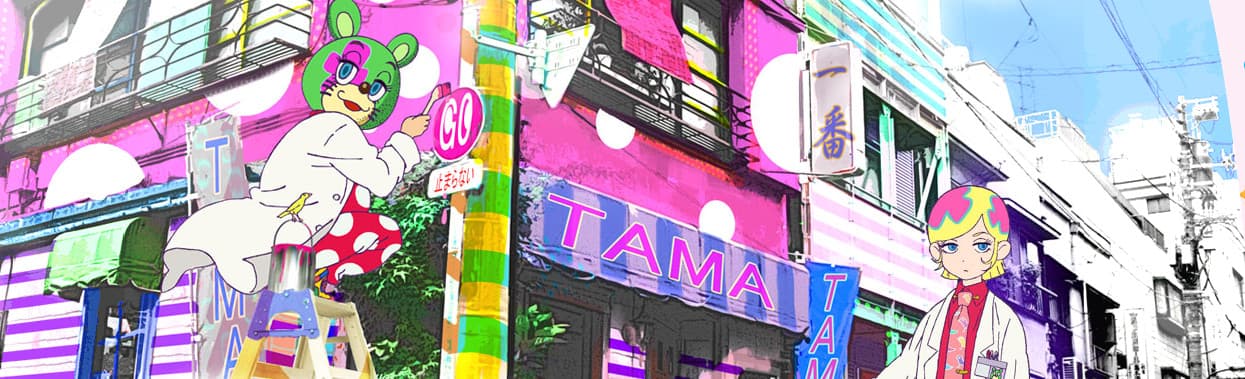
Kuuchuu Buranko is frankly violently psychedelic, sickeningly saturated, nauseatingly lit and one of my favourite looking animated series I’ve ever seen. Kuuchuu Buranko is tantalisingly tacky, gorgeously gaudy, brilliantly brash and Dr Ichiro Irabu is the perfect amalgamation of all these qualities. He dances so dangerously on the verge of being annoying but, for me, never crosses it. If you finish the 1st episode of Kuuchuu Buranko and think it’s a distasteful unattractive mess that’s perfectly reasonable, if you completely despise the manifestation of the series uniquely ugly aesthetic in Dr Ibaru that too is perfectly reasonable. I was perplexed by the 1st episode of Kuuchuu Buranko and a little bit disappointed, but with the 2nd episode something clicked, and I found that the continuing tale of Kenji Nakamura is one I’m glad to be on.
13 out of 15 users liked this review