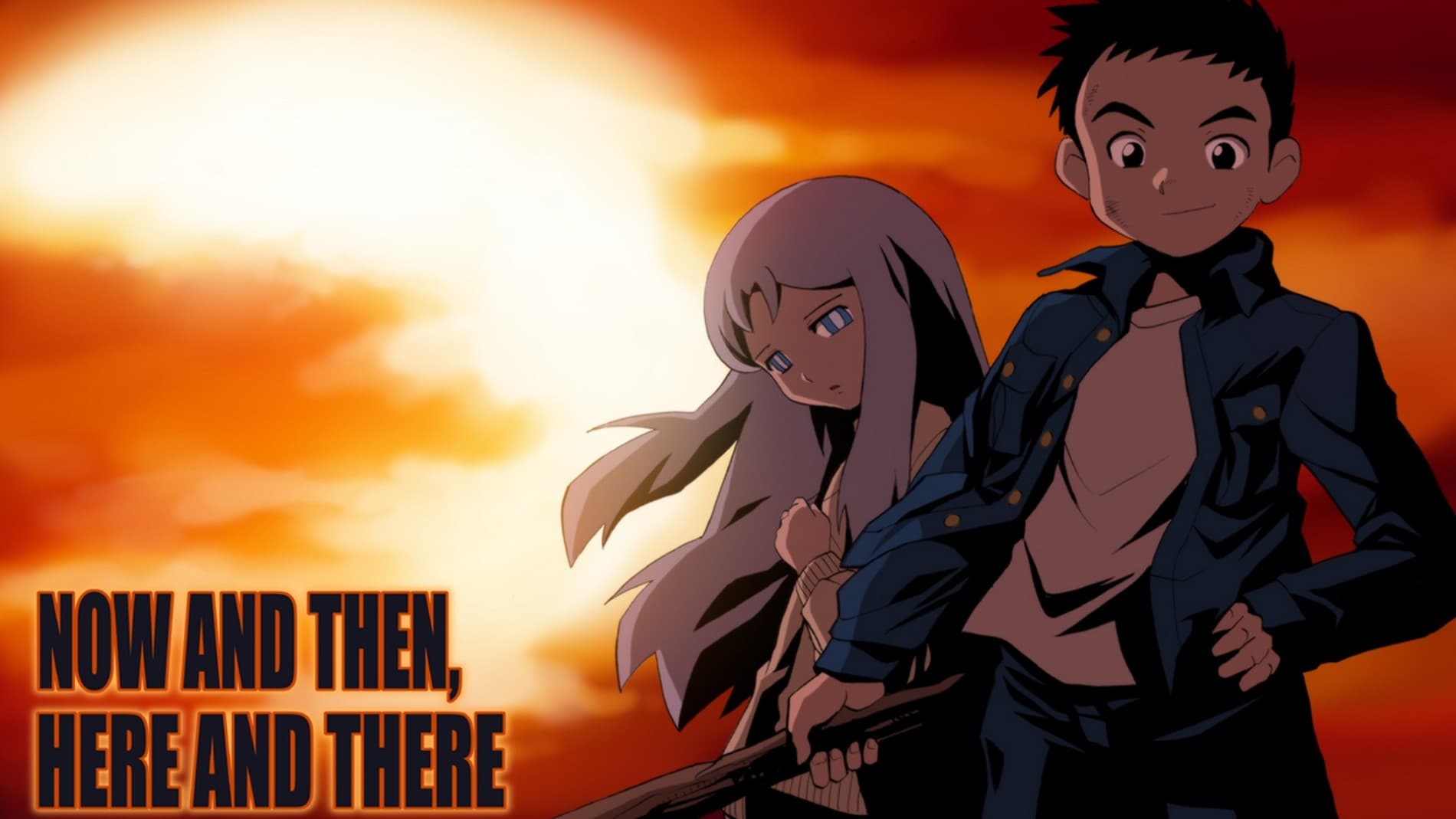
Shuzo Matsutani, or “Shu” for short, is a bright eyed, optimistic young boy with a heroic and earnest attitude, and the self-awareness of a pet rock. He has a passion for Kendo, but rather than actually putting in the effort to practice and improve his skills, he just enjoys the sensation of swinging a big stick around and putting on a show. One day, on his way home from school, he spots a lonely girl with bluish silver hair sitting alone atop a giant smoke-stack, so like a rational person he climbs up after her to chat her up. As it turns out, that girl, named Lala-Ru, is a fugitive from a dystopian isekai wasteland, and when her captors come to collect her, they also wind up taking Shu with them, despite their best efforts not to. Now, trapped in a parallel world with no apparent hope of returning home, Shu must brave a world of war, military conquest, slavery, rape and child soldiers to protect himself, and as many other people as his gigantic heart possibly can.
Now and Then, Here and There actually has a pretty impressive pedigree behind it. It was produced by the main branch of AIC, which has proven itself multiple times to be perfectly capable of delivering premium results with less than stellar resources. For example, Battle Athletes Victory may not have always looked... Well, passable, let’s be honest, but AIC knew when to pour money into a sequence and when to hold back, and they went all in wherever it really counted, such as running animation, and a lot of that aptitude shows just as strongly here. There are small moments where the animation might look a little stiff or stilted, but more often than not, onscreen movement is fluid and graceful, especially during any kind of action scene, or just really intense scenes in general. There’s also a ton of extra attention to detail put into the smallest of movements, the kind of details that make perfect sense when you see them, but you totally wouldn’t miss them if they were omitted.
What pushes this anime over the heads of other AIC shows, and yes, that even includes Battle Athletes Victory, is the strength of the director, Akitaro Daichi. To be clear, Daichi hasn’t been attached to a ton of well known anime, but in addition to the storyboarding work that most directors and production companies dabble in, he’s also dipped his fingers in cinematography, writing, and even a little bit of voice acting. During all of this, he has picked up directing work on countless smaller and lesser known projects... A few series that never made it overseas, some forgotten OVAs, that sort of thing. Not the most impressive resume in terms of popularity, but more than enough to suggest that he had ample opportunities to cut his teeth and home his craft before working on anything thatr was going to be remembered by the masses. The one exception to this, which is shocking at first but may make more sense when you think about it, is that he was the director of the original nineties version of Fruits Basket.
The reason this is surprising is because in regard to tone, these two shows are on completely different ends of the spectrum, and it’s hard to imagine the same hand guiding the two. Then again, Spielberg directed both Schindler’s List and Tiny Toon Adventures, so I guess it’s not that shocking. The reason why it gets less surprising the more you think about it is because despite Fruits Basket having a bright and family-friendly exterior, it also featured a wealth of emotional maturity, and it’s far more memorable for its slower and more quiet moments than for jangling keys in your face. Well, as it turns out, this combination of studio and director was a match made in heaven, because their efforts... Combined and separately... Are borderline perfect. Aside from directing, Daichi was also the series creator, which means he basically came up with everything about it from scratch, and AIC were clearly more than happy to supply him with the resources to bring his vision to life.
Rather than just being a thoroughly well animated series, just about every aspect of this anime’s production works in perfect synergy to establish a consistent tone. The lighting is on point, from the comfortable encroaching darkness of the evening in Japan, to the dark and claustrophobic interior of Hellywood, to the bright and clear skies of the open desert and the oasis settlements of beyond. The cinematography seems to strike somewhere inbetween the influences of Stanley Kubrick and David Lynch, especially when we’re seeing the interior of Hellywood. The designs are also extremely clever... For one example, the mad King Hando’s living quarters feel almost like a prison cell, sparsely furnished in a way that’s just lavish enough to put a thin veneer of comfort on top of what is otherwise an isolated glass dome, the perfect metaphor for his dangerous mental state. For another, the character designs are deliberately childlike and cartoony, calling back to a more classic anime aesthetic, giving the series a consistent aura of corrupted innocence.
My only real complaint is the aspect ratio, because it doesn't do any favors to scenes taking place out in the desert, but it still works just fine within Hellywood itself. The music is really strong and striking, but oddly enough, I was more impressed by what this show was able to do with silence, moments where the unsettling atmosphere is truly able to sink in, with scenes like these often putting you into the headspace of a character while all we’re really doing is watching them think. The English dub was a Central Park Media effort, and yet despite that group’s laughable reputation, the dub is actually really strong. Some of the child character’s actors sound a bit too old, like Ted Lewis and Kayzie Rogers as Shu and Sara, but they still pull off phenomenal acting jobs, especially with the human emotional roller coaster known as Sara.
Lisa Ortiz is enough of a legend that I shouldn’t have to tell you how good she is as Lala-Ru, all you need to know is that she does not seem at all like the right vocal register for that character, and yet she still fits her like a glove. Dan Olk is skin-crawlingly terrifying as the Mad King Hando, he was clearly having a blast in the recording booth, and God bless him for it. Pokemon’s own Rachel Lillis plays two characters who sound completely different, yet are intertwined by fate in a fairly unexpected way. The only real sour note is Crispin Freeman as Tabool, one of the meaner child soldiers, and while it’s never easy to criticize an actor as talented and well known as Freeman, he was badly miscast in this role. He sounds all right once in a while, but most of the time he delivers his lines in a register that’s less believable than Donald Trump’s wig. I guess it’s worth mentioning that a lot of the voices are similar enough to their actors’ more popular roles to be distracting... Especially with Tracey Sketchit and Lina Inverse as the main protagonists... But it’s still a stellar dub for the most part.
So right off the bat, Now and Then, Here and There is already in pretty good company, as it fits pretty cleanly into a category that I like to call “Legacy Isekai.” This is a term I came up with to describe relatively older anime that show all the classic signs of being isekai, but came out a good amount of time before the isekai explosion of the 2010’s was able to kick off. They feature protagonists who have been transported to another world that exists outside of the reality they came from, but they also feature a lot of unique quirks and qualities that don’t quite fit into the modern isekai mold as we know it. A lot of the more tiresome tropes and repetitive cliches don’t really figure into them, which allowed them to take what I’ve always considered to be a super fun story concept that allows for boundless creative freedom, and actually turn in a final product that ironically feels a lot more fresh and unique than more modern fare.
This lack of confinement to modern trends also elevates what is probably the show’s strongest aspect, which is, again, the overall tone. Now and Then, Here and There has a reputation for being a deadly serious anime, with a heavy tone and dark atmosphere. If it had come out in today’s market, I wouldn’t hesitate to call it a dark subversion of the Isekai genre, but again, I do not believe that kind of influence really figured into its conception. Being the kind of anime that you almost have to watch with the lights on and a furry friend in your lap for emotional support, it’s popularly considered to be the kind of tragic masterpiece that has the power to traumatize its audience as it explores the darkness of the human condition and the horrors of war. I will admit that this is the kind of anime that every anime fan should see at least once, provided of course that you’re not instantly turned off by the multitude of trigger warnings that come attached to it... But having said all that, it might surprise you to hear that I fucking hate this show and everything it stands for.
Before I start to go off on why, I should clarify that yes, I do still recommend watching this series. When I was in highschool, one of my favorite classes was Cinematic Literacy, where we would both watch and discuss classic, historically important, and critically acclaimed movies. If I were to teach an anime equivalent of that class, I would definitely have Now and Then, Here and There on the curriculum, despite my personal hang-ups, because it is a highly provocative and divisive piece of media, which of course means that it’s prime pickings for thoughtful discussion and discourse. I actually find most of the things I don’t like about it to be far more intriguing than some of the stuff I like about a lot of other titles, and in spite of the above average production values and admirably consistent tone, for me, the biggest problems with this series boil down to its writing, and while I promise I’m going to give out some specific examples a little later, my main issues generally revolve around this show maybe being too dark for it’s own good?
And no, I’m not saying that there’s a limit to the amount of darkness I’m willing to take, but the more serious and tragic a story gets, the more deft a hand you need to have in writing it, and the more effort you need to put into justifying it. One cannot simply write a story as bleak and balls to the wall traumatizing as this one without having a good reason for it. The perfect example of this is probably The Hunchback of Notre Dammes... Or, more specifically, the original novel, Le Notre Dammes de Paris. If you’re only familiar with the Disney movie, you may be shocked to find out just how dark and cruel the source material is. To make a long story short, everyone suffers, and if I remember correctly, the only well known characters that survive until the end are Phoebus and the goat. But there was a reason for all of this.
Victor Hugo originally wrote his novel with the intention of drawing public interest to the titular cathedral, because it had been severely damaged through the years(mainly due to human idiocy and apathy), which bothered Hugo because he believed strongly in architecture as the language of time, and that before the invention of the novel, it was the edifice that was most ideal for shepherding the ideas of the past into the future. The reason all the human characters in his book(again, except Phoebus) are fated to toil, suffer and die is because they’re not important, neither to time nor the story... The main character is the cathedral itself, which stands impassively over their pitiful ephemeral lives, weathering every storm even as their blood stains its steps. Hugo’s message was that only architecture can possess true immortality, or it would, if you motherfuckers would stop tearing it down already.
And you know what? It worked. His book made the cathedral so famous that it was soon restored and renovated, and the movement for preservation of historical landmarks really began to kick off. It is directly because of Hugo’s efforts that the cathedral survived into the 2020’s, where it would finally burn down in front of millions of tearful spectators, which is a far more beautiful fate than it would have suffered otherwise. And to prove my point a little farther, once the book achieved its goal, it started to receive adaptations that were a lot less harsh, and a lot more optimistic, as they moved to a new purpose; IE, justice for the oppressed. And amusingly enough, Hugo was directly involved in a lot of those adaptations, because he was more attached to his magnum opus than Hideaki Anno is to Evangelion.
Look, I’m not expecting Now and Then, Here and There to revolutionize the world, but at the very least, I’d expect the kinds of atrocities it has to display to leave me feeling something a little more substantial than just emptiness. There are countless decisions made throughout the story that feel like Daichi’s priorities were entirely on shock value, at the expense of making things make sense. Like, one of the first things we see in Hellywood is King Hando murdering a cat. The intention of this scene is obviously to show us how evil and insane he is, but I think it would have been more effective if we had at least one glimpse into what his relationship with the cat was like BEFORE he killed it. Where did he find a cat in the middle of a desert wasteland? Was it his pet? Did he steal it from someone he enslaved? Was it a pest he couldn’t get rid of until that moment? Call me crazy, but not having these details kind of takes the sting out of it.
But ultimately, these do tell us the reason for why this anime is so relentlessly cruel and bleak... Not because it has anything specific to say, but because Daichi’s main priority was to maximize his story’s emotional effect on the audience. That is the textbook definition of emotional manipulation. Yeah, there are individual themes thrown in here and there... The horrors of war, the corruption of the innocent, stuff we’ve seen before. There’s the cost of vengeance, which is a theme I like, because I do believe violence begets more violence, but it’s hard to take seriously from a show whose narrative punishes the vengeful and the merciful in equal measure. These individual themes don’t fit together into a cohesive thesis. It’s dark for the sake of dark. It’s cruelty for the sake of cruelty. It uses characters up and throws them away, and I know some people say the same thing about my favorite anime, Fullmetal Alchemist 2003... Which I will admit is the far more dark and harsh alternative to Brotherhood... But at least that show has a main character who grows and develops as he navigates the cruelty of reality, and who evolves as the world around him strips away every layer of his innocence. You really can’t say that for Shu.
I’m a little sick of holding back on this, but Shu is a fucking idiot, and not in a fun or inspirational way like with Luffy. He has plenty of admirable qualities, such as his heroism, his strong convictions, and his willingness to risk harm to himself to help others. He also refreshingly doesn’t have a perverted bone in his body. These qualities would make for an outstanding protagonist, provided that he had the wisdom to know how to apply his beliefs, the skills to put them to effective use, and the empathy to understand why people do the things they do. This show needed a Vash, or hell, even just a Rushuna, and Shu falls far short of either of them. He is so fucking annoying, and while his traumatic experiences do force him to grow up a little, he’s still basically the same self-righteous boyscout at the end that he was in the beginning. Even the show itself seems to hate his guts. True, the world itself does change as a result of his actions, but for various spoiler reasons I won’t specify, it doesn’t feel like much of a net positive, and a lot of the changes feel like they would have happened eventually anyway.
Hell, even the name Hellywood sounds like something a juvenile edgelord came up with, and I might even believe as such if it had been named by a native English speaker. Now I could stop here, say I have mixed feelings about this show, and I don’t think many people would challenge me on it. There is, however, one element of this series that takes me from a skeptic to a full on hater, and it’s going to involve some heavy spoilers, so if you’re still planning to go in blind(which you should), you might want to skip the next three paragraphs.
There is a character in NatHat named Sara. She was abducted from America because she looks like a blonde Lala-Ru. It’s not clear how old she is... She looks as young as fourteen, but she was abducted while “picking up her father from work,” which could make her as old as sixteen. While Shu is forced to train as a soldier, Sara becomes a sex slave to create more soldiers. She’s raped at least twice, before she murders her third partner and escapes Hellywood in... Well, probably the show’s best individual sequence. When we meet up with her later, we find out she’s pregnant. Her grief and anger overwhelm her, pushing her to attempt suicide, which Shu interferes with, stating that the new life inside of her is a chance for a fresh start. I don’t think Shu realizes this... Hell, I don’t even think Daichi realized this... But telling a suicidal pregnant rape victim to live for the very thing that made them want to die isn’t just stupid, it’s abjectly cruel.
Sara does not kill herself, which IS a good thing, even if Shu’s approach to stopping her made me want to cringe into a black hole. She is told by Sis, the village’s resident orphan caregiver, in her dying words, to not take out her anger towards her situation on her baby. Her rapist gets redeemed, after committing at least two atrocities that we know of... Okay, sure... And Sara stays behind when Shu returns home, to live out her new life with her own baby and all of Sis’s orphans. Or, you know, she COULD take them to Earth with her, so she could still be reunited with her family, and the orphans wouldn’t have to grow up in a fucking wasteland, but hey, what’s important is that a forcibly impregnated child made the noble choice to give up on her own life and never see her grieving family again so she could dedicate the rest of her life to motherhood, because this show can go fuck itself with a rusty fork.
And you want to know what the worst thing about all of this is? From a purely plot-relevant perspective, Sara is a pointless character. You could remove her from the anime entirely, and all it would do is make the series maybe an episode or two shorter. And yeah, I know, there have been some genuinely good, beloved characters in media that didn’t technically need to be there, but when a character’s entire purpose is to suffer some of the worst indignities a person can possibly suffer only to be rewarded with a starring role in her own life’s adaptation of The Handmaid’s Tale, well, that’s just one of many moments where Now and Then, Here and There goes from disturbing content to disturbing intentions. This is not a deep show, it’s an edgelord show, it’s like Elfen Lied without the boobs. The best thing it does, by far, is remind you how fucking lucky we are that Trigun never took the time to establish Vash’s opinion on women’s reproductive freedom, because I don’t think I could live in a world where Trigun was as big a dumpster fire as this show is.
Okay, spoilers over...
I honestly wasn’t expecting that section to go as long as it did, and I also wasn’t really expecting to have anything to say afterwards, but while I was all wrapped up in talking about Sara, I realized that I actually feel really weird about how all of the suffering in her character arc hits with me. A lot of terrible things happen to her, and they’re all things that I don’t want to see happen to anyone, and I feel bad about them happening on a conceptual level, but because I still don’t know almost anything about her as a person, I don’t actually care about HER. The same sentiment extends to Shu, and a bunch of other characters I don’t feel like mentioning, and even King Hando’s poor ill-fated cat. Even Lala-Ru is basically this show’s Rei Ayanami, and I always found Rei to be kind of boring. I don't know, maybe Nabuca struck me as a real prson to some extent, but other than that, I’m not emotionally invested in any of these characters, they’re all just victims of atrocities. I’m against those atrocities, but I’m certainly not feeling broken or traumatized by them, as so many others claim to be. I don’t have that problem with Notre Dammes... I care about those characters, even if the cathedral and the passage of time don’t. But for NatHat, well, I guess there’s at least one more popular tearjerker anime out there that doesn’t really work for me.
Now and Then, Here and There is currently out of print, but it can be streamed on Amazon Prime. Secondhand copies aren't terribly hard to find online, and they're not TOO pricey, either.
In spite of my own negative feelings towards it, I still believe Now and Then, Here and There is a series everybody should watch at least once, because there are plenty of fascinating ways to look at it. This show deserves all the credit in the world for being as well produced and thought provoking as it is, as well as for walking a frighteningly thin line where it always manages to take itself exactly as seriously as it needs to without spoiling the overall tone. Still, personal opinions are always going to be an important part of media discourse, and you’re probably reading this review to hear mine, so here goes: I think this anime came about as Daichi’s attempt to recapture the psychological depth and emotional resonance of Fruits Basket except with an original project, and he wound up stumbling as a result of not having a pre-existing manga to lean on, and while he did a lot of things right, he still managed to come up short where it mattered most.
I give Now and Then, Here and There a 4/10
19 out of 24 users liked this review