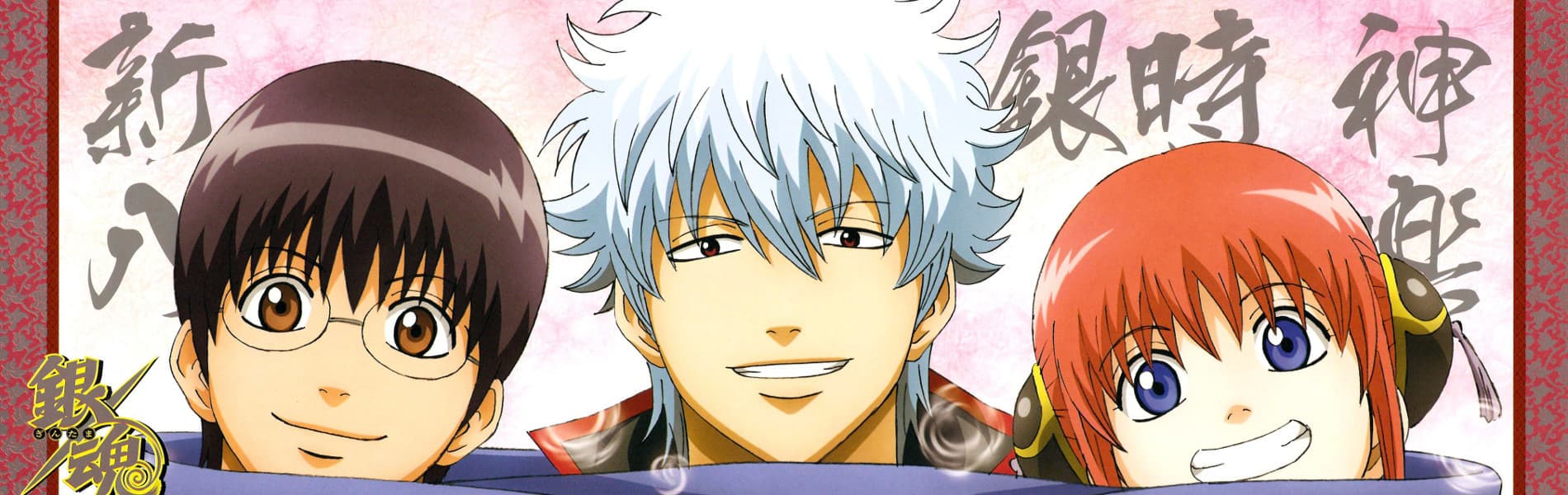
As much as I love the comedy of Gintama and as much as the serious arcs of Gintama wouldn't exist without its foundation of silly slice-of-life slapstick comedy, the reason I love this show so much is the sheer breathtaking emotion that its serious arcs evoke and Enchousen is the pinnacle of this, so far.
This review is NOT spoiler free, so please proceed at your own risk.
__
Kintama/Kintoki Arc__
I have to admit that when I first started this arc, I was expecting pure, silly comedy. What Gintama gave us was so much more: a lesson in the complexities of friendship and how a bond with another person can be so deep that it transcends our memories and etches their very name into our souls. Seeing Gintoki struggle with seeing Kagura and Shinpachi so happy with Kintoki, coming face to face with his own weaknesses and fighting against his friends was incredibly moving and a beautiful character study of Gintoki through the lens of the relationships he's built with other people. (Seeing Tama get the opportunity to have the limelight for a bit was a very welcome addition to the arc, as well.) It's not secret, at this point in the story, that Gintoki's backstory is incredibly tragic, but this arc shows how much more he is than simply a man with a wooden sword. While the overall plot itself is nothing particularly special, as with everything Gintama does, it's the execution that makes it so meaningful -- after two hundred and fifty two episodes of seeing Gintoki and his friends squabbling, fighting, or otherwise causing trouble, it's extremely refreshing to see them fighting for him and for a future with him.
My favourite scene was Gintoki attempting to sacrifice himself in order to take out Kintoki, and Kagura, Shinpachi and Otae taking his hand and sharing his fate. I think it's a theme that is wholly prevalent throughout this season, if not the entire show, that Gintoki takes all of the burden onto himself, often making himself out to be the villain, so that his friends can have an easier way out. This scene shows how much Gintoki means to them, how they will keep chasing after him, sharing that lonely burden -- a great message for an arc that centers around Gintoki struggling with the consequences of saving himself. And yes, this is a reference to 'Sakura Mitsutsuki'. We'll get to that.
On the topic of opening songs, I absolutely loved the choice to release two versions of opening 12, one featuring Kintoki and one with Gintoki in his place. I loved the minute differences in their facial expressions, their distinct behaviour and how it changes the feeling of the opening. I always felt a little uncomfortable seeing Kagura and Shinpachi's happy moments with Kintoki, feeling a deep-rooted wrongness, and the catharsis of seeing Gintoki's version of the opening was incredible.
~~~
Courtesan of a Nation Arc
I watched this show because of SPYAIR, I'll admit, and I'm sure that I'm not alone. I've been a big fan of their music for a while and, seeing that they wrote 5 songs for Gintama, I had to check out the anime. I've always loved 'Sakura Mitsutsuki' and now that I understand the song, I don't know if I'll ever look at it the same again. This is the only time I have ever shed tears over just the opening, especially just a live performance of the song, without any of the anime's visuals -- that's how poignant the lyrics, and the story behind them, are. 'The parallels between the lovers' story, Gintoki's struggle with his past and losing his teacher are highlighted in a beautiful way by the opening's lyrics and visuals. Sakura Mitsutsuki' may very well be the best overall anime opening, including visuals, lyrics and music, that I have ever seen, and that's not a claim I make lightly.
I was expecting good things from this arc, and I was not disappointed. Suzuran and Maizo's story was heart-wrenching and engaging -- despite a bit of a rocky start with Maizo's introduction (in the way of some very strange masochism). However, Soyo revealing the true story of Suzuran's promise was an absolute stroke of genius, allowing the audience to put the pieces together before it's ever confirmed on-screen. Suzuran and Maizo's narrative was written beautifully, coming to a heartbreaking and yet somehow hopeful close, in a timeless, boundless night under the full moon, cherry blossom flowers blooming. The end of their story wasn't a complete surprise, given that Gintama never tried to hide the fact that Suzuran was dying, but its execution was still well-done enough to be an absolute tearjerker. They waited so long, spent their entire lives searching for the moon to fulfill their promise under, and finally, at the end of everything, they managed to find each other.
Gintoki has always been someone who fights for the sake of protecting, and it's always been made abundantly clear what it is he's protecting: his friends, his way of life, his teacher's legacy. His way is that of a protector, not drawing his sword for himself, but for the sake of others, and coupled with the implications of his backstory, likely is what defines him as a protagonist and keeps him from slipping into vengeance-fueled cynicism. To that end, seeing his friends refuse to let him fight alone, is incredibly heartwarming. Even more so is the way the Shinsengumi come to his aid, never once saying directly to his face that they're with him or that they agree with his ideals, but letting their actions speak for themselves. I might be biased as a Shinsemgumi fan, but I really loved Okita and Hijikata's lines about "don't die before your execution" and "you might as well commit a crime worth your conviction", and the quiet support that is so in character for both of them. Seeing the Mimawarigumi do the same is also great closure to the Thorny arc.
Then, there's Gintoki's past. This plot was brilliant, teased through small scenes, but providing just enough detail for the audience to walk away with a tale of grief, loss and vengeance. I can't be sure, but I think there was one shot of Shoyo's severed head on a cloth in front of Gintoki, and if I'm correct about that, that is absolutely diabolical and I love it. The show gives us just enough to satiate the mystery of his past, while still leaving us wanting more. A lot more.
Finally, the Shogun. He's mostly been portrayed as a buffoon, as comic relief (even in this arc, with the can bit and impersonation scene, both of which actually made me laugh out loud), and seeing him stand up for the samurai and their principles gave him some much needed development. His rebellion and resignation were pleasant surprises I didn't expect from this arc, but I am so glad were included.
My only criticism about this arc is that I wanted more -- I wanted a bit more about the political factions, their differences and motivations, their future plans, etc. However, there's still plenty of time, and I am more than willing to wait for future episodes and see what they have in store. That aside, Takasugi assassinating SadaSada genuinely did catch me by surprise, and it was a well done scene with the subtle reminder that Gintoki likely isn't alone in being severely affected and in some ways, shaped, by the death of his teacher.
While the Shinsengumi Crisis arc still remains my favourite arc thus far, I have to admit that this arc is right up there with it.
Beam Saber Arc
I don't think it's a very controversial opinion to say that this arc is by far the weakest of the three -- especially for me, since I haven't seen Star Wars and I have no idea who Obi-Wan Kenobi (obviously who 'Obi-One Kenofi' is parodying) actually is. Unlike the other two arcs, the juxtaposition between comedy and serious drama fell a bit flat for me, and actually did feel surprisingly jarring. I couldn't really take "Obi-one-nii-sama" very seriously, and I think the dramatics of the arc fell short for me because of that. While I don't have an issue with blatant parody arcs actually being serious (I did somewhat enjoy the Renho arc), I feel as if this arc could have benefited from more subtlety with the parodies, and having Shinpachi and Otae's sibling figure be a much less in-your-face parody.
That said, I really did enjoy the concept of their relationship and I was really caught off guard by Shinpachi landing the final hit. As I mentioned earlier, it's a running theme this season that Gintoki often shoulders the burden of difficult decisions, playing the villain if he has to, and this arc is the most blatant about it. I was very glad that it wasn't another rendition of Gintoki saving the day, and very pleasantly surprised that Shinpachi, despite the obvious emotional turmoil within him, stepped up and stood up. Regardless of the rest of the arc, Shinpachi was the stand out for me.
Hajime's farewell, especially the line about a samurai returning to the country of the samurai, was quite well done, I must admit. Seeing Gintoki, Otae, Kagura and Shinpachi walk away, with the siblings having tears and a smile on their face, symbolizing all they've learnt and the path still ahead of them, was great. The comedy at the very ended, though a bit jarring, was quite funny, and does make sense given the important role laughter plays in this arc. On another note, I must say, Kondou and Kyubei are a duo I didn't expect to enjoy as much as I did -- though I'm sure Otae really needs a vacation from both of them.
The Finale
Sadaharu is actually a character I was just thinking has been quite underutilized, though it's fairly unsurprising when Gintama turns on Serious Mode. This episode was brilliant, one of the best single-episode stories in quite a while. Sadaharu's initial anger and hunger turning into care and desperation, turning into determination and finally, despair, was incredible and a perfect showcase of how Gintama can write a character journey in such limited time. Hijikata's mayonnaise obsession returning and Sarutobi getting comedy that doesn't involve BDSM or her obsession with Gintoki were both much appreciated. I have a soft spot for animals, so I have to admit that I shed a few tears when the puppy appeared to have passed away, and the visual storytelling in the montage of Sadaharu's increased determination and the puppy getting weaker and weaker was absolutely brilliant. And once again, Gintoki plays into the theme of playing the villain in order to shoulder the burden, but it's a small enough part of the episode that it doesn't feel repetitive or stale. I'm glad that Sadaharu got an episode to shine in. Thus ends Gintama' Enchousen on a surprisingly emotional note.
Overall, this season perfectly captures why I love Gintama so much and why I have stayed with the show for 265 episodes: a perfect balance between absurd comedy, poignant drama and characters that feel all too human in the face of incredible odds.~~~