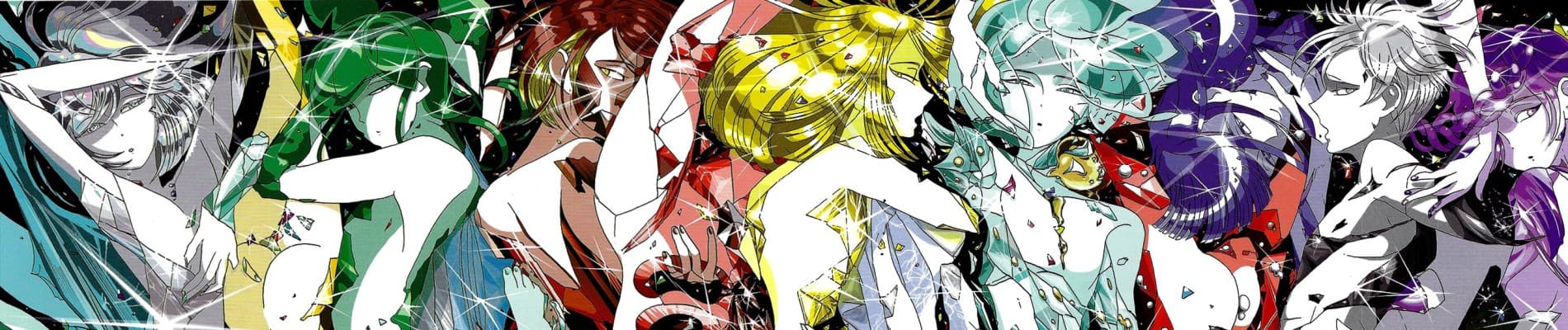
What a trip it's been! At first, it's a really endearing story. It starts with goofy humanoid rocks battling Lovecraftian aliens on the moon, which is creepy. But then it quickly becomes one of the most surprising, weirdest, and most philosophical stories I've ever read in manga. If you're into mystery, action, or simple plots, you might still find something to enjoy, understand, or interpret from it. But maybe Land of the Lustrous isn't for everyone.
Despite engaging, the plot works well because moments that seem to go on forever won't be needed. Plot twists frequently occur, particularly amid the narrative. While the second half might seem a bit messy, I think that's because it feels relatable in its chaos. It's like a rock falling without knowing where it's going.
The story repeats quite a bit in certain sections in the middle; it gives the plot a bit of a jagged but manageable feel. This might be due to the story's confined setting at that time. It started to feel a bit dull, but thankfully, things quickly changed, and the plot picked up steam and became more straightforward again.
Phosphophyllite, or Phos, is one of the most fascinating characters you can study. They're perfect for character studies, psychology studies, religious studies, philosophy studies, or just for admiring how intricately developed they are. Many great manga characters start unremarkable and only become interesting later, like Kenshin Himura from Rurouni Kenshin or Light Yagami from Death Note. But Phos has this genuine sense of incompleteness that makes them immediately engaging and captivating.
To be clear, comparing Phos, Light, and Kenshin doesn't mean Light and Kenshin aren't complex characters. Each of these well-known manga and anime characters has its own unique story and themes. This comparison demonstrates the unique aspects of Phos' journey and how it varies from Light and Kenshin's while maintaining the same level of intrigue.
To clarify! In contrast to Light and Kenshin, who had an obvious advantage from the beginning of their adventures—Light's intelligence and Kenshin's incredible sword skills—Phos is a fragile character. They're the weakest gems in the manga, both physically and emotionally. They don't appear to be very helpful. This inherent weakness gives Phos a sense of unfinished business that makes their journey relevant and emotionally impactful right from the start.
Another essential component of phos' identity is their drive to find their purpose and give back to the community. But since they keep falling short, they start feeling inadequate compared to the other Gems. This sets the stage for their quest for self-awareness and growth as they try to convince Cinnabar and understand the true motives of their mentor, Kongo.
On the flip side, Kenshin's journey is about atonement, while Light's is driven by his obsession with power and the gods. Phos, conversely, stands for "absence" and their efforts to comprehend it. They're searching for something, whether it's a destination, a reason to exist, or a safe haven.
I see Phos' character journey as a metaphor for real and symbolic loss. As the story progresses, Phos loses both their physical traits and their innocence. Every loss impacts Phos's inner thoughts and produces an external change (such as swapping out a body component for one made of sturdier material). They gradually lose their essence, becoming more emotionally detached, cynical, and hardened.
Of course, Light changes too. But Light's transformation is a moral downfall driven by arrogance. Phos' transformation is even more tragic because it comes from the search for meaning itself. Unlike Light, whose downfall is due to ambition, Phos' development shows the harsh results of their situation. Kenshin, on the other hand, seeks peace by retreating from aggression. On the other hand, Phos' path travels from idealism to pragmatism via naiveté. As Phos grapples with their identity and moral dilemmas, Kenshin is focused on finding peace.
Phos is a tragic hero because their fundamental weakness is their need for meaning. They only make things worse for themselves and everyone around them when they try to better themselves or assist others. This tragic cycle makes Phos' quest intriguing. Even though I know they'll eventually fall, I still hope for their redemption.
To draw a parallel! Light's ambition and arrogance led to his downfall. Despite his troubled past, Kenshin found serenity and forgiveness. It seems even more awful that Phos should die because of their weakness and desperate attempt to fit in. Their tragic situation seems even more inevitable because they are caught in a never-ending cycle of loss and change.
The other characters are likewise skillfully portrayed; numerous Gems reveal their weaknesses and offer fascinating glimpses into their personalities. They have enough time to develop in the story. While it might seem like they exist to further Phos' story, I don't mind.
There are two categories of incredible artwork in the manga. The realistic and intricate Blade of the Immortal, or Shigurui, which focuses on human anatomy, is on one side. On the other side, there's Land of the Lustrous.
Haruko Ichikawa is a master of minimalist art that's visually striking and evocative. Her work avoids the detailed shading and perfectionism of artists like Takehiko Inoue. Instead, she excels at composing panel layouts with symmetrical negative space. The way the panels flow into each other makes it a compelling read.
Another aspect of the manga is its fascinating blend of humor and melancholy. Humor is present throughout the series, but unlike many manga with exaggerated humor, Land of the Lustrous uses a cleverer, more subtle kind of humor that occasionally borders on dark. Since these moments are spaced out, the humor never feels overdone and always hits the right note.
The ending is satisfying. It might not be the unexpected conclusion some readers were hoping for. But it's a fitting and beautiful end for our protagonist. Anyone interested in classic manga should definitely check out Land of the Lustrous. Whether you like it or not, I can say for sure that it's a one-of-a-kind series. It's a flawed masterpiece in every way.
24 out of 24 users liked this review