Spoilers
I really wanted to love this manga like everyone else, I'm no stranger to iyashikei stories, I know what it takes to enjoy these stories to their fullest. A cup of coffee every morning, with the calming scenery of a new day's sky, taking in the detail in each panel. Over the last year I've been collecting the english versions of this manga as they release, and now that my money has been spent and they lie quietly on my shelf, I feel obligated to give this series my unfiltered thoughts.
Though I guess I'll get this out of the way. The act of reading this manga in the way I did, had a positive impact on my life. I can understand the people who love this series for that simple reason. In the reviews I've read of this series, the theme of nostalgia continued to pop up, as the passing of time coincides with the writing of this manga, as a wistful tale of the world changing, where the present is calmly enjoyed, and the past quietly mourned. It's what endeared me to iyashikei stories in the first place, the ability for the story to recenter my state of mind and allow me to take on the day with a calm serenity, where small moments of bliss were allowed to enter, such as a quiet glance out of the classroom window, or a deep breath of the fall air. However these factors do not make this story stand out in my mind, or when my thoughts fall back to the time period of which I've read this story. That isn't to say that said time just disappeared, it's just the memories are found in different places. When I think of the anger of my senior year of highschool, I think of how Mushishi calmed me down and allowed me to get through that rough period somewhat easier. When I think of my first year of college, meeting new people both online and off, I think of the aria series and how it brought people together in the creation of a wonderful evocative setting. When I think of last year, I do not think of YKK, that is all.
With that said, Yokohama Kaidashi Kikou is a slice of life manga about a robot named Alpha, who runs a quiet cafe on the Miura Peninsula. The series is considered a sci-fi, with elements of futuristic technology such as advanced artificial intelligence, but also strange creatures such as plants that light up at night and new species of flying arthropods. In my experience the world building of this series is extremely vague, and one is implied to infer the events that take place. The sea levels are rising, and Mt Fuji has erupted, but when did this happen? What infrastructure was destroyed? How many people died? It's a rather bizarre task to ask the reader to simply ignore such aspects of the work, or infer their events as unimportant in the experiences of our character's day to day lives. In a recent untranslated interview with the series' creator (linked at the bottom of this review), Hitoshi Ashinano confirms what I've believed ever since reading the first page of this manga, that he started this manga out of a desire to draw nice landscapes. The interview goes over a various number of topics, such as his love of the physicality of motorcycles, and the vague trips he would take on one getting lost in the countryside, his preference for old toy cameras he had when he was younger, and generally sharing a kind report with another iyashikei mangaka inspired by YKK. My point is that Ashinano's interest in sci-fi materialized in the illustrations, as he himself admits that he didn't like writing sci-fi as it's use of jargon to immerse the reader wasn't appealing to him.
Quite simply this aspect of the manga having all these loose ends, such as the mysterious absence of Alpha's master which is never resolved or explained, the question as to humanities' overall future, and the silent airplane that passes over the peninsula every volume or so, are plot points that I feel should've been explained. This isn't to say the setting itself can't produce illustrations of great brilliance, one of the most striking moments this manga has to offer, is Alpha overlooking the town consumed by water as the sun sets, and watching all the lights come on, but these moments feel lacking in comparison to that of an all too over used natural setting of uninteresting rocks and trees. My mind wanders to the similar hills and valleys of Mushishi, who's settings and story aided in giving a sense of mystery and wonder to the wildlife and nature present in it's story. Naked Misago, flying fish with sunglasses, night light plants, and giant chestnuts and persimmons only arrive to add a spark of novelty to the world, only to disappear as briefly as they came.
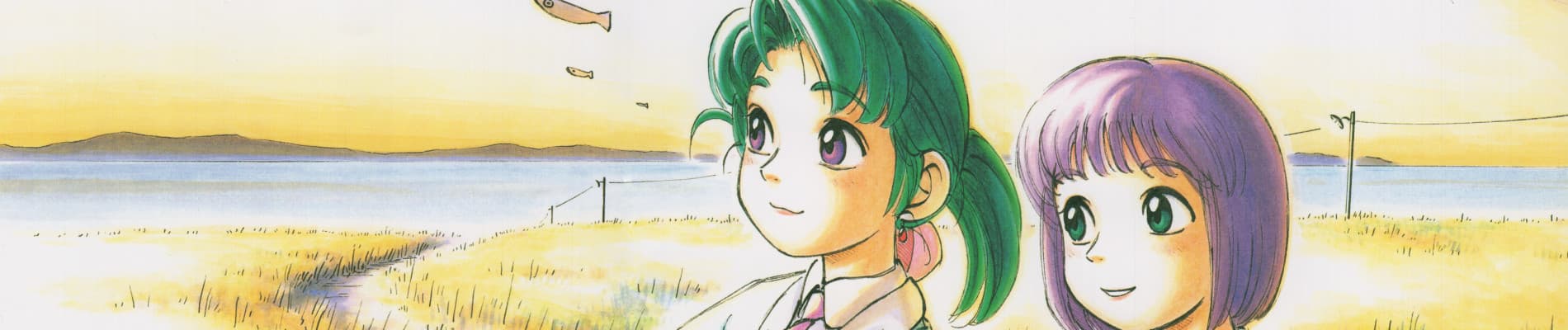
Maybe I'm the odd one out, but I fail to see through the art to find something mystical about it that others have vividly described. The rounded line work definitely creates a calming feeling, and I find the illustration of large fields, with Ashinano's careful meticulous line work, to be rather evocative, but the "negative space" present in many panels leaves much to be desired. In the interview he said that he wished he could have drawn the whole series in color, and that he imagines the colors as he draws, unfortunately there are only a handful of colored chapters which I think get the feeling Ashinano is describing. The soft line work paired with the watercolor is just so beautiful, and for a little while a colored panel of Alpha swimming was my phone background. However their occasional novelty creates many chapters that just feel a lot more empty, and the repetitive drawings of the same fields and hills fails to capture my interest in the setting past the first three or so volumes. This may be pretentious of me, but I believe much of the praise given to the art of this series just comes from an aesthetic connection to the objects Ashinano finds appealing, planes, coffee, trees, beaches, scooters, and other such common place items and areas.
I think the series is at it's best when Alpha's cafe was destroyed, and she had to consider what she was going to do in the face of the hardship. I think it was a great aspect of growth during the series, where she went on a journey of self discovery, taking up odd jobs, seeing new sights, meeting new people. It's there where I see the growth others mention her going through, as do the other characters such as Takahiro and Makki growing up and moving out of their decaying old town. However, the most integral aspect of this series I find to be quite disappointing is how rarely Alpha leaves the cafe, it's her job after all but this tranquility eventually erodes into boredom. I mean how many chapters can you write of an immortal robot doing housework, some times she just gets drunk and flies in the sky, ending up in a road in the middle of nowhere.
I think the idea the story explores of "mono no aware" translated as "sadness for the transience of things" in a rather strange way. Alpha, being immortal, inevitably watches humanity growing older, the destruction of the nearby environment, and the disappearance of people, the reclamation of nature. Where the phrase implies a sadness, there is often a lack of necessary introspection on Alpha's part, her overly chipper attitude often puts the ownness of the reader to breathe contemplation into her character and the world, but I find that to be lazy. She often seems to forget herself, and the position of someone being immortal can be room for much needed grieving in a setting so bleak. I find her to be rather static of a character, which could imply her being a rock upon which other characters find peace and comfort in, if she was as involved with others throughout the series to the degree that properly illustrates this theme.
Anyway those are my thoughts, may the 5 english volumes of Yokohama Kaidashi Kikou lay patiently on my shelf until I one day sell them or something. You were a nice complement to my morning routine, but I have other series I'm waiting to explore.
15.5 out of 24 users liked this review