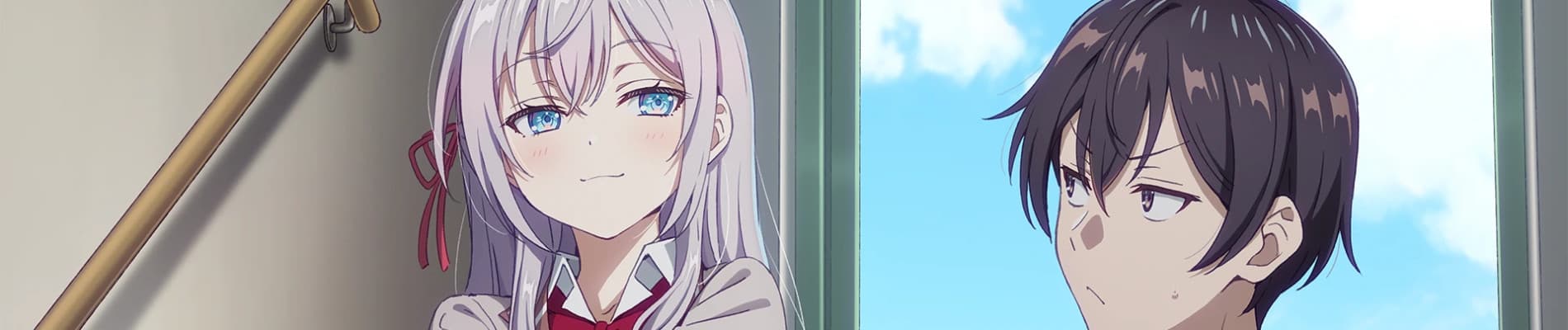
There’s a moment early in Alya Sometimes Hides Her Feelings in Russian when the titular Alya / Alisa Mikhailovna Kujou takes off her wet sock, making Kuze Masachika uncomfortable. Noticing this, she devilishly chuckles to herself and uses Kuze’s own discomfort for her flirtatious amusement, asking him to fetch another sock and put it on her leg. But an ill-advised remark about Kuze’s supposed cowardice (lyingly translated from Russian by Alya, which Kuze is all too aware of) prompts Kuze to immediately turn the tables on her, and now Alya suddenly finds HERSELF in great discomfort as Kuze does what he was asked, accidentally grazing her nethers in the process. A quick kick in the face and hasty evacuation leaves them both in, arguably, a worse state than they had been in just a few moments ago. It’s an interaction that lasts for all of two minutes, yet says much about when the series shines at its best, and makes its subsequent detouring all the more disappointing.
Alya Sometimes Hides Her Feelings in Russian loves making its characters disoriented, such to the point that it wears it like a form of armor. Looking beyond the sock incident, there are other similar interactions among the show’s cast that, either directly or indirectly, make a point of knocking the characters off from any supposed positions of authority or superiority. The calm and cool Alya is thrown constantly into insecurity regarding her own feelings for Kuze, not helped in the slightest by her older sister Masha playfully teasing Alya for feelings that are brazenly obvious, dismissive as she might be. Yuki’s own sheltered and posh upbringing gives her smarts to slyly navigate her high school’s upper crust by disarming and endearing with charm, yet she can turn that off like a switch to indulge in her own uninhibited hijinks and jokes. And then there’s Kuze, dealing with a rambunctious sister, trying to disassociate himself from what he once knew, and reconciling Alya’s own truths—for you Umineko fans out there, “I’ll say it in Russian!”
Informing that lies the show’s central gimmick – Kuze is fully aware of what Alya is saying when she speaks Russian, in part because of his own impassioned study of Russian thanks to a girl he once knew and loved many years ago. When Alya thinks she’s being secretive, Kuze holds more cards than she realizes. Situations between Alya and Kuze allow the sense of hiding one’s true feelings to be subverted to move the story forward, an intriguing take on a tired old miscommunication convention. This therefore leaves both Alya and Kuze alike in a strange twilight zone of both understanding the other and, admittedly frustratingly, holding one another at an impasse – they’ll be able to grow closer both platonically and romantically by spending time with each other, but they’ll never cross that final confessional threshold until either Alya says her feelings in Japanese or Kuze admits that he knows everything that she’s been saying in Russian. Either way, someone will have to bear the brunt of the final embarrassment, and it’s difficult to not wonder why Kuze doesn’t just clear the air, even given his mental and emotional hangups.
But perhaps that’s fine. Alya’s rougher exterior isn’t consistently up and violently striking down Kuze at every perceived sleight or blunder. Kuze himself understands just how important Alya’s pursuits are in her academic life, and is more than willing to put any goofiness aside. Alya Sometimes Hides Her Feelings in Russian manages the magic act of having it both ways – comedically flirtatious and slapstick-like, and putting the jokes on hold to have a conversation that’s actually important. What blooms is a more amusing relationship, oscillating between moods, ideas, and episodes with a blush and a smile, ultimately reading as more sincere than it might have been otherwise if it had remained wholly committed to something more dynamically restrained. The final “endgame” might be put off until volume whatever-the-editor-demands, but to see Alya and Kuze play off one another is to constantly ask which one will come out the other side more disoriented than the other, and rarely in a way that feels unpleasant (with a couple of notable exceptions). Especially considering that Alya is playing with the deck stacked against her since Kuze knows everything that she’s saying when speaking Russian, seeing Kuze be thrown off-kilter in some fashion offers its own brand of pleasantly surprising satisfaction.

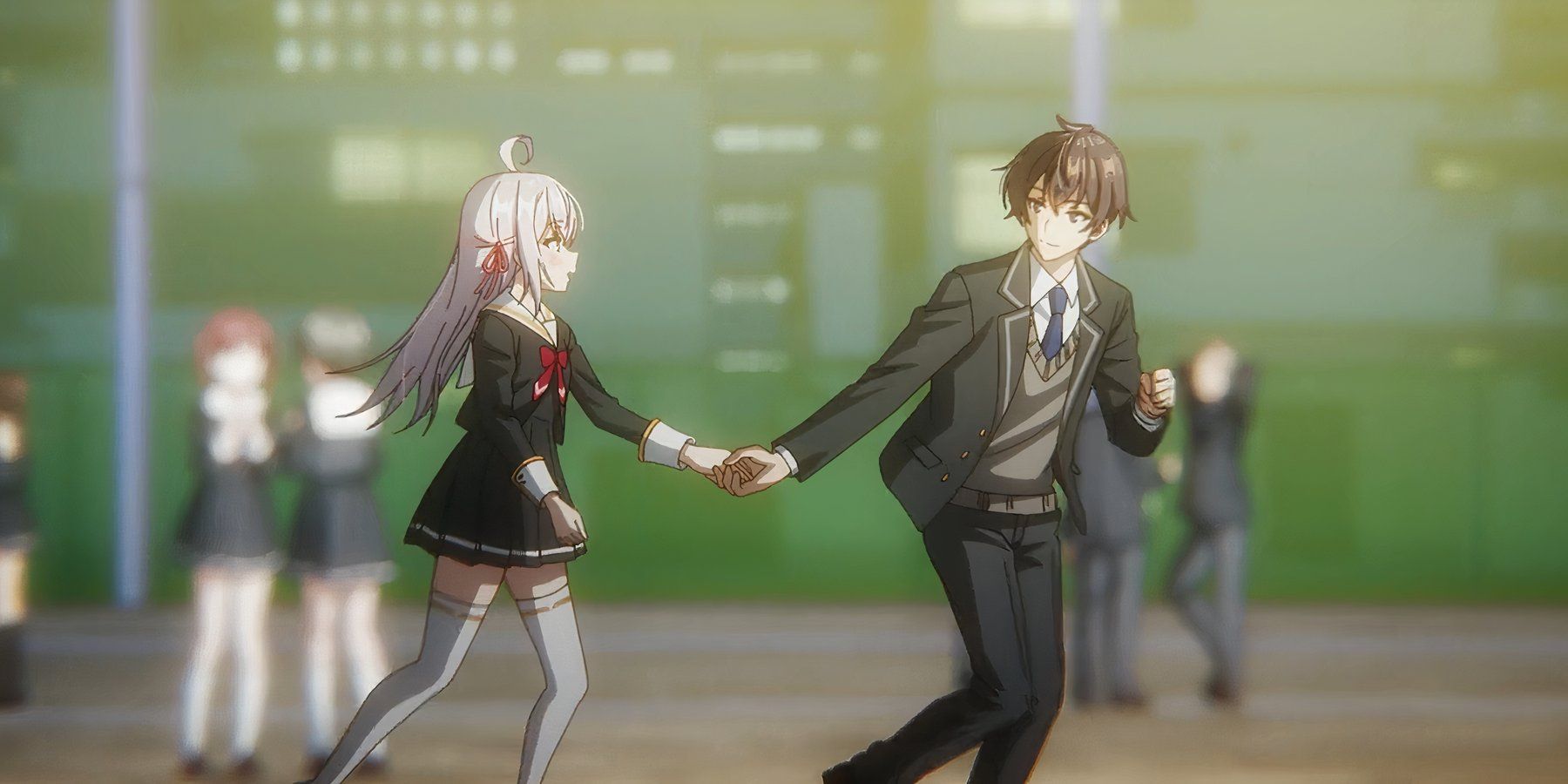
Though the serious discussions between Alya and Kuze “three-dimensionalize” their relationship, from where some of those discussions manifest undercuts the material’s own innate delight. Wrapped within the romance is the larger political current of their school, and the student council offers Alya the chance to establish a station for herself beyond just the treasurer. However grand the pursuit, Alya Sometimes Hides Her Feelings in Russian makes it clear that her own ability to navigate the school’s landscape is haphazard at best (not helped by the underlying “ethno”centrism of the student body being averse to outsiders) and dismally outclassed at worst. Against the larger figures within the sphere, Alya stands adrift. It reframes and disorients Alya as one of the central protagonists; the girl we’ve seen tickle and be tickled by Kuze fails to prove her own capability for independence, framing her as a woefully inept political figure who seemingly can do nothing without Kuze’s interference or long-term planning. Social ineptitude befits her characterization – nothing is inherently wrong with Alya failing at something, nor the implication that she will improve over time (as she begins to do). Yet, its scale as presented comes at the cost of her character position within the overall picture. Seeing Alya stumble so badly, even under the auspice of improving over time, comes across as unengrossing as a whole plot. The student council election robs the zest that makes the two leads’ dynamic work well.


Though to say that the show has “two leads” is, itself, rather misleading. Both in [Sunsunsun’s]( /staff/211473/sunsunsun) original story and [Itou Riyota’s]( /staff/142412/itou-ryouta) direction of the adaptation, the material with commendable insistence implants Yuki into the thick of both the romance and the political drama. Though I mentioned her slyness and propensity for explosiveness of comic sensibility, she stands in Alya’s way on all fronts, both as popular darling for student council presidency and for putting up barrier after barrier to Alya and Kuze’s potential happily-ever-after. Yuki, when viewed through Alya’s eyes, is the construction of everything that Alya aspires to be – in command and with Kuze. Though she stands at the meeting point of both the political and romantic plots, she is not an antagonist in the strictest sense of the word. That does not mean that it would not be open season on Alya and Kuze. Lord knows that Yuki gets her jollies out of a little trolling.
It therefore makes it unfortunate that her strongest impression is that of the meta-aware character, frequently breaking the fourth wall in spirit by offering a comedic reward for directly pointing out something about otaku media and culture that fans would inherently recognize. She’s the successor in a long line of characters doing this (recently brought back into larger consciousness with Cid Kagenou in The Eminence in Shadow) and it seems that it’s a trend that’s here to stay. It’s already long outlived its welcome, although its half-life can be prolonged—albeit temporarily—by the sheer weight of Yuki’s consuming on-screen presence. Though, each time a joke of this nature was made, it seemed to call more attention to the balancing act the show couldn’t quite manage.


All that transpires within Alya Sometimes Hides Her Feelings in Russian, in terms of the political matters, the Kuze and Yuki family dynamic, and whatever romantic fate awaits Alya and Kuze, hints at developments that see ultimate payoff down the line. Despite all that promise, as presented with this season, the series succeeds with more finesse and fluency in its more lighthearted romantic affairs rather than its indulgences in something beyond the sociopolitical scope of its romantic duo. When characters pondered about how to respond to whatever student council matter was on the table, images of clothes shopping, a school dance, and botched Russian pronunciation asserted themselves in memory.
One question does remain, however – will Alya ever get used to spicy food?
«может быть...»
It means “definitely.”
146.5 out of 191 users liked this review
