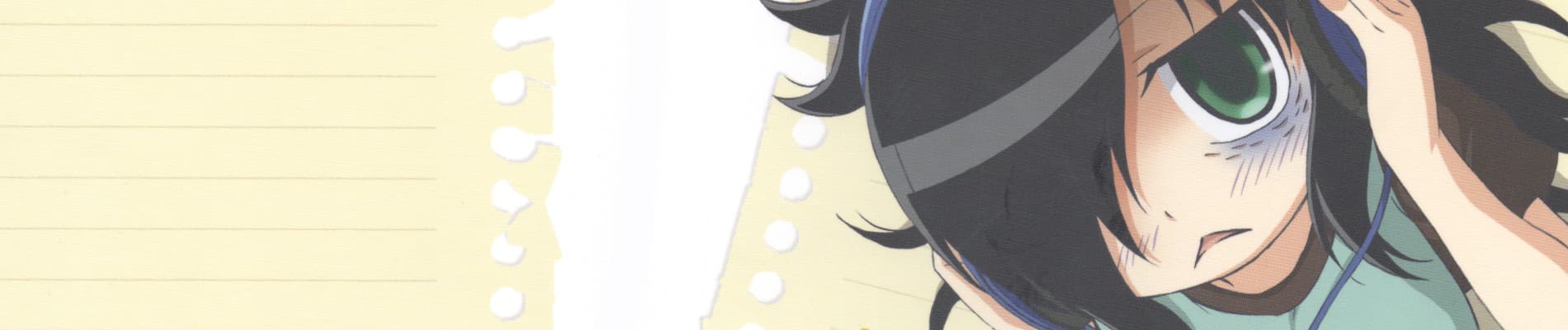
It’s your high school debut! They say the final years of your education before university are some of the most important years of your life... Hell, in the anime medium, they’re often the only years of your life... So you want to make sure you’re able to get the most out of your senior high experience. It’s time to make friends, explore your identity, leave all of the cringe of your middle school experience behind, and do whatever you need to prepare to take that first important step out into your future, with your friends by your side... But for Tomoko Kuroki, it’s not going to be that simple. Suffering from severe social anxiety, Tomoko wants to embark upon an ideal high school experience, but finds herself unable to communicate with anyone other than her family, and one select friend from middle school who’s attending a different school from her. The longest of journeys begins with only a single step, but when that one step terrifies you at an irrational level, can you ever truly move forward?
Watamote is the mercifully short version of the title “No Matter How I Look At It, It’s you guys’ fault I’m not popular,” and it was produced by Silver Link, at the direction of Shin Oonuma, and it’s a very interesting looking production to say the least. To start, the production values were obviously really generous, as I can’t honestly say I spotted any real budget cutting tactics, or any cheap looking moments in general, throughout any portion of the series run time. From what I understand, this lavish budget paid off pretty well, as Watamote was so successful in Japan that I’ve actually seen other anime from around that time taking good natured shots at it for being their competition(most notably Chronicles of the Going Home Club). Silver Link does seem to have a mostly positive history in terms of animation quality among its stable of anime titles, but when it comes to Watamote in particular, a lot of its more interesting visual elements are due to its director, who stands out amongst the rest of the production for a number of reasons.
First of all, if you’ve noticed that Watamote has some visual similarities to the Monogatari franchise, you’d be correct, as this show does use a smattering of DBD(Different By Design, read my Bakemonogatari review for more information) here and there. As it happens, Shin Oonuma began his professional career working at Studio Shaft, and he worked under Akiyuki Shinbo, the king of DBD for better or worse, on a number of different projects before eventually moving over to Silver Link. As a director himself, Oonuma likes to use a lot of Shinbo’s visual tricks... Top down shots, strange close-ups, artistically striking filters, unconventional angles, you name it... But unlike Shinbo himself, Oonuma chooses to employ them sparingly, rather than needing to make every single shot look weird for the sake of weird. The DBD shots he uses are often intended to communicate the feel of a moment beyond the words of the characters, rather than just to promote himself as an auteur or distract from boring dialogue.
The only part of his approach that ever feels excessive is the lighting, as he uses a constant overlay of translucent, geometric boxes stretching across the screen, and while these shapes do often succeed in highlighting Tomoko’s feelings of isolation from the world around her, I’m sorry, they do not need to be active 24/7. For the most part they’re either important to a scene or at least easy to ignore, but sometimes they can be irritatingly distracting. Otherwise, the color palette is bright, but mostly normal enough for a slice of life anime, and the same could be said about the character designs, which are mostly on the generic side, but considering just how strikingly different Tomoko is supposed to look like from her peers, I actually think this works in the show’s favor. Tomoko’s classmates look normal enough to fill out the background of any given high school anime, but just distinct enough that they don’t feel interchangeable, and Tomoko’s more attention grabbing pale complexion, tired eyes and unkempt hair contrast with them perfectly.
The English dub was an effort by Sentai filmworks, and I’d like to reiterate that while it is possible to miscast Monica Rial... Personally I think she was the wrong choice for Junji Itoh’s Tomie... She is an actor you can count on to take starkly unique and challenging roles and knock them out of the park. Tomoko is easily one of her strongest roles I’ve ever heard, standing right alongside Tanya the Evil as a testament to how high her level of talent can reach when she’s not being type-cast. She is so good in this role that fucking Emily Neves play her one-note best friend, and I never once wanted to hear them switch roles. Besides, while Yuu-chan might be below her usual capabilities, Emily Neves still smashes the role of Tomoko’s bright and sunny best friend. Rounding out the rest of the important cast is David Matranga as Tomoko’s long suffering brother Tomoki(not kidding, that’s his name), who is so believably over his big sister’s bullshit. The adaptive writing is on point, even with all of Tomoko’s delusional ranting about her more social peers carrying the perfect US equivalent of her nasty and judgemental insults towards them. Top quality dub, I highly recommend it.
Watamote is one of those anime that will offer an entirely different experience considering who’s watching it, and in a way, that makes it kind of a tough anime to review. The plot of this series, at least on the surface, is fairly simple. This is a show about an extreme introvert who desperately wants to enjoy the social benefits of being an extrovert, but is held back by her crippling social anxiety and awkwardness. She’s terrified of talking to people she hasn’t known for years prior, even when they’re the ones who approach her or attempt to initiate contact with her. She comes up with random schemes to raise her social status, often based on severe misunderstandings of how social interactions even work, sometimes based directly on the tropes of anime and adult games, yet nothing she tries ever works in her favor, and she’s too delusional to ever admit to herself that she might be the problem without driving herself deep into a self-loathing depression, turning to hopeful fantasies and vague, non-committal thoughts of suicide as a coping mechanism.
You get twelve straight episodes of this, with little to no progress, rinse and repeat. Now right from that description, you probably know exactly what your experience with this series would be, and a lot of that ultimately comes down to just how much your experience as a youth resonates with Tomoko’s. From that perspective, Tomoko may actually be one of the most strongly and realistically written characters in anime history. It might be difficult to grasp this fact in its entirety if you’re a normal person, but there are people in real life who, at some point, lived the exact same experiences that Tomoko did, even if most of them did eventually break out of it. There are people out there, especially among the teenage demographic, who are so catastrophically shy that they struggle to vocalize to people they’re not yet comfortable with. There are people who will be at their loneliest while sitting in the middle of a crowded room, wishing they could open their mouths and join the friendships going on around them, but find themselves trapped in an invisible box of their own making, resorting to hating and even demonizing the people around them to cope with their own envy.
If all of that sounded a little too specific to be made up, that’s because I was kind of a Tomoko at certain points in my life. It wasn’t exactly the same for me, at least not at the same time, but a lot of the smaller details of Tomoko’s characterization were very real to me at some point or another. Well, to establish one distinct difference right off the bat, I’m on the autism spectrum... Specifically I was diagnosed with Asperger’s syndrome in third grade, and while I know that term has fallen out of favor in recent years, it’s hard to detach from a term that you accepted as part of your identity for literal decades... And I don’t think Tomoko is Autistic herself? I dunno, I’m not about to play arm-chair psychologist again. But yeah, I can distinctly remember situations where I had some harsh mental blocking preventing me from gathering up the nerve to interact with people, or to even speak to them. I definitely found myself isolated socially, feeling depressed about all of the friendships around me that I wasn’t in. I distinctly recall indulging in edgelord fantasies that, by all rights, should have landed me in a psych ward.
Of particular note is the opening, and while screamo rock might not appeal to you on its own, the video is the voice of every social recluse ever screaming all at once. The OP shows Tomoko held back by chains, screaming in pain and fury as she struggles against them. When she finally breaks free, she manages to step only a couple of feet forward before slamming into a glass wall that barely cracks with the impact. If you do any research on social anxiety, you will come across individuals who have been haunted by imagery that’s either exactly like this, or at least similar to it, and not only in their nightmares, but there’s also probably a very good chance these metaphors are pasted all over their creative work, especially if they write poetry. As for me, I broke through my chains a long time ago, as I am 38 years old now, but the glass wall is still there. One thing I’ve come to understand about myself is that I can accomplish anything I set my mind to, as long as it doesn’t involve reaching out to other people, as I am still not able to overcome the massive chasm standing between us. There’s a good reason I started writing reviews again after I couldn’t find an agent/publisher for the novel I spent three years and nearly 1000 dollars developing/editing/critiquing. At least when a review underperforms, I have the comfort of knowing I self-published it for free.
Unlike Tomoko, there were times in high school where I acted outgoing, but I was also really fucking weird. If you were weird in highschool in the nineties, and your peers had no idea how to categorize you, it was pretty common to have the label of “Gay” slapped onto you, because that was just the nineties and early 2000s label for anything that was generally off putting, and when teens in the nineties think you’re both weird AND gay, you got bullied, a lot. This is one part of my experience that Tomoko doesn’t share, but I guess that’s kind of a good thing, because she’s so self-loathing and self-destructive already that the very existence of bullies in her school would have upset the balance of the character and essentially turned the series into torture porn, so that’s good. The only real antagonistic force she has to deal with are her family, but it’s never more than she deserves, and to their credit, the dynamic she has with each of her direct relatives feels just about 100% authentic, as her mother’s expectations of her are completely reasonable, and her bickering with her brother feel organic not only in the moment, but when applied to the history between them that we gradually learn about.
So, as a character piece, Watamote is a borderline masterpiece. Tomoko is a fully fleshed out representation of a very real and very raw experience that a lot of people have had, and she was somehow written in such a way that she’s still likeable no matter how frustrating she is, as well as sympathetic no matter how many negative (and occasionally repulsive)qualities she has, especially since she is very deliberately written to be her own worst enemy. It doesn’t matter how awful she is... Blaming other people for her problems while not even having the basic self awareness to understand she brings nearly all of them on herself... Because throughout the entire series, you’re rooting for her to overcome herself, and if you have even the slightest understanding of mental health, you can probably envision just how little effort it would take for her to resolve them if she had the right kind of help. This poor girl has no idea how to deal with her intrusive thoughts or anything. Honestly, if I had the ability to send just one fictional character to therapy, I would pick Tomoko over Shinji Ikari, not because she’s worse off than he is(that’s arguable) but because I’m certain it would do a world of good for her.
But she never gets any help, does she? I’m pretty sure nobody in the entire series even mentions the word therapy, and that leads to the much less defensible half of this series, that being the lack of progression for... Well, anything, really. You would have to squint your eyes really hard at this series to say that Tomoko really ever develops as a character. This is kind of a spoiler, but it’s a spoiler that I don’t think would lessen the viewing experience at all; Tomoko is just as cripplingly socially impaired at the end of the series as she is at the beginning, and any small step forward she makes throughout is usually accompanied by at least two huge steps backward. This doesn’t bother me for the majority of the series, because again, I find her experience to be highly relatable, and even when the worst aspects of it are played for laughs, I find myself laughing at the well-intentioned lampshading of my own cringey past. To a certain extent, you can’t overstate how comforting and reaffirming it is to see an experience you relate to playing out on screen, and from that perspective, magical deus-ex-machina solutions that would never fall into your lap in real life just feel condescending.
I can appreciate the writers’ decision to stick to the reality of the situation and never allow Tomoko to break out of her shell. Given the nature of the story, and the material being dealt with, I do believe that was ultimately the right choice. Not every character has to develop. I think it’s perfectly possible for a character to remain in stasis for 95% of their series, as long as there’s at least a hint of a light at the end of the tunnel. Sure, that light doesn’t always work out for the best... Shinji Ikari’s big moment of breaking out of depression was clumsily handled to an insulting degree... But on the other hand you have Cowboy Bebop, where Spike Spiegel spent most of the series in sort of a waking coma before he left the comfort and safety of his found family to rejoin the life of crime he’d previously escaped, becoming himself again, finally living so that he could finally die and rest in peace. I won’t spoil the last moments we see of Tomoko, but suffice to say, her light at the end of the tunnel is nowhere near hopeful enough to compensate for just how far from her goals she winds up falling.
On the other hand, the manga apparently does show her getting better, but it does so at the expense of any shred of identity or personality that Tomoko or the series has in the first place, so yeah, that's a catch 22 right there.
Of course, at least Watamote has the benefit of being consistently funny. A premise like this, realized through such a pitiful and self-destructive character, has a ton of potential for dark humor,and while the comedy in this series isn’t frequent, it is potent and well timed when it wants to make a joke, most of which do land. Now, having said that, there will always be those on both side of the table who are going to find the act of playing adolescent depression and social anxiety for laughs to be distasteful and even downright cruel, but personally, I find that the best way to overcome the unpleasant memories of our cringey youths is to laugh at them, and from that perspective, the humor never really crosses the line into mean-spirited territory. There’s a lot of reference humor, which probably isn’t a surprise given Tomoko’s otaku nature and the target audience of the series, but it’s not like your typical weeaboo industry wank fest, where an anime will just namedrop a succession of other anime properties that the audience is likely to have heard of.
There’s usually a specific point to Tomoko’s references. She likes to bring up the tropes and conventions of other anime in order to either explain or sometimes even demonstrate why they wouldn’t work out the same way in reality that they do in fiction, such as how an expressionless character like Yuki Nagato is only feasible if she has a love interest main character who feels predisposed to approach her despite her silence. One specific reference I’d like to highlight is Ghost in the Shell, as at one point, Tomoko fantasizes about herself in the shoes of Major Kusinagi, a badass sniper who can’t let people get too close to her dangerous life and line and work. This is important because, if you can look me in the eye and tell me with a straight face that you’ve never envisioned yourself as a badass mysterious lone wolf edgelord, then let’s face it, you’ve never been THAT lonely or unpopular.
Judging by it’ gallows black sense of humor, disdain for tropes and cliches and overall style in reference humor, it’s hard to not notice that once in a while, Watamote feels kind of like a dark subversion of the anime Lucky Star. For those of you who are unfamiliar(all 2 of you), Lucky Star is a show that technically has four main characters, but the mascot of the series is Konata Izumi, who is a lazy, entitled otaku who is constantly dropping both obscure and obvious anime references while making bluntly honest comments and occasionally objectifying other girls, just like Tomoko does. Unlike Tomoko, however, Konata has a close group of her friends who are always around her, and that put up with every ounce of her bullshit, and yet she still takes them all for granted. Tomoko is kind of the anti-Konata, answering the question of “What if Konata didn’t have the plot hand her a social life on a silver platter?
Actually, now that I say that out loud, it’s a better pitch than just “Hopeless femcell chases her tail for 12 episodes.”
Watamote is available from Sentai Filmworks. The manga, by Nico Tanigawa, is available from Yen Press.
Watamote is a difficult series to review, or at least to pick a rating for, because while it speaks to someone like me on a deep and personal level, I can’t ignore the fact that its appeal is extremely limited, and the majority of the people who check it out are probably going to drop it, and early at that. If you do not have enough experience with social impairment to at least understand why Tomoko is the way she is, there’s a very good chance this series is not going to work for you, and I can hardly blame you for that. Normally in a situation like this, I’d just throw caution to the wind and go with my own personal opinion above all else, but for this show in particular, I feel like it would be dishonest of me to not at least acknowledge its general lack of accessibility. It’s not for everyone, but if it speaks to you, it will find a special place in your heart.
I give Watamote a 7/10
28 out of 32 users liked this review
