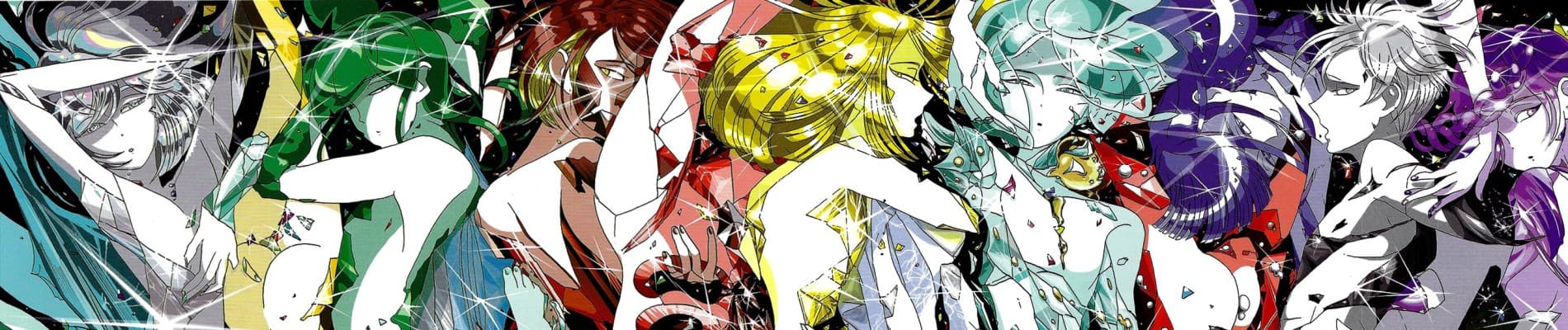
LAND OF THE LUSTROUS
Clarifications made by Jackdevil. Review / insights translated with google translate. You can read it from the following pdf link in ITALIAN link
INTRODUCTION
The clarifications will concern curiosities and religious references ranging from Christianity to Buddhism, after all there will also be references to the book Life and Culture of Y-3579203181277 which was together with one of the Japanese volumes of Land of the lustrous, I will repeat certain things in the brackets to don't lose the thread of the conversation and reconnect certain things more easily.
CHRISTIANITY
I start from Christianity so it is easier to reconnect with certain points of Buddhism. Phosphophyllite stone comes from the phosphate family which can go from green to blue in color(the change of phos when blended with lapis). The purest color of phosphorus is white (the final deity form that becomes phos). Phosphorus in Greek mythology is the god and Personification of light and morning, later in Roman mythology phosphorus took the name of lucifer understood as a bringer of light and in Christianity he became the devil and the fallen angel. Lucifer (phos) rebels against god (kongo) because he wanted to become like him, (this thing is reversed in lotl since it is phos who wants to transform kongo into a true human capable of praying for the selenites) furthermore following the betrayal lucifer will come forgiven only at the end of time(the end of the Buddhist cycle 108). The Selenites can be seen as the souls of hell and as we see in a chapter Aechmea appears with devil horns. To reach nirvana (see the Buddhist section) the Selenites need a human to pray for them and Kongo cannot because Imperfect but Kongo already knew that phos has the potential to become human given that in one chapter Kongo said that phos it has no qualities but it is a gentle gem, recognizing in fact that it has humanity within itself and that it will be able to forgive (by saying this Kongo confirms that it has seen inside phos The three signs of existence), so it was seeing how things have evolved.
BUDDHISM
Buddha(phos), i.e. Gautama was a very protected person by his father (kongo) and was forbidden to do anything dangerous (phos was not allowed to fight), so Gautama rebels against his father (god) and runs away to find out the external world (phos going to the moon). On his way Gautama finds himself faced with something called "the 4 noble truths" depicted as four people that Phos also faces in some way in his story:
- the dead man (antarcticite)
-the sick man (padparascha)
-the old man (Yellow diamond)
-the Monk (cinnabar)
KSITIGHARBA
Ksitigharba is a Buddhist figure with the role of a bodhisattva(Enma). A bodhisattva is basically someone who is one step away from becoming a Buddha, who is trying to help all other beings achieve enlightenment. The meaning varies depending on the school of Buddhism, but this is the most suitable definition for Kongo since they call him Enma or the judge who decides whether people's souls go to hell (Naraka which would be purgatory) or to heaven ( nirvana).
108
It represents the end of the Buddhist cycle of life or the end of times understood in Christianity
BHAGAVAT
For Bhagavat yes He means Visnu, Krsna, Siva, but also Buddha same as it comes Understood as a god who manifests himself to his followers followers to lead them to Unfavorable rebirths, (phos when he returns from the moon and tries to convince as many gems as possible to go with him). Subsequently Bhagavat manifests himself to his deniers to be worshiped (phos returning with the others to attack the gems and kongo).
THREE SIGNS OF EXISTENCE
By three signs of existence in Buddhism we mean the three characteristics that are shared by all dharmas, that is, by all physical and mental phenomena. They are also sometimes referred to as the Three Seals of Dharma. Since Ichikawa attended a school of Chinese Buddhism on the signs of existence I will refer to the Chinese ones even if it doesn't change too much. In Chinese Buddhism the 4 seals are named.
-ANICCA: all composite things are transitory (represented by the race of admirabilis who can live and then die). There is also ANATTA, that is, something that persists over time (represented by gems that do not change shape, with the exception of phos)
-DUKKHA: the "Four main sufferings" of human beings: birth, old age, illness and death, as well as the "Four secondary sufferings" which are: obtaining what you do not want; not getting what you want; not being able to maintain what you have. (we are interested in the secondary ones, furthermore Dukkha is also defined as "absence of self, no soul" and this represents the Selenites with their desire for "nothingness") -
SHUNYATA: All things have no intrinsic existence due to their viewpoint dependence
NIRVANA: lies beyond concepts (nothingness)
Anicca There is not much to say about this, it refers to the physical change of phos when it merges with gold, lapis lazuli and other elements, we will return to it later with the three treasures.
Shunyata indicates one of the fundamental doctrines in Buddhism, according to which reality has no intrinsic existence but arises from pratītyasamutpāda (translated as "conditioned co-production" or "interdependent origination")
pratītyasamutpāda To put it simply, it is the cause and effect cycle of the universe until nirvana (nothingness) is reached, this cycle is made up of various rings whose number can vary from 9 to 12. The first 9 are references more concerning the psychophysical aspect so I won't name them because they repeat the same references as before. The others are:
- Bhava: being, becoming (phos slowly transforming into human)
- Jati: birth, (the wait for 10,000 years of phos transforming into god)
-Jaramarana: old age, death (the death of phos as a deity at the end of the cycle)
Nirvana
Nirvana is the final achievement of life or nothingness, but in reality it is not depicted as nothingness as it is considered the end of suffering and pain or a moment of unimaginable self-awareness (we could see it as the purpose of Japanese life ikigai) . In fact, from the point of view of a Buddhist, land of the lustrous should have a positive ending and does not paint the Selenites as "bad" while from the Western point of view it is the opposite and for us "nothingness" is not seen positively even though it is even talked about in Christianity.
Dukkha
I wrote about Shunyata and nirvana before because it is easier to understand dukkha that way.
The dukkha defines pain as a fundamental aspect of life, it is as if it were part of the soul (although we remember that for Buddhists the soul is not as we understand it and here it is linked to the Selenites, their pain serves to achieve the nothingness they desire)
SEVEN TREASURES
They are a set of 7 spiritual values of the individual, which have a list of 7 jewels that represent them. We are only interested in the jewels of which 3 of them are: gold and silver (the alloy of the limbs of phos even if the silver was replaced by platinum) lapis lazuli (the head of lapis)
THE SELENITES
At the beginning The Selenites they are represented to us with clothes and appearance Buddhists, but when are they on the moon they have clothes modern so it does think that they don't are truly Buddhists but who have embraced this religion over time and to facilitate Kongo to pray for them. Furthermore, aechmea never talks about nirvana but calls it "nothingness", reinforcing this theory.
AECHMEA AND CAIRNGORM
Their relationship is hard to understand but probably aechmea became obsessed with cairngorm, he manipulated her by reversing cairn's adoration of phos onto himself so he could marry her and distance her from phos at the same time
Scheduled breaks
It is not clear how many of the ichikawa's pauses were programmed, but the largest one (the 10,000 year one) is programmed. The moment you read the next chapter determines how you perceive it, if you waited all that time you will have forgotten about the atrocities the Selenites did to Phos and the betrayal of the Gems, and therefore you will forgive them just as Phos left in isolation did wanted by aechmea for 10000 years if you read the whole manga in a row you wouldn't be able to conceive forgiveness for everything they did to phos.
CONCLUSION
Land of the lustrous is full of references to Chinese Buddhism but also to others such as Hindu and Japanese. If you have seen the film "the story of the shining princess" you will notice many similarities between the character of phos and kaguya, in addition to the moon itself as an element of misfortune for the protagonists, although in the end the message of the two works is totally different.In conclusion, land of the lustrous has a free interpretation ending even if Ichikawa with the last chapter seems to focus on the positive, reconnecting to the number 108 of Buddhism (the total number of chapters of the manga) making it the end of the cycle (the story of phos) and the beginning of another. Below there will be curiosities and quotes from the book Life and Culture, and at the bottom the sources from which I took the information.
CURIOSITY
-the inclusions are recharged by being in the sun, and in fact the buds hibernate in winter because they don't receive enough of them.
41.5 out of 43 users liked this review