I don’t know if it’s just me, but doesn’t this year of anime seem kind of… bad? Two Jump manga ending with unilaterally disappointing conclusions aside, 2024 is probably the weakest year of the decade so far, and one of the weakest years of anime I’ve witnessed since joining the community six stupefying years ago. Despite harboring a strong winter season, 2024 has been the victim of constant underwhelming release after underwhelming release. In a year with Slime Isekai, Mushoku Tensei, Demon Slayer, the return of Code Geass, the return of Konofuckingsuba, all at the same time, the most praise I’d passively seen from spring was for the most recent season of My Hero Academia of all shows (and Dungeon Meshi, a show from winter). To be fair, maybe I’m just distant from the community compared to my college years, and I don’t want to sound like some self-absorbed elitist who’s arrogantly noting what flagrantly isn’t true. But, if you told me a year ago that season 2 of Oshi no Ko, an adaptation of surely one of the defining manga of the decade, was going to be fighting for top billing of the summer season against some goofy cheap ass light novel adaptation because the imouto went viral on social media for being a deranged, incestuous, weeby freak, I would’ve thought OnK had shat itself far earlier than what fans of the source material were claiming. However, that isn’t the case at all, OnK Season 2 is very well received, people just give that little of a fuck.
In this way, I want to sympathize with a show like Makeine. The show is clearly something produced with the full intention of being one of the most popular anime of the year, and is thus packed to the brim with the most passionate staff A-1 pictures could muster that didn’t get funneled into the Solo Leveling meat grinder. Under the helm of freshman director Shotaro Kitamura, A-1 created what is essentially a Cloverworks show under their currently existing deleterious system. There’s a sense of youthful creative ambition that’s nonexistent in any other A-1 show that, while not as vivid as you would find in a Cloverworks project, is still far above the cynical, lifeless, abused, and beleaguered A-1 Pictures of 10 years ago. In some ways, Makeine feels like it was made to be a massive flex that eagerly awaits to be read off each staff member’s resume, and if that’s what the showrunners wanted, they succeeded. Unfortunately, there’s a degree of tension in the writing that leaves me perplexed. I wonder, how did so many exceptional animators get sucked in to working on some passe light novel adaptation? Realistically, it’s just that a handful of cunning producers from both A-1, Cloverworks, and Wit of all places, found the source material to be strong enough to justify reigning in a bunch of hyper-talented animation staff in an industry which requires natural skill to survive. But if this material was enough to convince the sublimely talented Souta Yamazaki to create one of the most impeccably realized ED’s of the decade; then maybe I really am some solipsistic, ivory tower climbing, Frankfurt school gas huffing, Jacques Derrida dickriding, disciple of Theodor Adorno, who hates all things fun and wants to watch the world burn. Because this? It ain’t it chief.
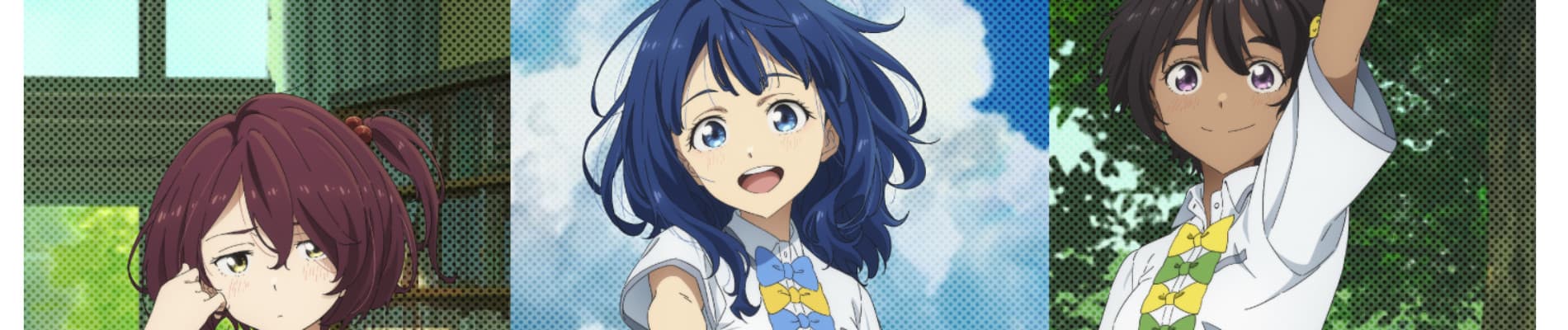
For the uninitiated, Makeine is a meta-otaku romcom light novel about some dweeby bookworm who so happens to make friends with three anime archetypes whom either were just cucked, or are about to be cucked, in their own high school harem romcom scenario—and how they emotionally manage in the fallout. The meta qualities of this one are excruciatingly apparent, each girl is attached an archetype that tends to lose harem romcom scenarios (the osananajimi, the tomboy, and the dandere), they lose to more popular anime girl tropes, and they lose out on boys who are themselves, visual iterations of typical harem romcom main characters. This show is so unashamedly meta that it almost feels dated sometimes, like this is straight up a show from like 2014-2015 that somehow tripped on a flight of stairs and got isekai’d 10 years into the future. That doesn’t mean that’s what my problems with the writing are, I love my meta bullshit as much as the next guy, but it does clearly tell me what draws Japanese audiences to a story like this. I’m sure most otaku are not casanovas in their own right, so having a story where cute girls navigate through the same skin peeling emotional experiences they had as teenagers, and on top of that achieve some kind of emotional catharsis, is deeply fucking satisfying. It doesn’t hurt that Makeine is full of “down to earth” conversations where characters sincerely talk through the plot or their feelings about the plot. There is your decent share of anime melodrama, but in many ways Makeine is evidence of the natural progression of a post-oregairu light novel scene. Characters are still going to do stupid shit, and be way histrionic about everything, but they function based upon pathology, and that will be progressed in such a way as to be narratively satisfying. The story is still fairly lighthearted so everything will ostensibly work out fine; since this isn’t like real life where even intimate friendships will implode in a single conversation because one of the parties involved refuses to lower their ego, characters are ironically more reasonable. But these dashes of realism are partially what make Makeine frustrating for me to watch, even if I can respect how conversations are written scene by scene.
It becomes incredibly jarring to spectate a delicately crafted scene, with characters struggling to convey their feelings or accept themselves, only to dive head first into a bit with the quirky student council president with big tits who’s also a gyaru, who also acts and talks like a fucking ghost. There’s a degree of eccentricity that I can appreciate, even support in more down to earth settings. But past a certain point, Makeine just indulges in gimmicky light novel bullshit that actively undercuts its ethos. I can’t believe I’m saying this, but the tone is actively disrupted by being so inconsistent, and I’m the guy who supports drastic narrative tone shifts! Because otherwise, Makeine is generally a lighthearted slice of life show full of the typical mundane scenario writing you expect in shows like this (they go to the beach, they have a school festival etc.). And even then, these aforementioned jovial moments can even undercut the serious drama that you’re supposed to be invested in. There’s this segment in episode 6 where one of the main characters goes like miles into the country to be all depressed, and the main cast all come out to go see her. This being incredibly inappropriate aside, they get lost on the way and just start fucking around on a riverbed catching crabs and taking Instagram photos. The bit itself is fine, but this completely undercuts the little tension I had because I actually liked the character involved and was wondering if they were okay. I’m sure in the novels this felt more natural, or more justified, but this completely broke any sense of tension I had. I had a few issues with this arc in general, but suffice it to say, Makeine’s writing is such that it makes it hard to take seriously when its whole shtick is that it’s a “serious story with real emotions that’s also a meta-otaku light novel.”
Complaining about the writing aside, I mentioned before that there were some serious staff behind this show, and you can trust me when I say that is very much true. Makeine looks good, it’s probably the best-case scenario for a show of its kind. While there are still a few of the shortcuts you tend to see with TV anime, Makeine is consistently well animated, is often well storyboarded, and has some of the most effective digital compositing I’ve seen in a slice of life show. I’ve seen people comparing Makeine to looking like a Shinkai movie, and for once, I can kind of see where they’re coming from. These days, Shinkai movies are always engrossingly cinematic, even if the writing is lackluster. But importantly, Shinkai movies have a particular form of digital compositing and color direction following the Children who Chase Lost Voices. And when I watch Makeine, if I squint my eyes, I can see glimpses of something like The Garden of Words. But comparisons aside, there are scenes of Makeine that look genuinely incredible, and if they were in a better show I would be gassing this thing up to all my friends and pushing it to the top of my best of the year list. That isn’t to say the show looks incredible all the time, there were episodes given to less talented directors/storyboard artists, and in some scenes, it felt like they had no idea what the fuck they were doing, so there’s some noticeable drops in quality each episode. But I can recognize that Makeine is a step above normal anime in terms of direction and general visual fidelity. As it stands, even if not every dramatic scene is my cup of tea, I think it melds well enough to the visuals to justify putting in all the work, the problem is the rest of the show in between.
Even now as I am reaching the end of this review, I feel complicated on Makeine. By the time I finished, I really wanted to like it as much as the internet seems to, but I just fucking can’t. I don’t know how well I’ve conveyed what it’s like to what this show scene by scene, but I’ll say, despite Makeine being a comedy it’s inconsistently funny. Komari is by far the best character in the show, and easily garners the most laughs from me, but it falls off pretty quick with everyone else. I should love Lemon but it seems like the main joke is that, much like with Tomboy characters, they can be a little overfamiliar and dense to the fact that everyone thinks they’re hot as fuck. There’s a bit early on with Lemon that made me want to drop the show because I thought it was so corny that I was completely turned off. Yes, I get it show, Lemon has some very lickable abs, I don’t need to be reminded of that every other episode. With Yanami... eh, the show really wants me to like her in the same way you’re supposed to like Chisato from Lycoris Recoil but she’s dumb and eats a lot. And in many ways Yanami is charming, but she is ultimately just light novel main girl so she has this dissonant maturity and self-awareness beyond her years that’s intended to appeal to an older audience in a way I find trite at this point. Additionally I feel like Hikaru Toono’s performance delves a bit too hard into overacting, and as such, ends up upstaging all of the other characters in the show. In this sense, I can’t really “enjoy” her bits because they feel constructed for explicit likability and that’s also a turn off.
While it may have been initially impressive, Makeine quickly lost its charm for me and was consistently a mixed bag of tiresome anime tropes with hints of interesting characterization all the way through. I may be a loser who writes anime reviews, but at least I’m not someone whose continued existence relies upon tasteful anime side-titty.
Have a nice day.
51 out of 81 users liked this review
