
Updated with now 2 rewatches.
Note: This review contains a spoiler-free section, an initial review (now updated), a pre-rewatch section and a post-rewatch section.
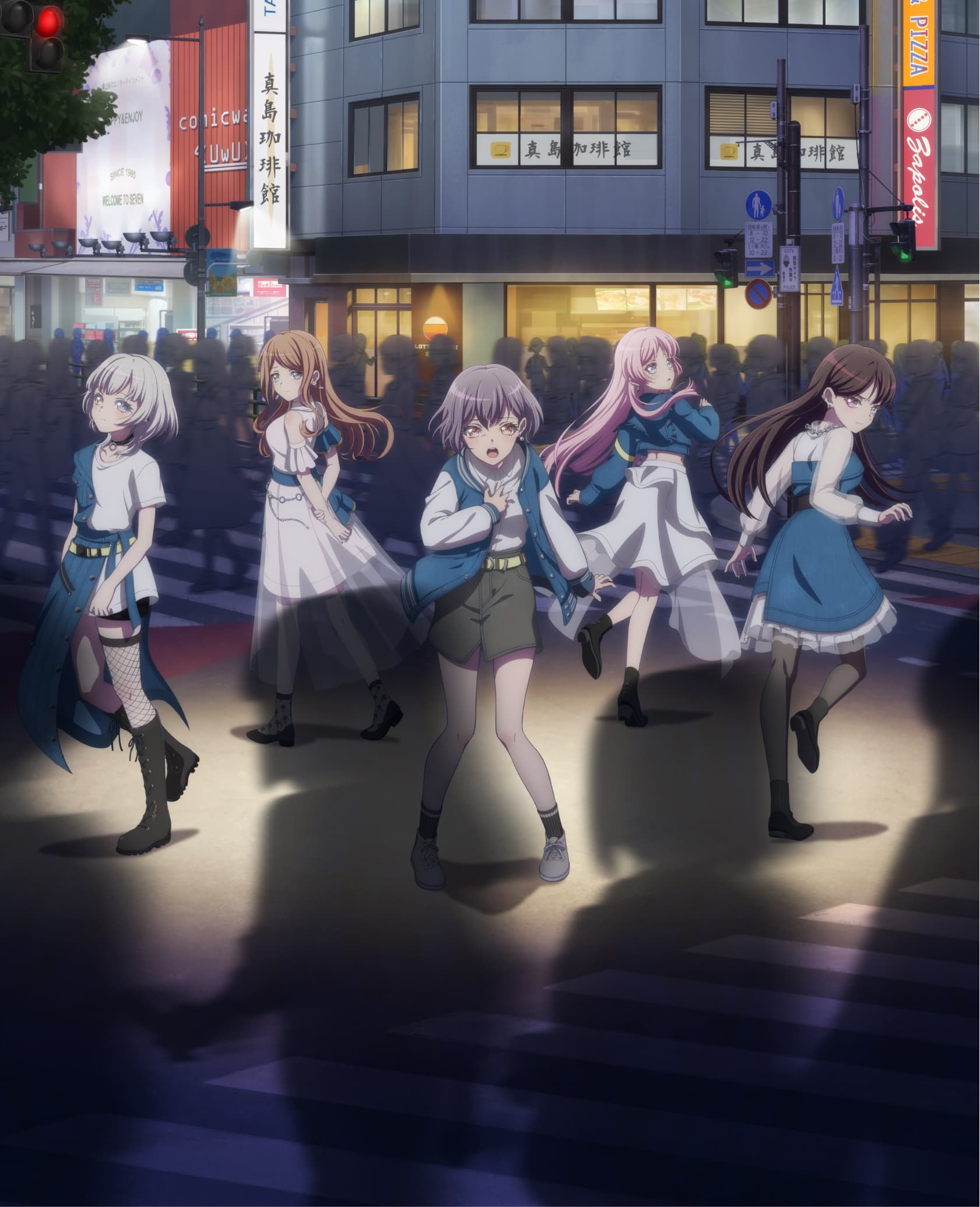
Starting with MyGO, the Bandori anime takes on a very different approach to many aspects of the series’ usual makings, but manages to not only shine, but stick its landing, tasked with kicking off the next Girls’ Band Generation.
To sum it up without spoilers, it’s a deeply interpersonal character drama with music as its base of operations. What stands out about MyGO’s take on this concept is its willingness to take on the characters’ perspectives yet also express their feelings well even when they’re not in focus, not only in their day-to-day interactions but in the performances, which are incredibly detailed and intentional. It will also test empathy, especially with its drama hammering on intricacies which continuously unravel. While one might find it a bit hyperbolic at times, there's very well-established rationale to why the characters act the way they do, sometimes earlier than you’d realise. On top of that, it’s really the nature and weight of the personal (self) and overall conflict here that makes the payoff in the latter half all the more satisfying. The characters are a mess; an endearingly human mess, one I couldn’t lay my eyes off of for even a second. If you’re already into the Bandori hole, as drastic as some changes may feel, this certainly retains the series’ DNA and is worth a shot. If you’re a newcomer or still side-eyeing the franchise, perhaps this might be what you’re looking for, or at least a more direct, more thought-provoking take on a girls’ band anime.
(spoiler-free section ends here.)

Beginning with, out of nowhere – a band disbands then and there, dropping the first but most crucial piece to this puzzle. MyGO finds a reverent balance between past and present, particularly with its placement of characters recalling and coming to terms with their memories of CRYCHIC, the band that haunts this very narrative on both counts. The deeper you dive into the story and characters, the clearer the significance of CRYCHIC becomes. See the first episode in Tsukinomori where Soyo invites Mutsumi to talk about reuniting, sitting at a table with enough seats for five people, specifically the members of CRYCHIC at this time. Seeing the characters during and after CRYCHIC is a quick gesture, but telling of how they felt in what is really the most normal, most precious band they could’ve asked for. AveMyGO exists as partly a post-mortem of CRYCHIC for each of the members, which is why its presence and absence within the story cannot be stressed enough. To that end, it delivers plenty, especially from a direction standpoint to convey this vital story beat.


On that note, in both the opening scene and the opening itself, it’s raining, and they’re particular as to who is under an umbrella. I think this represents the maigos (Translator’s note: maigo means lost child) who are lost, ready to go off the rails at any moment, but free to express themselves. More on that last point, though. The way these characters are portrayed as the 迷子 really sets the stage for everything here, and it’s clearly defined in just about every scene. Tomori’s state of stillness, filled with regret from the past she’s unable to share with anyone at the beginning of the story, Anon and Saki’s desperate escapes to find/make something new for themselves, and so on. All of these cracked fragments are gradually connected together, while telling of the effect of, ultimately, Japanese high school girls trying to find themselves. In a land they found themselves stranded together, related by their state of not feeling human, and connected through a journey formed through solely mortal hands. Art built from human suffering, finding solace and authenticity within it. All of this makes for a very push-and-pull narrative, where every incident of drama has major inciting meanings and implications, where characters stand as individuals but unequivocally leave a lasting effect on each other, even through unsaid words and actions, like Saki’s absence fueling Taki to take on the role that Saki had in CRYCHIC for MyGO: supporting Tomori and being the producer for the band, like Anon and Soyo’s attentiveness to each other developing, and like the stray cat’s very presence.

She has little to no involvement in any of the drama unless directly addressed, and even then she usually just shrugs it off, because she’s an observer to the chaos, who will join and leave at her leisure, much like a cat. Yet when push came to shove, it’s her resounding guitar that lifts the band back up to stand on stage once again. A selfish approach certainly, but it ultimately works out for MyGO, because she’s finally found a group she can fit in, can care about, a place to truly call her own. A character like her, as well as the many appearances of older Bandori characters, particularly the Poppin’ Party members, helps keep things balanced and Bandori-like still, placing them into the story in a light-hearted and very tasteful manner, while keeping the focus on MyGO slowly pulling things together out of their incredibly disjointed states. And oh so disjointed they are, coming out of conflict after conflict, be it internal, external, in selfishness and blindness. They’re scattered across different schools, and quite literally slowly find each other as they slip into their breaking points, which is predominately in that latter half episode run.

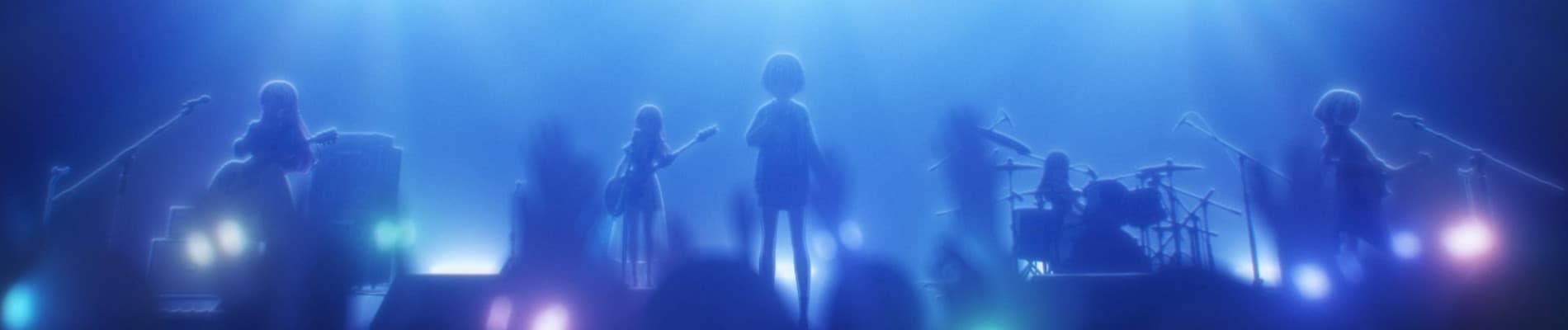
When it comes to the music and performance aspects of MyGO, the performances and insert songs for this show are so… powerful. Perhaps the strongest of any music anime, or at the very least band anime, I’ve witnessed thus far. There’s Haruhikage (春日影), an endearing, passionate expression of reflection in thankfulness from Tomori to CRYCHIC and Sakiko, with sentiments and meanings changing as well as carrying over to MyGO.
Then there’s Utakotoba (詩超絆), the Episode #10 song. When all feels lost, Tomori turns to performing solo. Cut the guitars, bass, drums, and what remains is one lost girl and a microphone. Everything that builds up to this point creates the riveting moment in which Tomori finds sincerity through her raw human expression, reading and eventually shouting out, which in itself builds up making it all the more cathartic when she finally fully belts. It’s not just the music itself, but the way it’s performed and put together in the first place which reflects so well the nature of the band. There’s so much improv and last-minute action, yet it still reaches through, because this band perseveres through its insanity. Note by note, they’re finding a way, because their hearts are caught in this band. Episode #12 features Melody (迷路日々), with a full acknowledgement of personal qualms, but a collective promise to move forward despite, or exactly because of everything – the screams of MyGO. There’s a line from here which particularly stood out to me: 「独りよがり あてもなくて」 which was translated to “Self-righteousness with no particular destination”. It sums up the band’s status quo quite well.
Musically, I do also quite enjoy the songs; the vocalist in Youmiya Hina, and the absence of a piano player, along with the spoken-word verses make its sound uniquely distinct amongst the Bandori lineup.

In general, I find myself really enthralled by the show’s central concept. Yes, these maigo will miss out on many social cues or flat-out ignore them, and sometimes they will exert themselves more than necessary, and it’s precisely because they are lost. Technically free to do as they please, but at odds to what that special thing could be for them. It’s all very crushing, yet atmospheric, much due to the colors and the conflicts which take place around them, all building upon their promise to do the band “for the rest of their lives”. Everything comes back to these quickly established values of the band.

A necessary Anon Chihaya mention before wrapping this up:
Anon Chihaya, the gift that keeps on giving. Her presence in this show perfectly encapsulates everything that works about it: being all over the place, rooted in very real struggles, but managing to find authenticity and come out a different person in the end, influencing her peers for the better, and even pulling her weight in regards to her guitar skills. The selfless selfishness she has makes for an incredibly intriguing, engaging and endearing character, all the more evident in her dynamics with everyone in the show.

All in all, MyGO!!!!! Is a daring yet sincere story in which each member of the band gets mingled; in the past, in their own insecurities, all the while forging twisted, progressing relationships. It’s all rather extraordinary – but still perfectly human, and inspiring. The production team makes use of everything at its disposal to express these ever-changing, passionate feelings: facial expression, body language, lighting, and most of all, sound. It’s because of these defining features that I thoroughly enjoyed this. What’s here is very moving, and certainly something I’ll remember for a long time, as a phenomenally immersive and intricate Bandori experience.

PRE-REWATCH THOUGHTS:
I’ve had some more time to think over – many times, about this show, and I think I can further articulate what it does for me. As I’ve sat with it continuously, I’ve realised that this show really maintains a balance between being a conceptually interesting show that I was quickly invested into, but also one that strongly, painfully, and truthfully resonates with me at the same time. Not just at this particular point in time, but it has encapsulated many things I’ve felt over a long span of time. In the busy two months that have elapsed since my first viewing, it has unsurprisingly remained on my mind constantly. I’ve only been listening to the band’s music more and more, and my appreciation for the characters has only continued to rise, especially for Anon, Taki and Soyo. I will also be rewatching it in great anticipation for you-know-what. As such, this entry has proven its staying power to me – I mean, here I am writing about it again even though I haven’t even rewatched it yet.
POST-REWATCH
Upon rewatch I am further amazed by the finer details and strengths of this show. My main gripe with it from my first watch, the shift from MyGO to Ave Mujica at the end is now null and void, as I was able to pay more attention and become more immersed to that side of the plot this time, which often played into the MyGO plot anyway. The two groups are in conversation in a way, each providing their own answers to their state of being lost, and affect each other in said states as well. While MyGO is a band based on its individual members' decisions, Soyo attempts to morph it into CRYCHIC spontaneously to return to her past warmth. On the other hand, Ave Mujica is a group completely and carefully assembled by Sakiko as her new place of warmth, her next chance as she moves on. Many similarities can also be drawn between the individuals and the nature of their relationships in each group, some of which can be found in my episode-by-episode notes, along with other scene and character analysis. As such, this season does well to build the two groups at the same time. Looking into the characters further has both elevated my already strong appreiciation as well as have newfound appreciation and understanding for characters I paid less attention to before. I also caught onto the way a lot of scenes are set up, such as characters inviting each other to sit down before having a conversation, telling of their impressions of each other in that moment. With this rewatch, I feel much more anticipation for Ave Mujica's world and an increasingly deeper appreciation for MyGO. If you haven't done so yourself, I strongly vouch for this show to be watched and rewatched. This Bandori run will be one for the ages.
