A good work needs to evoke empathy in the audience or allow them to feel the metaphors within. Frieren: Beyond Journey's End clearly embodies the former.
Frieren: Beyond Journey's End left such a deep impression on me that it reminded me of the shock and awe I felt years ago when watching Attack on Titan and Fate:Zero, along with the emptiness that followed.
Only Memory is Eternal
In a world inhabited by long-lived races like elves, dwarves, and demons, the relatively short-lived humans inevitably seem pitiable. When the topic of "longevity versus brevity of life" is discussed, such narratives take on a more tragic tone, which is particularly evident in the early stories of Frieren: Beyond Journey's End.
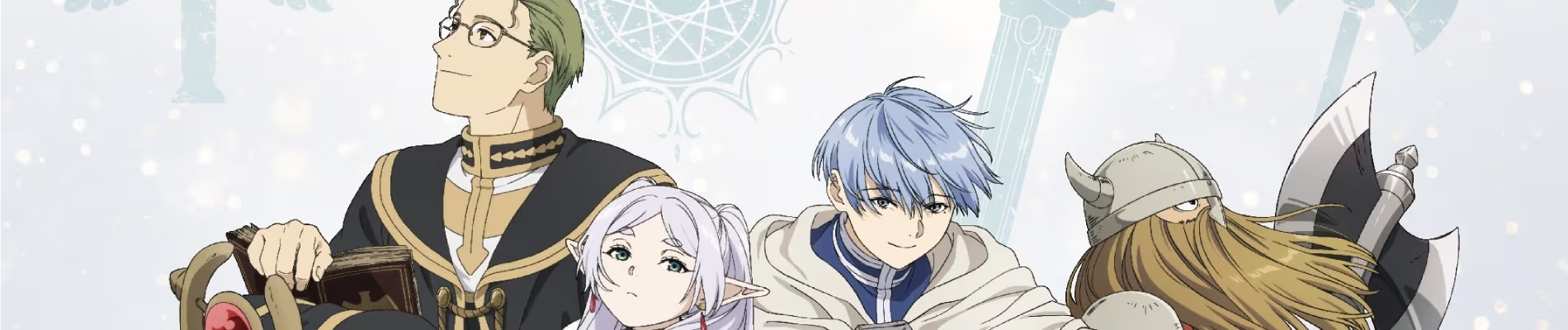
The elf Frieren and her human companion Himmel, along with others, formed a team that successfully defeated the Demon King after ten years and returned home in glory. Afterward, the team disbanded, and everyone returned to their own lives: the hero Himmel decided to find a job, the monk Heiter became the Chief Pope, the dwarf Eisen returned to his village, while the elf Frieren chose to continue traveling the world in search of magic.
In Frieren's eyes, those ten years spent defeating the Demon King were merely a fleeting moment compared to her long life. When she returned after decades of travel to visit Himmel, he had already aged significantly and soon passed away. For the first time, Frieren, as an elf, felt a piercing pain of regret for not having truly understood this human. This prompted her to embark on a journey once again with her former companions to rediscover human emotions.
The beginning of the story is simple, yet the sense of "wistfulness amidst the passing of time" lingers around Frieren. Before the story begins, Frieren has already lived for several thousand years. Having weathered many storms, she possesses a calmness that seems almost indifferent. Her speech is flat, lacking tonal variation, and accustomed to the ebb and flow of life and death, she feels nearly numb to the transient nature of things.
Yet, despite this, when she stands before the coffin of Himmel, who lies peacefully within, she is inexplicably filled with sorrow. This is a feeling she has never experienced in her long life. She cannot understand why she is so concerned about a friend with whom she spent only ten years, nor why she feels such deep sadness at a funeral that she has long been accustomed to. She cannot comprehend it; she is filled with regret, certain that she must have overlooked something significant during those ten years. Thus, she resolves to pursue her journey anew.
Regret is a theme in the early part of the story, which is shrouded in a hazy sadness. For Frieren, everything happens so suddenly; she finds herself rapidly drifting away from what is important without noticing. The timeline of the story is marked by "Himmel's passing," and Frieren's helpless weeping, along with the rapid aging of her old friends, serves as a constant reminder that time waits for no one. The things she has missed are numerous and irretrievable, and the desire to pursue what she has lost becomes the impetus for Frieren to set out on her journey.
Time always moves forward. In the long river of years, some try to linger in the past, but the era continues to evolve, and no one can truly hold onto time. The past has become history; the story of Himmel and his companions has become legend. Even though the once quaint village has turned into a bustling town, and the once young children have grown into adults, Frieren's new journey is never devoid of Himmel's story. People erect statues in his honor, and the older generation always remembers the tale of the brave heroes. As Frieren follows the steps she once took with her companions, she reminisces about Himmel's words and seeks the self that was once deeply moved.
She has not truly missed out; she has simply been unaware. She is not a heartless machine. In revisiting the past, Himmel appears vividly before her. All those who knew him, including Frieren and the rest of the hero party, remember Himmel; they cherish his memory and understand his character, contemplating how he would act in their place. "If it were Himmel, he would definitely do this." But I want to say that even if Himmel did not intervene, Heiter would still save that girl contemplating suicide; even if Himmel stopped reminding them, Eisen would take in that unfortunate apprentice; even if Himmel no longer appeared, Frieren would still wake up early to watch the New Year's sunrise.
Frieren did not come to understand these feelings only after embarking on this journey; she merely realizes now how profoundly Himmel had influenced her all along. Although Himmel is gone, he is everywhere.
Death is Just the Beginning; Forgetting is the True End
What the hero party experienced, what Himmel left behind, and what Frieren missed and later rediscovered could be a memory, a feeling, or a belief. But regardless of what it is, only what Himmel left in Frieren's heart can truly allow her to resonate across time in her subsequent journey. When Frieren reminisces, she can recall these memories of the past.
Himmel still lives on in everyone's hearts, in their memories, leaving traces of his existence in the world: "If it were Himmel, he would definitely do this." It is because someone remembers them that they continue to exist.
All attempts to prove a person's existence pale in comparison to the enduring nature of people's memories of them. They will inadvertently recall the flowers blooming outside the crumbling palace, the girl saved in the village, the dwarf chasing after a pink flower crown, the companion trapped by the treasure chest monster, the monk who was always drunk, and the gentle face of the blue-haired youth.
Born Free, Living Brilliantly
Though the individual is gone, they can continue to live in the memories and lives of those who come after. People use various means to commemorate them, hoping to preserve their images and stories. However, memories fade over time, and those who remember their tales will also grow old and pass on.
For Frieren, the ten years spent with Himmel are but a fleeting moment. Yet she will spend the decades and centuries that follow searching for him, striving to catch up with him, becoming him, piecing together the moment that once was Himmel. Time has already frozen him at the moment of his death; Frieren battles time with her own journey.
On her new path, Frieren reflects on the past and gains new insights. From a human perspective, Frieren is undoubtedly an "irritable old lady" who has lived far too long. Despite her vast experiences, she should have developed a calm indifference towards all things. Yet she remains like a girl who refuses to grow up—sleeping in late, holding grudges against Heitar for calling her "irritable old lady," packing her suitcase with a variety of strange and fun items, and constantly falling for the temptation of treasure chests (traps). She inadvertently annoys Philen and feels regret for it. She is still that young girl, unchanged in the slightest.
Himmel brought her a gentle disposition, a resilient heart, a passion for life, an appreciation for the present, and a touch of romanticism, constantly inspiring, reminding, and influencing her.
Memories do not need to be beautified; Himmel became a hero not because he was great, but because he was great enough to be remembered as one. Hero Himmel was not a saint; he too was someone who feared, who felt disappointment, and who laughed heartily over trivial matters. It is precisely for this reason that Frieren changes, that there is change. The once emotionally dull Frieren now cares about the bonds between people; the one who was indifferent to the rise and fall of the world now slows down to savor the moment; the one who once wanted to destroy the Aoular puppet army now wishes to leave a mark for the deceased; and the woman who did not believe in gods now begins to hope for the existence of an afterlife.
Life is profoundly unfair; humanity is given but a hundred years, while other races are granted thousands. Under the weight of fate, it can be somewhat sorrowful. Yet, looking at the still youthful Frieren, Himmel, approaching his seventies, does not feel resentful or complain about the unfairness of heaven. Even the elderly Heiter remains steadfast.
They have lived a life radiant enough. "Give life to time, not time to life."
An Era Belonging to Humans—Only Memory Transcends Eternity
After Franmaye's death, she entrusted her will to Frieren, asking her to promote human magic education. Although she superficially looks down on humans, Sairei ultimately tells Frieren: the era of magic belonging to humanity will eventually come.
The demon race has long devoted itself to the study of magic, and the elves continue to learn and gather magic tirelessly. Compared to the two, short-lived humans cannot match them in talent or time; this fact holds true, as none of the human disciples trained by Sairei have surpassed her. Yet, Sairei chooses to believe in humanity. Why?
The demon race has indeed dedicated everything to the study of magic, achieving great successes, but without a sense of family, there are few opportunities for large-scale cooperative battles or exchanges of magical knowledge. The elves have certainly mastered worldly magic and even defeated the Demon King, but their indifference towards finding kin and neglecting reproduction restricts the flow of magic to a select few.
The elves who defeated the Demon King were human disciples, while the two young heroes who took down the elite demons trained for over a thousand years were barely twenty. Only humanity has successfully established a true civilization. Why? Because only humanity can carry on its legacy.
Both Fern and Stark are Frieren's disciples, inheriting the responsibilities once held by Himmel and Heiter, who have passed on, and Eisen, now in decline. Frieren carries forward this same belief, passing it onto these two young individuals.
I wonder, years later, how that red-haired warrior and the purple-haired woman will feel when they recall the journey they took with the quirky white-haired elf, filled with uncertainty.
The Flame of Humanity, the Flame of Civilization, the Flame of Heritage
Decades-old statues will slowly develop patina; even someone as long-lived as Frieren will one day pass away; and although Heiter has already departed, the legendary tales of hero Himmel and his four companions have not been forgotten—because memory can be passed down.
In the vast river of history and time, countless years of longevity pass in the blink of an eye; no one can outrun time. Things fade, and everything related to them seems to cease, yet the spark of civilization continues to move forward.
Only memory can transcend time, which is the essence of "Generations flow provide a ceaseless tide,Moon on river, year after year, they abide."
43 out of 46 users liked this review