Original Video Animation is the creative flux-capacitor that powers are current obsession with everything 80s Japanime. The ludicrous amount of animation that was developed for the futuristic and exciting breakthrough that was VHS was insane. You could plug up the Mariana Trench and pollute the 7 seas for 7 generations thanks to the polyester plastic base, polyurethane binder, magnetic oxide particles, iron, chromium, cobalt oxides, sometimes nickel and the unrelenting desire to animate anything and everything that came to any random animator’s mind. No matter how absurd, no matter how violent and no matter how niche it got made. And that is how we ended up with some of the most brilliantly creative, lovingly crafted and A>E>S>T>H>E>T>I>C pieces of animation of all time. But why were so many future, future funk thumbnails and endlessly looping Vaporwave’s video GIFs allowed to be made.
Bubblegum Crisis is undeniably dated, and I wouldn’t have it any other way. But there must be something beyond just being an animated museum of everything considered cool in the 1980s. Something that puts it above its fellow gloriously 80s counterparts. And the simple answer is just that Simplicity. Bubblegum Crisis is an extremely enjoyable and hyper-focused OVA that utilises its inherent cool factor to the upmost extreme. and it doesn’t really need to be much more. Complexity isn’t key with Bubblegum Crisis which is probably why I’ve watched it more than any other anime. It’s 8 easy-going episodes of pure unadulterated fun.
But why?
But what?
But who?
But how?
But not so much when and where as I’ve kinda already gone on about that long enough.
Almost in perfect contrast to the manufactured metropolis that looks to drown them out thrashes a crowd of hot-blooded rock and roll hearts revelling in the absolute sounds of the not so subtly named Priss and The Replicants. The raw energy of this whirlwind performance is contrasted by the city being terrorized and police being terminated by a mechanical humanoid know as a Boomer. The controlled chaos of Priss’s passion filled performance is the perfect anthesis of the berserk Boomers rampage. Whilst this scene has obvious and overt parallels to The Terminator and more importantly Streets of Fire, the latter of which Bubblegum Crisis far surpasses, it stands by itself as an incredibly iconic introduction to the series helped in large part by the undeniable badassery of Konya wa Hurricane.
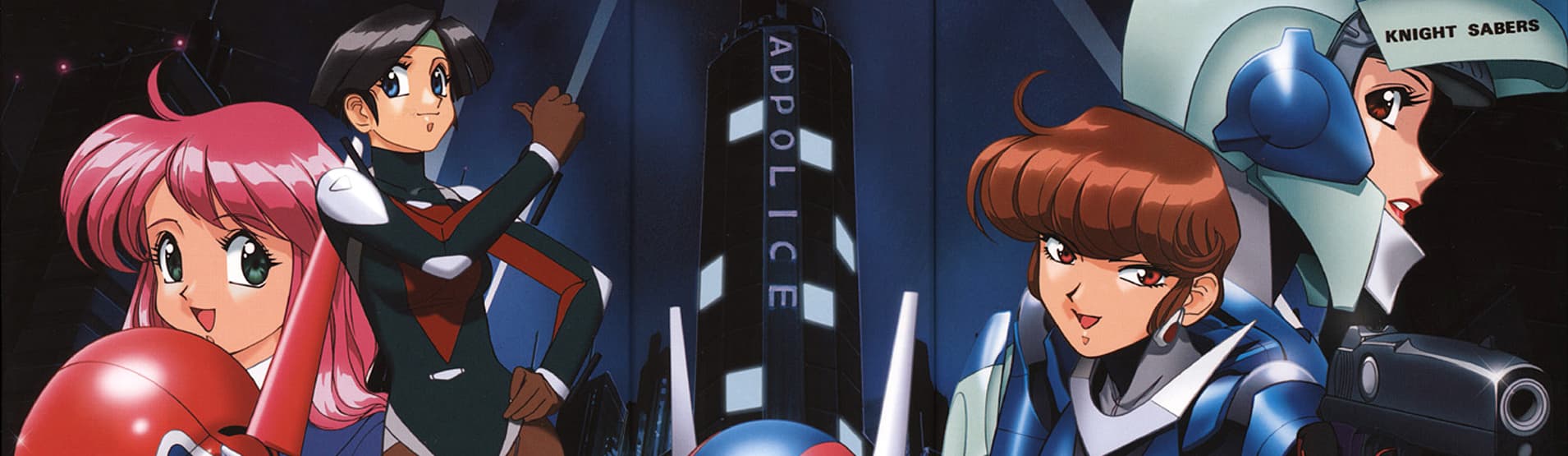
But there’s still a Boomer on the loose an no amount of sick guitar riffs, hot mid riffs or armed police are going to stop it. So, exit stage left Priss and The Replicants and ride in on transforming mecha-motorbikes stage right Priss and the Knight Sabers. The Knight Sabers are the brawn, brain and beauty that look to fight power with power armour. Rough and resourceful the aforementioned Priss alongside Sylvie, Linna and Nene make up the most badass group of bishoujo vigilantes’ anime has to offer. If they came to chew bubble gum and kick metal ass you best believe their all outta gum. All this happens in only the first 11 minutes of Bubblegum Crisis. Ridiculous right? I will try to avoid talking much about the story of Bubblegum Crisis or further episode specifics mostly because to be straightforward those 11 minutes are the strongest recommendation I can give. But there are some elements of Bubblegum Crisis I wish to spotlight, starting with the 4 main heroines.
Priss
The previously introduced rebel hearted idol Priss is a maverick among mercenaries. Priss both lives and fights with complete reckless abandon. She provides nothing but brutal honesty no matter who or what’s confronting her. Often overwhelmed by emotion Priss seems like the worst fit for a tactically taciturn troop of revolutionaries, yet or maybe because of her uncompromising nature she servers her purpose as the emotional core of the unit. The heart and soul that guides The Knight Sabers during their darkest moments.
Sylia Stingray
Despite being the level-headed leader of The Knight Sabers, Sylia’s reason for fighting against the ultimate symbol of corruption Genom is deeply personal. Regardless of her discontent Sylia understands that fighting an all-consuming mega-corporation is more complex than it seems. Thanks to her rationality and maturity Sylia finds herself handling more than just the complicated business of The Knight Sabers. She also handles the complicated emotions of her fellow Knight Sabers. She also owns a lingerie business because apparently, she wasn’t busy enough leading an underground revolution. Someone may need to sit Sylia down for a change and explain to her that keeping the almighty scales of justice in balance is fine but so is the balance of your work life and personal life.
Linna Yamazaki
If Boomers see red, then Linna sees green, giving Genom a run for their money in the greed department. Linna is also routinely ranked as the weakest of the main cast, and I unfortunately am no exception to this rule. Although I feel Linna being unanimously picked as the “worse” of The Knight Sabers speaks volumes to how loveable the 4 main heroines are because Linna is still a great character, I mean she’s literally an aerobics’ instructor by trade how could you not like her.
Nene Romanova
Save the best for last.
Not only is Nene my personal fav of The Knight Sabers but I believe Nene not only to be the most significant character of the whole series but also one of the most significant characters of the whole entire 1980s in both design and personality. Nene is the ultra-clumsy, ultra earnest and ultra passionate “redhead” of The Knight Sabers. Undeniably the weakest Saber in the field, Nene makes up for it with her technological talent. Nene also supports the Sabers with her precocious position as an Informant serving classified information to The Sabers on a platinum plater all the way form AD Police headquarters. Although Nene acts as a double agent, she is as dedicated to her role at AD Police as she is to the revolutionary quartet.
Nene is also the ultra-cutesy, ultra-animated and ultra-bubbly moe mascot of The Knight Sabers, kinda like an infinite number of characters form an infinite number of shows. Nene’s role as earnest entertainer and mega-kawaii super-serotonin booster has been duplicated beyond the boundaries of mere-action series. Some of Nene’s copycats are apparent, take Yuka and Youko form Burn Up and Aozora Shoujotai respectively, sometimes the influence is slightly subtler like in the case of Tessa form FMP. And then you find something stupefying drastic in its pursuit of Neneism. Something like Ginga Densetsu Yuna where basically every character is drenched in Neneisms. It's not that Nene is kinda like these characters, but these characters are be it directly or subsequently kinda like Nene.
in short Nene a da best. Nene Ichiban. All hail Nene.
Bubblegum Crisis by the end of its 8 episodes run amassed a total of 5 different directors. The first of which was Katsuhito Akiyama (Gall Force) Katsuhiko does an incredible job setting up the series although I do believe his 3 episodes to be the weakest of the whole series. He mixes the perfect amount of plagiarism whilst also curating the distinct identity that would allow Bubblegum Crisis to so freely shapeshift form one creative mind to the next.
Hiroki Hayashi would takeover for just one episode, making a proverbial pitstop, pun very much intended considering the focus on high octane vehicular action of his episode. This episode also features some of the finest interactions between Priss, Sylia, Linna and Nene and brings them closer together. Hiroki Hayashi proposed to AIC a spin-off series featuring The Knight Sabers in more everyday/fan servicey scenarios. AIC rewarded this excellent idea and Hiroki’s years of devotion to the company by swiftly rejecting it as they were already having trouble just getting the main series made let alone a spin-off. About 5 years later Hiroki would go “hey remember that great idea I had for Bubblegum Crisis that you rejected.” And Tenchi Muyou would be born saving or perhaps simply prolonging AIC’s existence for an extra 20 years.
Following on form Hayashi, would be Masami Oobari who had quite deservedly made a name for himself as one of the greatest mechanical designs and animators around thanks to being one of the greatest mechanical designer and animators around. This was thankfully before he quite deservedly made a name for himself as one of the worst director’s and character designers around this was thanks to being one of the worst director’s and character designers around. But for these two episodes he is unbelievable. He also makes some incredibly bold changes, Overhauling Sonoda’s design philosophy would seem like an act of sacrilege, but it totally pay’s off. If you understandably view Oobari’s directorial efforts as a joke these episodes will pleasantly surprise you.
After Oobari would come Fumihiko Takayama (War in the Pocket, Patlabor 3) which is quite a surprise because even with its darker moments, comparing Bubblegum Crisis to Fumihiko’s other work is like comparing Precure to Madoka Magica. For his episode Fumihiko unsurprisingly turns Bubblegum Crisis into a detective show. This creates a satisfyingly steady pace. This episode also looks to expand the world of Bubblegum Crisis whilst paying respect to the episodes and director’s that have come before, Fumihiko was clearly a fan.
And lastly there’s Hiroaki Gouda who directed episode 8, the finest and final outing of Bubblegum Crisis. This episode would be an acceptable career highlight for most, but oddly for Gouda it’s really his only career highlight form what I can tell. But damn what a credit to have this episode has it all, one of the greatest pieces of animation ever to be released straight to video. This episode marked the return of Kenichi Sonoda whose influence is massively felt throughout the series spectacular swan song.
23 out of 23 users liked this review