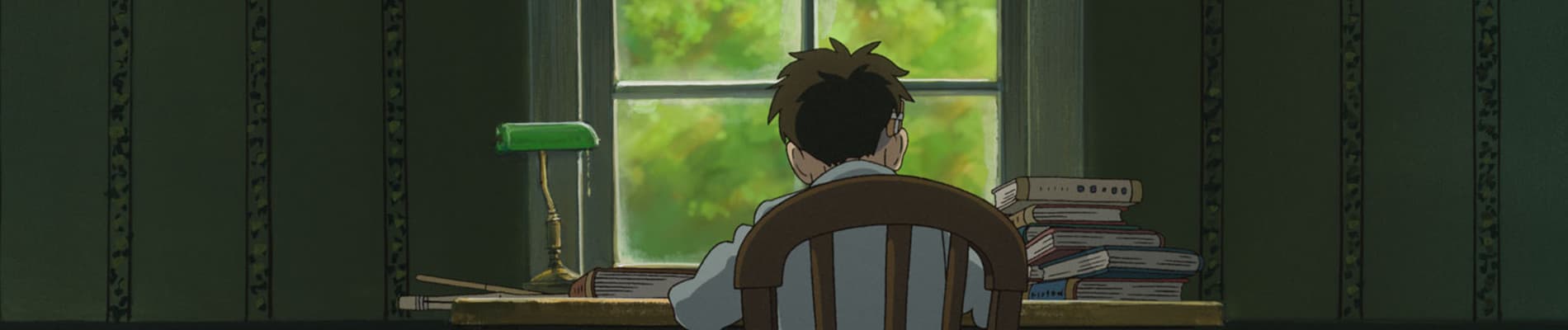
Is there a single artist on the face of the earth more tortured by their own legacy than Hayao Miyazaki?
You'd think he wouldn't have much to complain about. This is a man who's spent his life creating some of the most enduring works of art of the modern era. From Nausicaa to Totoro to Mononoke to Spirited Away to Ponyo, Miyazaki's filmography has enriched our world with timeless masterpieces that have redefined what animated storytelling is capable of and still stand as the high-water-mark of this art form decades later. He's jumpstarted the imaginations of countless impressionable children, made adults rediscover their own joy of creation, crossed language and cultural divides to unite people all over the world in their shared love of the worlds he's built and the people he's placed within them. He isn't just a great artist; he's the great artist, a once-in-a-generation master who's name and works will be remembered and revered long after he's gone. Anyone would kill for a life like that.
And yet. For all the joy Miyazaki's movies have given the world, it's impossible to ignore the sense of anguish that has pervaded his work lately. The Miyazaki who appears in his movies today is not a man facing his twilight years with the grace and contentment of a life fully lived. No, his late-stage work feels wracked with torment at the effect he's had on the world, scared and resentful and grappling with what he's actually leaving behind now that his time is ticking to a close. For god's sake, The Wind Rises has him comparing his own artistic drive to the man who engineered Japan's warplanes in WW2, casting a life spent on creation as the source of untold destruction. And somehow, even that isn't as self-critical as The Boy and the Heron, a sprawling, surreal fever dream of a movie wherein Miyazaki condemns his artistic legacy to the ashes of history and suggests we may well be better off forgetting he ever existed in the first place.
I realize some may find it pretentious to focus so much on the creator when talking about a movie or TV show. Death of the Author exists for a reason, there's only so much outside factors should influence your opinion of the work itself, all of that I agree with. But this movie in particular practically demands to be read in context of Miyazaki's life and work. The whole thing practically feels like a remix of Ghibli's greatest hits at points, the building blocks of his storytelling sensibilities repurposed and smashed back together. Like The Wind Rises and Grave of the Fireflies, it's about the horrors of World War 2: the protagonist Mahito loses his mother in a bombing run. His father remarries his wife's sister and takes them to live in a countryside villa straight out of Arrietty or Totoro. He's then Spirited Away to a magical otherworld in search of his stepmother after she goes missing, with a dreamlike surrealist tone reminiscent of Howl or Earthsea. There's even a focus on sea imagery like Ponyo and a scene with little puffball spirits that wouldn't feel out of place in Princess Mononoke. If you've watched a single Ghibli film before, you will feel its echoes rippling through this one.
But these are not gentle references or nostalgic callbacks, oh no. The world Mahito is drawn into is explicitly a world of death and entropy. The first place he visits is the door to a towering graveyard. Gentle spirits are ripped from the sky by carnivorous birds. The sea bulges and ripples like it's constantly on the verge on overflowing and swallowing the land whole. This isn't just an amalgamation of all Miyazaki's work; this is the corruption and degradation of his attempts to build something beautiful. The closest comparison I can make, oddly, is Dark Souls 3, a work that feels like a creator's legacy crashing in on itself, themes and aesthetics and concepts smashing together in some kind of apocalyptic spiral as the worlds they were born from are stretched past their breaking point. This world is dying, dying, dying, and as we find out near the film's end, only one man's stubborn refusal has kept the proverbial First Flame's embers flickering as long as they have. But soon, even that will be snuffed out as well, and this exhausted carcass of a landscape will finally slip back into the darkness.
What's most striking about this portrayal, though, is how explicitly The Boy and the Heron condemns Miyazaki in the approaching apocalypse. Spoiling as little as possible, we come to understand that the reason this world is so off-balance is because of its creator's attempts to fill it with joy and whimsy. But all his efforts turned sour, his creations that should've been sparks of imagination instead turned carnivorous and insatiable, ravaging the land with unquenchable hunger sparked by his own innate malice. The creator of this world, in other words, the man who just wanted to make something beautiful, only ended up creating nightmares poisoned by his own inner darkness. He wanted to give his gifts to the world, and all those gifts have done is lay waste to it. And now all he can do is fiddle away as the Titanic goes under, hoping that someone better than him- someone untainted by the world's darkness- can create something better from the scraps he leaves behind.
It's a nihilistically dark self-portrait from Miyazaki, to the point it's almost comical. Like, you're telling me My Neighbor Totoro is a poison you unleashed upon our world? Sure, grandpa. But the film argues that point with such raw agony it kind of makes you believe it. As typically gorgeous and jaw-dropping as the animation is, the whole film feels drowned in stillness and sorrow, even before we reach the mystical otherworld. Mahito's big introduction to his new house is almost completely devoid of music, long stretches of time going by without so much as a line of dialogue to alleviate the crippling dread. So many of the early scenes portray his grief and rage not through dialogue or action, but the silent, subtle changes to his numb expression. This world is already so steeped in darkness, the movie seems to argue, that trying to create anything out of these poisoned building blocks will inevitably cause nothing but misery. Even when the titular heron shows up, there's no fanfare, no sense of discovery or whimsy at the reveal of something magical intruding upon the normal world like you'd get in other Ghibli movies. Mahito just confronts it as if he'd known it was there all along, as if this mystical otherworld is just one of the many diseases that make our world such a hell to live in, so intimately familiar and intrusive it's more akin to a tumor we can never fully carve from our souls.
If it seems like I'm talking a lot about the themes without discussing the actual story, well, there's a reason; it's kind of a mess. Once Mahito fully crosses the threshold into the otherworld, The Boy and the Heron very quickly devolves into Miyazaki's loosest, most surreal narrative yet. It operates on heavy dream logic, floating from one set piece to the next, introducing new concepts and characters seemingly out of nowhere, not paying much heed to how any of these parts would form any sort of whole. And that's fine in concept; this world is very clearly designed as an outlet for Miyazaki's angst more than a piece of credible worldbuilding. But at times it feels the narrative is swimming haphazardly amidst that current, bobbing in and out of focus as it struggles to maintain a clear line of thought. By the time the movie's over, it feels like more than one thread was dropped somewhere along the way. What was the Parrot King's deal and why did he only show up at the very end? What exactly turned Mahito around on his stepmother? Why is there no thematic resolution for his overbearing dad and what he might represent? At its worst, it reminds me of what a mess Howl's Moving Castle was, and that's not an experience I'd ever like to repeat, thank you very much.
But maybe asking for coherency is beside the point. This is, after all, a catalogue of its creator's psyche first and foremost. And if there's one thing The Boy and the Heron makes clear, it's that Miyazaki has in no way come to terms with the demons that drive him, even after pouring so many of them into this project. It's art therapy taken to its furthest possible extreme, an outpouring of grief and anxiety and despair and hope spilling like paint across canvas in an effort to purge the darkness within. I can't claim to know what's in Miyazaki's head, why he feels so disillusioned with his legacy, what the exact point was for each and every symbol. But if nothing else, I can tell this is exactly the movie he wanted to make, warts and all. It's a staggering, lumpy, uncomfortable mess of a thing, but it's raw and honest in a way that's impossible to tear your eyes away from. If this is Miyazaki's farewell to the life he's leaving behind, I can only hope his next work will bring him the joy he seeks in whatever time he has left.
16.5 out of 18 users liked this review