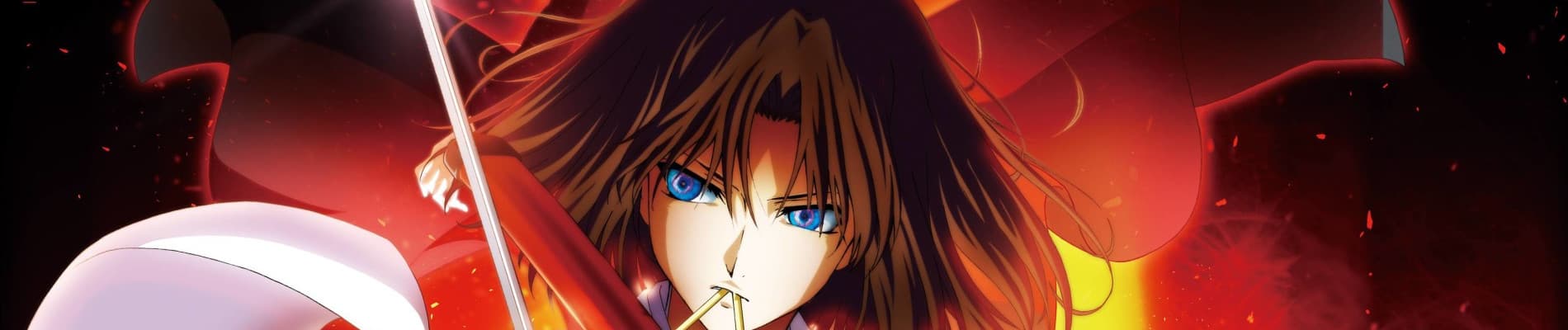
Kara no Kyoukai chapter 5, here we fucking go. Paradox Paradigm might be the most critically acclaimed of the series’ chapters/movies but also arguably the most divisive. It’s a movie that combines plot twists, symbolism, dialogue, and choreography very well but its own combination is so complicated that you wouldn’t really know if it’s good or not. In a way, I really wouldn’t blame you for that. This movie, even to this day, is confusing (albeit intentionally). It creates a handle of symbolism that isn’t written or designed literally. It will mess with you if you try to understand it literally. But generally speaking, this whole movie, despite how serious it can be, wasn’t meant to be serious to begin with. As I keep needing to say this, it’s figurative. And it’s not just figurative, it’s arguably one of the best figurative stories ever created. With how it’s written and directed, there’s so much charm to be found.
---
This movie’s plot is relatively unique compared to the others. The 5th chapter of KnK starts with a boy named Enjou Tomoe (not to have his looks confused with Emiya Shirou) who has nightmares about his personal fears in the past, all of which are repeated and narrated by a magus named Araya Souren. Enjou gets bullied by certain kids until Shiki comes into play and Shiki thinks it would be a good idea to invite Enjou into her apartment. Both of them talk about how their relationships would go and what kind of mysteries they discovered in their personal lives. Meanwhile, Araya and another magus, Cornelius Alba, are plotting in their mysterious hotel, which Enjou used to live in when he was parentless in his teenage years, about how death should be viewed and portrayed. Kara no Kyoukai has an interesting and endearing start because we’re only in for a few minutes and we already see a perspective of Enjou’s life and past, instead of reserving it for the last parts. That backstory of Enjou isn’t fully fleshed out just yet but we’ll get to that later.
From here, we encounter this film’s first symbol, that being personal fear. Enjou fears that his mistakes will be repeated today. Simply put, this is portrayed because Enjou as a human being is very flawed, even if he really isn’t on the bad side. He never learns about his responsibilities and he wants to be free from consequences. This, however, is far from the truth for him because Araya knows this. Araya has studied and pointed out the highlights and flaws of I believe every single human being. This eventually gave Enjou repeating nightmares about said flaws. Enjou will truly need more than heavy thinking to escape from this kind of curse. This is one of the best beginnings in any series because we initially see a perspective of how a character would be portrayed for the rest of the movie. This beginning gives a lot of substantial characterization to Enjou and thus, succeeds at making him a character we would truly sympathize (or empathize with if any) from the start despite how awkward he can be at certain times. All of this progression is to allow him to explore what he has done before and how he can overcome the problems he causes that turn him into one of Araya’s victims.
Another thing this movie really succeeds in is how it explores the concept of paradoxes. I didn’t mention this until now but paradoxes in this movie are mysterious magic that holds certain secrets and how they toy with them. They hold a handful of symbolism such as the one we talked about before. These symbols also contain death, imagination, knowledge, and so on. The paradoxes coincide with the symbols very well because one of the selling points of Paradox Paradigm is how it uses confusion and the spirals use that advantage to play as a perfect foil to the protagonists. Symbols aren’t the only things the paradoxes hold. They also contain certain analyses of a specific human being and how they point out your strengths and weaknesses as well as puppets that will fool you completely. The paradoxes will lure you in if you dare to learn about them and use your memory to fight against your soul. They will punish you if you don’t recognize their very complex patterns. Araya designed all of this so that he could progress toward his goal of cementing the concept of death with his own vision further. They’re used as some sort of puzzle to challenge said protagonists and this is handled excellently, regardless of how heavy dialogue is involved or not.
Going back to symbolism, fear isn’t the only symbol that’s handled very well. We also have relationships, fatigue, observance, etc. Those symbols explore the challenges of Shiki and Enjou enticingly as well as consistently exploring worldbuilding. Notice how the hotel we talked about is mysterious, hence the lack of a parking lot for a very big building. That’s where the black magic came from. Again, those are used to weaponize against the two protagonists by having them progress all the way until they realize that they’re analyzed and then trapped, especially Shiki who temporarily became Araya’s puppet. However, the best symbol in my opinion is contrary. It’s a symbol that shows a clash between Shiki and Araya. This symbol is especially amazing because it shows and narrates how much Shiki has gone through analyzing death with her own philosophies, those being how it’s a nature of responsibility whereas Araya’s philosophy is that death is pointless. Both of them, are trying to fight over what is more reasonable. They’re a very interesting yin and yang.
And speaking of yin and yang, this movie’s overall portrayal is absolutely amazing. As mentioned, Shiki and Araya are trying to clash with each other so they can reach if they’re able to establish what death is. This whole death argument and battle isn’t the only thing about the movie’s portrayal of twisted balance. Enjou virtually fights alongside Shiki against Araya because he wants to prove that he still has the mind, heart, and soul of a human being despite the fact that he’s no longer human. Enjou figures this out by gaining help from Mikiya, whom he suddenly encounters, but chooses him because Mikiya has been with Shiki since the beginning. Mikiya empathizes with Enjou by pointing out that even though you failed, there’s still a way. In Enjou’s former house, we get to see a complete backstory of Enjou and his irresponsibilities and he knows what causes him to be puzzled. Enjou finds his answers and this weakens Araya by addressing what he has done. Remember how the paradoxes are black magic? This can actually be fought against by acknowledging and addressing your problems. This is a great twist because Enjou finally learns what it means to start from scratch. Araya tries to establish his philosophies which are actually well-written but his biggest mistake is overriding why humans are flawed without realizing that humans still try. By extension, this also freed Shiki. Heck, even Touko knew this since she knew Araya and his feats very well. After all, she also analyzes the people involved in a certain yet major chaotic event.
The story of this movie has always been brilliantly told simply because it finds its way to present a figurative story. It takes the idea of confusion and surprisingly uses it as a valuable advantage. We see how both Shiki and Enjou (although mainly him) fight against their own nightmares. They actually have a great relationship which we will go over in a bit and they help each other figure out where their nightmares come from. They finally meet their culprit, Araya, and with that, both of them try to fight Araya not only with their strengths but with Enjou’s growth mindset as well. Even though this isn’t very realistic, you can solve puzzles made from black magic by observing the surroundings you’ve faced and acknowledging where you went right and/or wrong. This is what Kara no Kyoukai did and it’s not only beautiful but also heartwarming. The whole exploring and then solving with strategy thing and how it’s portrayed here is one of the best plot twists of all time.
---
Now enough of that, let’s move to characters. Starting with Shiki, the protagonist and the stoic girl who studies death, Mikiya, the reserving detective and Shiki’s boyfriend, Touko, the main magus and therapist, and Enjou, the feared puppet. Shiki, as always, is a very compelling character despite her screen time in this movie. She still shows her philosophies very well, even though they’re not direct, and she still develops her relationships with the cast. She’s also a fantastic match for the yin-yang clash alongside Araya and thus, one of the best parts for the story’s climax. Mikiya and Touko are very good characters too. Mikiya being the professional empathizer and Touko being arguably the best character for this story’s worldbuilding as she explores and coincides with her relationships with the other mages.
But you all know who made this chapter-exclusive story. Enjou. Enjou is this story’s highlight. In a way, he narrates the extended concepts of fear, relationship, observance, and contrary. He’s the boy with an inferior complex who wants help from others so he can explore what and where he went wrong. The reason why Enjou is such as fantastic character is his personal struggle. He tries to fight against his repeated flaws and nightmares by developing complex relationships with Shiki and then Mikiya. From the start, he’s some sort of wimp. But as the movie goes on, he not only learns about his highs and lows but with the help of those two characters mentioned, but he also proves that even if you fail, you can still try again and think about where you want to start and then tackle with. His death is the best thing that could happen in this movie because by proving the statement of human improvement, he also virtually weakens Araya for how he’s in the wrong and frees Shiki for his relationship with her.
Araya, the central villain of Kara no Kyoukai, is also an amazing villain. He toyed with Enjou, Shiki, and other characters he has conflicts with by using his own ideals and storytelling magic. Araya is compelling because even though Enjou was more on the right, he still has a point. He tried to state how death isn’t something that shouldn’t happen and how the human race is flawed. Personally, he’s especially an interesting character in how he conflicts with Touko since both of them are dedicated mages who have known each other for a long. Also, even though he didn’t interact with Shiki as much, their clashing with each other is still interesting because again, they twistedly resemble a fight between the yin and the yang. Alba sucked, though. His only highlight is his beef with Touko and even that isn’t enough to compensate for his ignorance and incompetence, especially as a magus.
---
Even though this doesn’t apply to the overall quality, we still can’t forget about the amazing spectacles. Knowing from Ufotable and their passion for animating TYPE-MOON content, we never expect less. The movements are both over-the-top and balanced. Not only that but they also animate some of the best choreography of any TYPE-MOON series. Character designs are also amazing. Striking a perfect combination of simplicity, elaboration, and style. The music in this is just legendary. Each track perfectly blends well with each frame and sequence while giving a lot of heart to the themes. Lastly, the voice acting also deserves special mention for being dynamic. Enjou’s voice might be my favorite role from Kakihara Tetsuya of all time.
--- Quick character tier list for a recap
And… that’s it. I don’t know what else I could say here. Kara no Kyoukai is just fantastic. It knows how to present figurative storytelling, it knows how to direct its chapter-exclusive ideas, and it knows how to flesh out most of its characters (keyword, “most”). Chapter 5 pretty much proves that and with some of the best conflicts and some of the best twists, it stays a special place in my heart. Even though it’s not necessarily my favorite chapter, it’s still up there for being a visceral masterpiece.