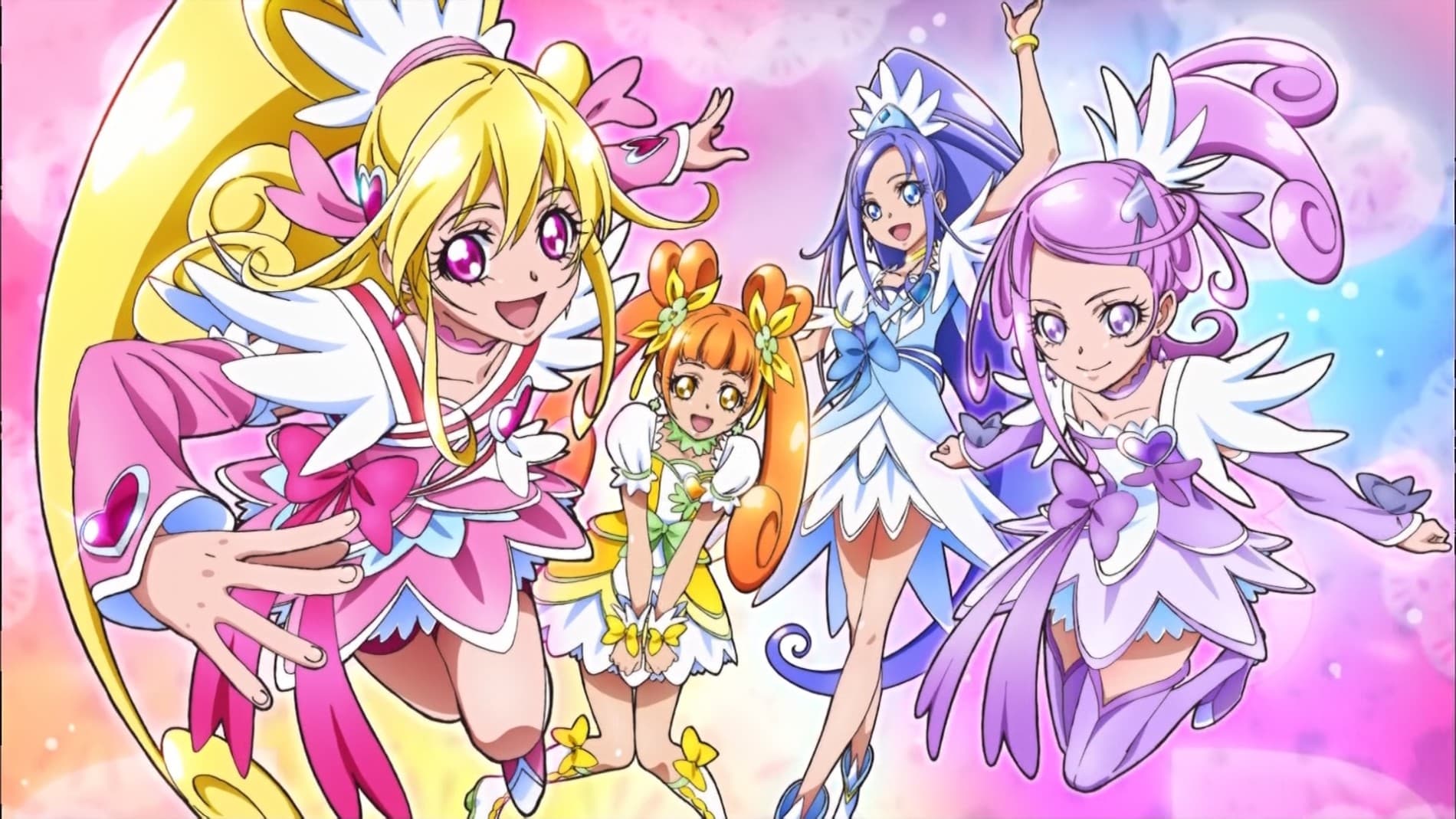
Before starting a Precure series, I reflect on the information I’ve involuntarily gathered before actually watching it. For Doki Doki, the amount of spoilers was slightly higher than usual. This relates to the fact that this series is probably the most plot-driven in all of Precure. Some might see this as a positive thing because some people get bored with fillers, while I steer clear of this view. It becomes more problematic when I don’t find the series plot that impressive, and only three characters are treated as main ones. These alternate in taking the lead, while one of them constantly remains relevant.
I’m referring to the absolute protagonist, Aida Mana, who has quite a controversial reception among the fanbase. Compared to the standard of Precure leaders, she is competent, intelligent, and very charismatic—almost too much so. Personally, I don’t hate her, but I understand why others don’t have positive feelings towards her, as Mana has an overwhelming influence on the other characters. I could take an example from each episode of this situation, but the last two episodes are emblematic: it should have been Regina and Aguri who spoke and resolved the situation with King Jikochu, but it’s only Mana who speaks, while the other Precures only think about Mana, not even giving a thought to those two. In the final battle, she even has an exclusive form (the same happens in the film), while the others say they can only lend her energy. Then, no one except Aguri ever tries to oppose her or question her actions, even when her actions could have serious consequences. Even in daily life, she has a completely incorrect lifestyle, which shouldn’t be given as an example to the anime's target audience: she accepts every request made of her and overworks herself every day without any limit. As already mentioned, only Aguri explicitly tells her that she needs to rest and not overdo it, but the episode’s conclusion (episode 32) tries to strike a balance when it should be much more a 90% Aguri and 10% Mana: it’s not enough that, for once, after being reprimanded, students try to ease Mana’s burden. Her ideology is never challenged, and in the end, she is always proven right. She is completely devoid of flaws, and I don’t seriously consider her being “off-key” as one. I knew the characters in Doki Doki were all part of Mana’s “harem,” but I think it goes too far.
Rikka and Alice, as they would say, are Mana’s two childhood friends. I think the series could have done much more with them, but they had so few dedicated episodes—since their events were disconnected from the main plot—that it was not easy to develop their growth. The biggest connection was the friendship between Alice and Reina, which occupied two (!) episodes, with a long gap of about 30 episodes between them. There are very few stories about the three friends as children, but I really liked the times they actually addressed their childhood, especially from Alice’s perspective. At least they each have a personality that I don’t mind. Besides, as Mana had formed a relationship with the enemy Regina, Rikka had a connection with Ira, but this was mostly ignored. About her, the episodes about karuta and the last one that was about her relationship with Mana were cute too.
Another character affected by this is Makoto, who perhaps suffered the most. She’s the first character introduced in the story, similar to Yuri in Heartcatch. The first two episodes portray her as an interesting lone warrior—the last survivor of her kingdom, experienced as a fighter, and rather cold. However, after joining the group within a few episodes, it seems they don’t know what to do with her. She loses much of her relevance in both battles and the plot, even though she should be one of the most important characters. Her emotions aren’t well-explored, probably because it’s a children’s anime, and the writers preferred to stay in their comfort zone. She comes from a kingdom completely wiped out—how does she feel about living on Earth? Many people died during the defense, including her fellow Precures; how is it possible they are only mentioned once? Why was there never an episode about her childhood, allowing the audience to connect with the kingdom? And how did she feel about being an orphan? There was so much to explore about her. To be fair, MakoPi remains the only Precure with real development: her songs were initially just a way to get closer to the princess, but now she loves singing and does it not only for herself but also for her fans. She also learns to empathize with others, to the point where she no longer hates Regina, the daughter of the one who destroyed her homeland, and sings a beautiful song to her in a very cool sequence. She expresses only part of her potential but remains my favorite of the group.
Now, it’s Aguri’s turn, one of the most disliked characters in all of Precure. Honestly, I think she’s too harshly criticized, despite her flaws. I believe the hate against her is, first of all, due to people expecting Regina to be Cure Ace and not a completely new character. I already knew this, so that may have made my view of her less negative. I won’t deny that she often feels out of place with the other Precures; however, I appreciate how she’s the only one who creates tension within the group. I don’t agree with the choice to make her an adult when she becomes Cure Ace, but her henshin is undoubtedly the most beautiful, while I find the others at best mediocre. I like her relationship with her grandmother and would have enjoyed seeing more development with Eru (unfortunately, they only had one episode). I don’t mind her bluntness, though there’s not much else to say. Personally, I didn’t like her decision to challenge Regina to a life-or-death fight just to fulfill Ann’s will, but it remains consistent with her character.
Speaking of Regina, I love her base concept: she’s introduced as a girl who behaves selfishly and without restraint because she’s never been taught otherwise; however, thanks to Mana, she learns that being friends doesn’t mean “possessing” the other person. Nevertheless, due to the Royal Crystals (I’m not sure why), she forgets her development. She frees herself from manipulation thanks to Ann’s body (though later it’s revealed that this wasn’t the real Ann, so it’s unclear how this happened), returning to Mana. Then comes her best moment, where she realizes her love for Mana in a life-threatening situation and decides to sacrifice herself to protect her. She is saved, and they spend more time together in one of the most yuri episodes of Precure (at least DokiDoki gave me this satisfaction). Regina begins to understand that her father’s actions are wrong and their relationship is toxic, but, just as she’s about to fully realize this, she’s captured and controlled again. After being brutally defeated by Cure Ace, she withdraws and disappears from the plot for 15 episodes (!), except in Mana’s mentions. She returns, and there are five consecutive episodes where the same sequence repeats: Regina does bad things ➔ a Precure tries to reach her ➔ she feels pain in her chest and runs away. Then, Ace appears out of nowhere and challenges her to a life-or-death battle, making her regain Ann’s memory. I’ll elaborate more when I talk about King Jikochu, but I really didn’t like her initial decision to side with him. Finally, she returns to Mana, and together they save her father. She enrolls in her school, and they all live happily ever after. I didn’t mind Regina at first, but what kind of character handling is this? Was it necessary to drag her storyline out to reach 49 episodes? Couldn’t she just stay with the Precures after a certain point?
Regarding the other antagonists, I’ll start with Bel, who had the most screen time in the trio. However, he never found the right balance between gag character and serious threat. Mammo and Ira are just likable enemies—nothing offensive, but nothing exceptional. They at least have personalities that allow for fun interactions. More could have been done, especially with Ira, given that, in one episode, he developed a bond with Rikka similar to Regina’s with Mana. Unfortunately, this was handled very hastily in the final arc. There are also Leva and Gula, two antagonists who didn’t make much of an impression on me and were killed by Bel within 10 episodes in one of the show’s coolest scenes. Apparently, as shown for a single frame in the final arc, there are two other generals, but they are only mentioned in a novel released in 2024, more than 10 years later. Furthermore, the lore of the generals is left completely unclear: are they also millennia-old beings?
King Jikochu is another odd antagonist. I find him totally unsuited for a Precure series, where certain events’ impact is minimized: Mana, and therefore everyone else, seriously asserts that a king who condemned his own kingdom to ruin for his daughter doesn’t deserve punishment. Really? This man may have been traumatized and perhaps slightly influenced by negativity, but he chose to risk everyone for one person. He is absolutely not a good person and does not deserve forgiveness or freedom. It’s clear that his actions caused countless deaths, brought his kingdom down, and endangered the entire universe. As a villain origin story, I love it, but he should at least be seen as someone who made a terrible mistake. Instead, he’s completely forgiven, and Regina, after learning the truth, initially sides with him. This comes after she’s been mentally manipulated multiple times by her father, who wasn’t even himself anymore: it’s one of the most toxic relationships ever seen. Luckily, the Nodoka/Daruizen relationship in Healin’ Good exists.
Among the supporting characters, there’s Joe, a royal knight who survived the invasion and is also Ann’s fiancé. The usefulness of this man in the story, from which he will disappear for as many as 20 episodes, is merely to deliver the Loveades to the girls, as he decides to play mysterious and reveal nothing until things get difficult for no apparent reason. My favorite, though, is Sebastian, Alice's butler: I adore his dedication, the balance between his serious and comedic side, his ability to do anything that is asked of him, and the care he shows toward his mistress. I really enjoy the episodes in which he takes on a main role.
The fairies/mascots of this season aren’t too bad. Ai is definitely the worst; she’s simply yet another baby plot device and doesn’t even make much sense being so relevant. The two episodes focused on Sharuru and Raquel are among the best; it’s a pity, though, that outside of those episodes they don’t have much personality. Still, I give credit to those episodes. Davi is the one with the most active role in the events; she tries to be as supportive as possible in the plot and is quite mature.
As for the technical side, there's a noticeable downgrade compared to Smile. There are no exciting battles, and just a few cuts are above average. My favorite scene is in episode 40, which is Makoto's walk toward Regina. Talking about the music, I like both the opening and the endings, although I wouldn’t consider them top-tier.
Among the issues with the series that I haven’t thoroughly mentioned is the secondary/tertiary cast. Aside from Sebastian, no character, except maybe Rikka’s mother, is memorable or stands out. For an anime where the protagonist is the president of a school, it feels rather lackluster in terms of setting, and no character is truly explored. I would find the situation acceptable if the main cast were good, but I’ve already spoken on that.
Lastly, I'll tell you how I experienced the series. From the beginning, I didn’t find it that special, but the plot seemed to be leading somewhere, and there were some mysteries, so I engaged actively with the series, giving opinions on most of what I was watching and speculating about the future. However, the further I went, the more I lost interest, aside from the rare filler episodes and a few others. The final arc had an interesting start, but after seeing how they handled the king, I barely managed to hang on until the end. With no other Precure series, except Delicious Party, have I reached the end feeling this way.
5 out of 5 users liked this review