Description and Historical BackgroundAdolf ni Tsigu interweaves the lives of the two fictional personas living in Kobe during the 1930s-1940s
Adolf Kaufmann – son of a German diplomat,
Adolf Kamil – a Jew – and factual
Adolf Hitler– an
Austrian politician. The fictitious setting receives support from the
Frankenberger thesis to cause mayhem and hope inside the cast’s psychological behaviour.
The real-life anecdote behind the
Frankenberger thesis is the rumours of possible Jewish blood in
Hitler’s veins. After researching the truth behind the mouth propaganda,
Frank’s conclusion foresees the parentship to his father’s root in a Jew called
Frankenberger who offered
Hitler’s grandmother financial support for 14 years after bestowing life to
Alois, while not being officially entitled as
Alois’ father. And, therefore, must be
Alois’ valid parent.
Frank’s motivations to reveal such backgrounds are only evaluated via theories – not legally accurate – because of
Hans Frank’s execution after
World War II. The motives’ tendency was, presumably, rather pro-
Nazism. An abstract, but realistic possibility of his motives, could lie in the nature of the propagated Jewish evilness. Behind every war is a Jew, from
Mischling to
Jude (see
Nuremberg Laws), with evil roots in Judaism.
Hans Frank concludes: If
Hitler is a
Mischling(Crossbred), the
Third Reich theory of evil is proven for a Jew was then the brain behind
World War II, therefore the anticipation that Jews pull the wires behind every conflict is verified.
Osamu Tezuka cleverly redevelops the thesis's fictitious origin into a factious one. Creating the main plot string. A huge conspiracy surrounding political outliers, mysterious homicides and spies.
Thematical AnalysisProgression into a propagated psychopathInitially, Kaufmann and Kamil are bonded by a deep friendship, oppositional to Kaufmann’s father’s liking, who forces the bright Kaufmann into the AHS (Adolf Hitler Schule) – to join the Hitler Youth for his pa has become obsessed with his son’s Nazi destiny. Resulting in a 180 turn in Kaufmann's life, who is onward to learn about Kamil’s dark side – Judaism. Kaufmann opposes his father’s decision, but is left choiceless, and henceforth lives in Germany where propaganda takes him into possession. The Jew-loving German grows into an exceptional Nazi and finally, unfortunately, leaves his prejudice-free world picture behind and starts killing and oppressing Jews like prey. Kaufmann’s hatred never ends, while subsequently peaking with the rapture of his former Jewish sweetheart, whom he was meant to marry after the Nazi’s victory. The antagonism possessed by obsessed human beings results in a cycle of never-ending hatred.
Kamil, Kaufmann and Hitler therefore symbolize the stages of Propaganda. Kamil, the everlasting resistance to Propaganda, Kaufmann, the change to Propaganda and Hitler, never-ending loyalty to the Propaganda.
[image removed]Nobody wins in war; some just lose less than othersTezuka’s philosophical agenda heavily relies on the peace of our race between nature, animals and other humans. The obvious breaking during times of war leads to the implementation of destructive scenery on each side of the ideological spectrum. Adolf Kaufmann – the heroic Nazi – sheds his sanity while gaining endless hatred. Adolf Kamil’s succession in family and peace via Zionism concludes in a fresh conflict between Palestine. And Adolf Hitler’s Utopia was massacred ranging from his grandeur building plans to his mildest pieces of Aryan ideology. The surviving Japanese not only lost the war but a majority were also deprived of their life, their organs, their senses, their pride, basically their cultural importance.
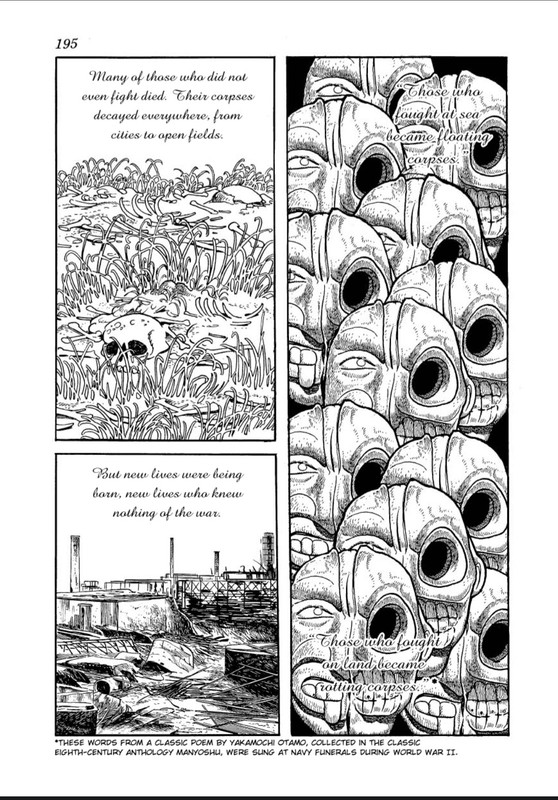
Destruction as the force of new hopeTezuka’s marvelous, poetic passage speaks for itself:
Those who fought at sea became floating corpses.
Those who fought on land became rolling corpses.
Many of those who did not even fight died. Their corpses decayed everywhere, from cities to open fields.
But new lives were being born, new lives who knew nothing of the war.
Storytelling AnalysisArt
Tezuka's artistic approach is of a rather conservative nature but primarily extends his emotional expression range. The harrowing faces of suffering burn into your brain like I’ve never seen in
Osamu’s artwork. Contrary, the facades of optimism and newborn joy have an expressing rhythm conveying their powerful testimony upon the reading experience. The comical art style that runs through
Osamu’s vein never loses its charm while minor reformations are the cause of bigger revolutions between the endless demographics
Tezuka aims towards, with divergent works. Ultimately,
Adolf ni Tsigu’s dichotomy of war and peace is not transported via experimental techniques, but a rather slightly progressive path into the right corners.
Writing
Adolf ni Tsigu is a well-rounded anti-war manga with thought-provoking character dynamics. Especially the unification of the protagonists-naming raises questions of fate, due to their different destinies, whilst sharing a duplicate name. In spite of that, the development of characters often falls short.
Kaufmann’s character journey solely carries the character writing. The people’s vividness is not lost, but lots of characterization potential was wasted.
Thematic density is unsurprisingly its key strength due to my adoration of
Tezuka’s leftist philosophy and, generally, themes being my favourite storytelling element to create notions about.
ConclusionAdolf ni Tsigu underlined its status as a Tezuka essential. Despite not having the philosophical depth of the human condition anthology Phoenix or the religious tale about the essence of karma – Buddha. Its interwoven narrative between fiction and reality crafted a world with an adult undertone, that points in its realism and its optimism. A pro-peace artwork, that will hopefully be interpreted rightfully to secure a peaceful future for mankind.