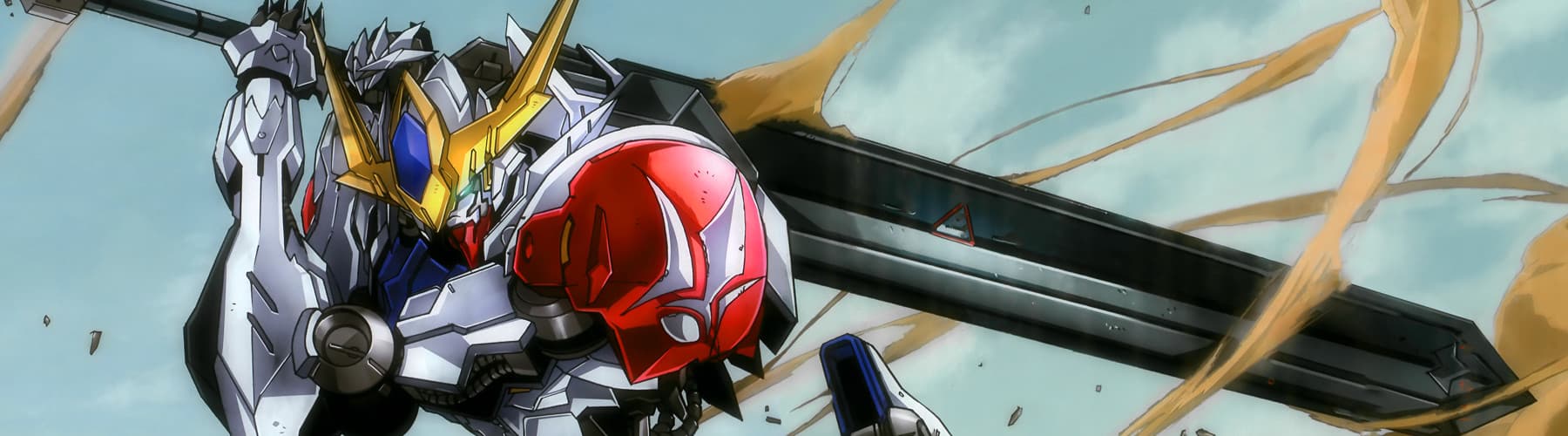
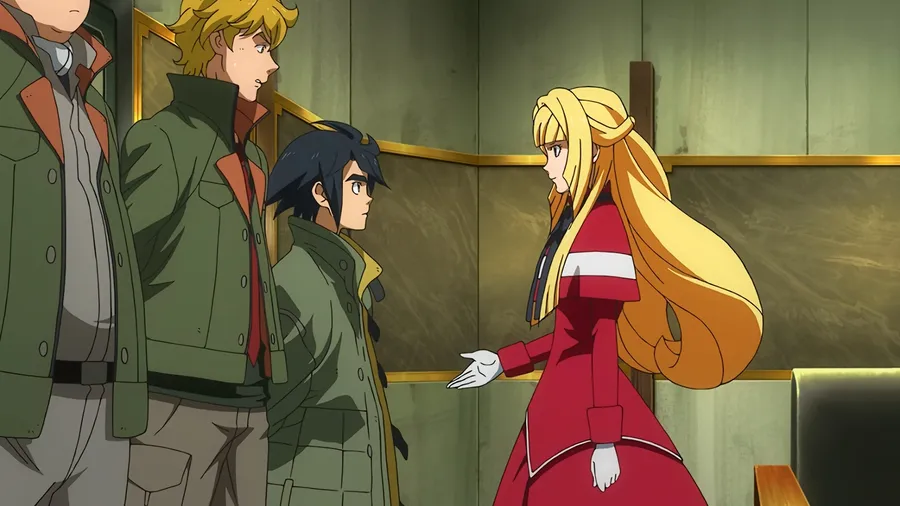
This review covers both S1 and S2, and contains minor spoilers for both of them.
Introduction:
Even as a relative newcomer to this franchise, it would be remiss of me to overlook the long and decorated history of one of anime's most revered titles. Mobile Suite Gundam is a franchise that has long spawned a vast and expansive universe filled with stories of political warfare, humanity, and values that are as old as the dawn of civilization. Each story chronicles the tale of different people, with differing backgrounds and ideologies, clashing for the supposed betterment of humanity’s future. Currently, I have yet to see the majority of these titles but based on observation, a certain commonality they seem to share is that the perspective of these stories can range from the lens of royalty, high society, all the way down to the less privileged. Which incidentally happened to be the case for the title I've chosen to reflect upon as it made me a fan of this franchise, enter Mobile Suit Gundam: Iron Blooded Orphans.
Taking place centuries after the events of a major conflict known as the Calamity War, a war between Earth and its outer colonies. The series centers around a mercenary group composed primarily of child soldiers known as Tekkadan, who then comes into contact with a young Martian woman named Kudelia Aina Bernstein, the foretold “Maiden of The Revolution”. In the hopes of vying for the independence of the Martian people, she then contracts Tekkadan to act as her escort en route to Earth for the commencement of negotiations. However as simple as this assignment may initially sound, it gradually develops to be more complicated as there is more to Iron Blooded Orphans’ story than merely being a fight for independence war drama. Offering insight into a plethora of real-world issues such as poverty, imperialism, politics, experimentation, and etc. as it explores the internal conflicts of the people of its own universe.
#Part I
>"You really think all those people died because of something you did? Don't disrespect my friends like that"
One of the things that immediately captured my attention in the opening episodes of Iron Blooded Orphans is inherently the series’ greatest strength, its characters. After agreeing to escort the lady Kudelia to Earth, we are then formally introduced to the numerous and varied members of Tekkadan. From the cold and distant ace pilot Mikazuki Augus, who was from a young age has been implanted with combat-enhancing cybernetics. His pseudo-older brother, Orga Itsuka, who also happens to be the inspiring leader of Tekkadan. Throughout the show, the two share an interesting almost sibling-like relationship reminiscent of Gurren Lagann’s Simon and Kamina. But besides them, there is also the brash Shino, the stoic Akahiro, the compassionate Atra, and etc. All these characters have distinct personalities and unique dynamics with one another that it was honestly hard not to be invested in their interpersonal character drama sandwiched in between the grander narrative.
Especially as throughout the series, there is this recurring theme of family and belongingness that permeates not only through the members of Tekkadan but to the other factions and characters introduced later on. This also extends to Kudelia, as even with her more lavish lifestyle, she too shares in the plight of Tekkadan, as through her the series explores alternate perspectives of the concept of family and its detrimental factor in shaping our sense of being. However, another character who happens to be a favorite of mine who also shares this idea of family, is the brigadier general of the autocratic Gjallarhorn, Fareed McGillis. A machiavellian opportunist who hails from a royal family, who becomes a sort of opposing force to Tekkadan in some episodes, as not all are in favor of Mars’ independence.
Speaking of which, on the destination course for Earth, there will be constant skirmishes and battles, from the titanic ones on the ground or the free-flowing battles in space. All of which are effortlessly awe-inspiring and grand, as the fight choreography, animation, and soundtrack are top-notch, as to be expected from this franchise. However, as stunning and glorious as these spectacles are, some of the most memorable moments in the series in my eyes were the intimate and poignant moments between the characters that I have mentioned previously. At the halfway point of the first season, one of the best examples of these moments that also embodies another core theme of the series is in episode 13. “Funeral Rites”.
>"You know it's short. When we're alive we make such a racket. We laugh and fight over small things. But it's an instant when we go"
In an episode that has long been etched in my mind even after the credits rolled, Episode 13 of the first season of Iron Blooded Orphans remains as one of my favorite episodes due to how it perfectly encapsulates the theme of purpose in the series. In this episode after the numerous battles and skirmishes en route to Earth, Tekkadan holds a funeral in memory of their dead. Death in this series is to be expected as at its core, Iron Blooded Orphans is still a war drama. This episode stands as pivotal in my opinion in understanding the theme of purpose, as even though a funeral is dedicated to the dead, it is also a celebration of life. Life that can shine so bright in an instant, and be snuffed out in the next. The story of Iron Blood Orphans forces its characters to look inward, as in the scenes of introspection, they question their purpose, their dreams, and their place in the world.
Which ties to another aspect I have yet to mention about the characters is the fact that most of the main cast are either children, young adults, or as the title implies, “orphans”. Throughout the series, there will be instances where it bares shades of being a coming of age story, as it includes scenes of our characters acting appropriately and consistently with their age. Such as being impressionable. Having a taste of romance. Making realistic misunderstandings and mistakes that would be detrimental to the plot. All of which simultaneously factors in these characters feeling more human and relatable. Making their interactions with each other all the more endearing, whilst also making their current predicament of being involved in a brutal war all the more heart-wrenching.
Furthermore, this notion of purpose further extends to the next season, as although Kudelia’s mission of reaching Earth spearheads the entirety of the first, the conclusion of it only serves as the beginning of the next chapter of our characters’ story. One that builds on the ramifications of Tekkadan’s actions and visions of granduer as a whole, and how the numerous factions such as the previously mentioned Gjallarhorn and the prominent figureheads involved with the colonies of Earth, such as the underworld bosses of Teiwaz, the Turbines, and many others react to their rising notoriety. Being a somewhat calm before the storm.
#Part II
>"Jealousy, hate, disgrace, shame, we are endlessly harassed by days long gone. And our supposedly bright future is wasted, on cleaning up the mistakes of a foolish past "
Now depending on who you ask among the fanbase, the second season of Iron Blooded Orphans sparked quite an outcry when it was released, as its quality and execution are put into question, and to some degree, I agree with the complaints. There are instances of contrivance, plot armor, and muddled pacing, especially in the first half. But honestly to me, the overall piece was greater than the sum of its parts. In my opinion, amidst all of its shortcomings lies a truly gripping and compelling tragedy. One that puts forth all the pieces being stacked up from the last season, just to knock it all back in an emotional explosion. One that centers on yet another far-reaching thematic underpinning throughout the series, and that is humanity.
Already in the introductory episodes, battles are waged immediately and constantly in the second season as Tekkadan rises in the grander scheme of things. But not everyone is too keen on their growing presence, as the route they took to get there is stained by the blood of allies and enemies alike. New characters are introduced but some are unceremoniously killed off as both sides aren't safe from the horrors of warfare. Although there are some exceptions of glaring plot armor as I mentioned previously, there was enough justification within the story's context for me to let it slide. But speaking of the other side, other factions such as the previously mentioned Gjallarhorn and Teiwaz go all in, to see who truly is favored by the cards in this game of war and bloodshed.
The humanity once found in the tender and intimate scenes of our characters spending time with one another as people, such as with Mikazuki, Kudelia, Atra, and the other members of Tekkadan are now few and far between as the walls slowly close in on them. Where now these scenes become more of a reward rather than a constant. If the first season can be described as an uphill battle, then the second can be looked upon as the utter descent from the already downward spiral our characters have been on since the beginning. Coming full circle in establishing that Iron Blooded Orphans is by and large a tragedy. A tragedy that examines its character's faults and follies. The errors in their judgments. The delusions of their ambitions and ideologies. Essentially reminding the fact that these characters are in fact children in an adult world.
>"You'll take me there, right? What should I do next? Who should I kill next? What should I destroy next? If I can reach your goal, I'll do anything."
Ultimately, however, upon reaching the end of Iron Blooded Orphans, my initial reaction was that I admittedly felt empty. Not in the sense that it didn’t make me feel a shred of emotion, as it undoubtedly did with the absolute heartwrenching of a finale. Rather it was more of a realization that this long journey was coming to an end, and it had me pondering whether the time I invested in this series was worth it, as even with the understanding that it ended in a logical conclusion, which also felt thematically appropriate, it was still a hard pill to swallow as you spend such a long time with these characters, understanding their inner dilemmas, witnessing their development, and seeing them end up in their tragic outcome was almost something I couldn’t accept. I tried to find ways or holes to discredit the ending, as I mentioned before there is valid criticism to be found in some instances of character actions being beholden to the plot. But alas, I accepted it for what it is and how potent it is on a conceptual level.
Much like all good tragedies, they serve as a means to providing catharsis born from the suffering. In my eyes, tragedy is fundamental in fiction, as it entails lessons that speak of the what could have beens and of the wasted opportunities. Gundam as a series has always been an anti-war message in response to the events the creator Yoshiyuki Tomino lived through, and based on my knowledge almost every single entry from the franchise, despite having different creatives at the helm, reflects that message with varying themes and ideas, and Iron Blooded Orphans is no different. All these characters were shaped by the world and circumstances they lived in, only searching for somewhere to belong. The path they chose was not only a result of their actions but who they were as a person.
However by the end of the series, as the sun rises on former bloodied battlefields, at its core, the story of Mobile Suit Gundam Iron Blooded Orphans, is that it presents a message of hope. The hope and optimism of taking into consideration all these lessons of family, purpose, and humanity, in order to find one’s place in the world. I implore you to watch this series, as it is one of the best political thrillers or war dramas of the sci-fi genre I’ve seen of in years and was a great introduction for me to the Gundam series as a whole. After this, I’m definitely looking forward to seeking out the other titles from this legendary franchise that I have been missing out on. Many thanks for reading.