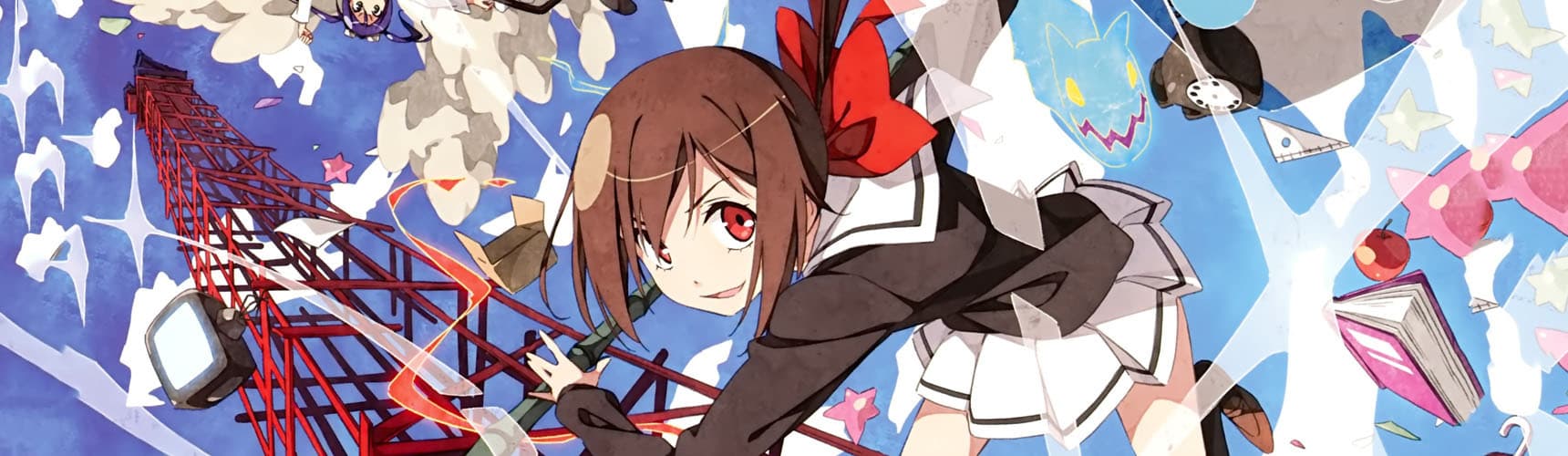
Kyousougiga
a review by anemoiaanime
a review by anemoiaanime
In 2013, Toei Animation took the risk of launching a new project by director Rie Matsumoto, her first work as main director: Kyousougiga.

Unlike the big projects that the studio usually takes part in (One Piece, Dragon Ball, Digimon) Kyousougiga is presented as an experimental work, difficult to classify in any of the well-known genres and subgenres of the scene. With a careful, expressive and explosive animation, Kyousougiga differs from other works of the studio by prioritizing quality over quantity/speed.
About the story itself, Kyousougiga is a work about family and love, in the most abstract of senses. It is a story about beginnings and endings, life and death; love, breakups and reunions; time, distance. Kyousougiga is an elegy to life in which through the crossing of past, present and future and the conflicts associated with the passage of time, the characters learn to reconcile with their past, appreciate their present and long for their future. With a very careful direction and production, Kyousougiga vibrates through the love with which it was conceived and seeks to deliver to the viewer.
As the series itself tells us at the beginning, Kyousougiga is a story that tells how “once upon a time, when countless worlds bordered each other and the line between gods and humans was blurred, there was a certain family whose story of love and resurrection we will follow”. Thus begins Kyosougiga: a story about a family, and although the composition of this family may seem strange, by doing so this family turns out, finally, to be one with which we can empathize through their problems and misunderstandings, the everyday and the extraordinary, but above all, this is a story of beginnings and endings, creation and destruction, this is the story of Koto and Yakushimaru.

Here ends the spoiler free introduction and comes the long-essay version of the review, so if you've not watched it yet, come back once you've done so!
In any case, before going into detail about the characters that explain the dynamics of this work, it is necessary to detail the construction of the world of this work insofar as the world where it develops does not act only as a canvas on which to develop the actions, but also forms part of these actions, conditions and grounds them.
Kyousougiga's world is alive and, at the same time, it is an inert world. With the gift of creation, Inari is one of the leading monks within an organization referred to simply as “The Temple,” charged with administering and preserving the balance between worlds, known as the 12 planes. However, Inari finds himself exhausted from his labors and in the tedium of everyday life decides to take refuge in the mountains.
It will be there where Koto, a black rabbit drawn by himself comes to life embodied in the body of a bodhisattva (Buddhist god), who allows her to live using her body as a way to help her get the love of the monk Mioue (Inari's own name as a priest). Thus, Inari (Mioue) and Koto (the rabbit) formed a family in the mountains and, under pressure from the Temple for the abuse of his powers for the formation of his new and artificial family, Inari (Mioue) decides to break the rules and through his powers, create a new plane, the thirteenth plane, Kyoto: an exact replica of the city at the foot of the mountain and its inhabitants, a city where everything that breaks or perishes is automatically repaired or revived, where nothing new is born or created, a city that represents Inari's longing to freeze in time an important moment in his life, such as being able to live, if only for this moment, with his new family.
In this new family created by Inari (Mioue) and Koto (the rabbit), Yakushimaru is the first of 3 siblings but despite being the first one, his position in the family is that of the youngest. Originally a human, Yakushimaru loses everything at an early age when his village is devastated by what seems to be a conflict with another village. Desolated, the then child Yakushimaru decides to take his own life, running away from his tormented present, however, his death wouldn't last long as he would later be revived by the monk Mioue (Inari) and adopted by him and his wife Koto (the rabbit) as their new son. This action would henceforth mark the character's conflict: What is the purpose of living a second chance in a life that was neither wanted nor asked for, what to do with this borrowed life? This conflict will shape the development of the character, who, immersed in this new world created by his new father, where nothing new is born and nothing old perishes, must live his life dealing not only with having to live, but with having to do so, presumably forever, since there is nothing in this new world that can take away his life.
It is within this context, and after inheriting his father's role and name as a monk in this new world that Mioue (Yakushimaru) reconciles his life and concerns with his new occupation as one of the three guardians of this realm along with his brothers, being the protector who longs for destruction as long as this destruction brings the necessary change to break with the monotony of a world constant in its non-changes, the destruction that can finally bring him the death he has longed for since before his resurrection.
Koto (the girl), on the other hand, is the daughter that Inari (Mioue) raises by himself after leaving the mirror city and resuming his duties as a monk in The Temple, keeping the secret about the creation and existence of Kyoto. There, he raises her as his disciple, with her unknowingly being the bringer of destruction.

Koto is a strong and sensitive girl, who, having reached a certain age, decides to embark on a journey through the different planes that make up the universe of Kyousougiga in search of the black rabbit she knows as her mother. Thus, Koto manages to land in the mirror city thanks to her powers, something that no one else would have been able to achieve, bringing something that had never been seen there before: the ability to change. The things Koto destroys with her hammer, a gift from her father Inari, do not regenerate. She is able, through destruction, to break the monotony and stagnation of this world, in a way, making time run again. Koto is the hope that Yakushimaru lost many years ago, Koto is the long-awaited hope, the only one capable of ending Yakushimaru's life.
It is interesting to stop and analyze the obvious contradictions raised in these characters. Yakushimaru, who decides to end his life, is revived without his consent and forced to live for eternity in the mirror capital yet at the same time, he is given the gift of preservation by Inari (Mioue), being in charge of maintaining the balance and stagnation in the city in the absence of his father. He who longs for the end, is the one in charge of postponing it. On the other hand, Koto, the lively youngest daughter, carries in her hands the power of destruction, associated with change. She, who sets out on her journey in search of her mother, in order to find a place where she can truly belong, create her space in the world and find calm, is the one who carries the destruction in this stagnant world. Thus, the relationship of older brother and younger sister that arises between these two when they meet presents a beautiful story where through living with Koto, Yakushimaru will gradually reconcile with the pleasure of the everyday by sharing his life with his loved ones, being responsible for them and letting them also take care of him, Koto gives him a reason to continue living, while Yakushimaru, unconsciously, gives Koto a place to belong, to call home. This dynamic between the two characters reaches its climax when, in the middle of a walk, Yakushimaru regains hope for his dream of finally being able to die, entrusting Koto, the only one capable of doing so in this world resistant to change, to be the one to end his life.

Subsequently, after her parents return to the mirror capital, the world they knew in the thirteenth plane begins to crumble. What Yakushimaru held in harmony with his brothers for so long, begins to be destroyed. Kyoto is discovered by The Temple and his existence cannot be allowed. What he so longed for begins to happen, however, not in the way he wanted it to. With the destruction of the mirror capital and many questions to ask his parents about the origins of this world and how it works, Yakushimaru finds another reason to live. This new life he has led is not a borrowed life, it is his life and only he can decide what to do with it, with this second chance on earth. He also has a family, not only the one he lost as a child, but the one he gained after his resurrection, Kyoto is his place in the world and Koto, together with his siblings, are the family that has always been there so long ago, but that only now faced with change he can see. The change you need only happens within you, is the main teaching that leaves us the character arc of Yakushimaru, who, along with Koto, finally defy the gods themselves (including his father) to reestablish the order of the planes and constitute the existence of Kyoto as one of them, the thirteenth and last official plane, their home.

Revisiting this series left me with many lessons, among them, how family relationships can be much more complex than one might think and how what one so longs for, at times, may have always been there in front of our eyes, needing one to step away from them in order to gain enough perspective to properly appreciate them. Yakushimaru's growth throughout the work; Koto's search not only for a place in the world but also for the recognition of his existence, as she seeks to have his problems and emotions taken into account in this complex web of family conflicts, are all emotions and dilemmas developed with great sensitivity and attention to detail, managing to capture in a show of only 10 episodes a message that others do not achieve in several seasons.

Kyousougiga occupies a very important place in my life, it was one of the first anime that made me see this medium as something more than simple animation, that anime could be art, that anime could transmit complex feelings, that it could be something with which one could empathize. Kyousougiga is for me a story about the beginning and the end, a story about nostalgia and longing for whats to come.

31 out of 31 users liked this review
